Help us become the #1 Data Podcast by leaving a rating & review! We are 67 reviews away!
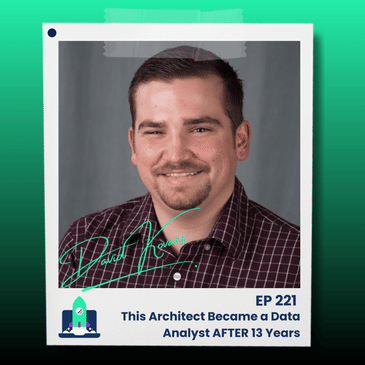
David spent 13 years in architecture before switching to data. He landed his first data job in about 90 days.
💌 Join 33k+ aspiring data analysts & get my tips in your inbox weekly 👉 https://datacareerjumpstart.com/newsletter
🆘 Feeling stuck in your data journey? Come to my next free "How to Land Your First Data Job" training 👉 https://datacareerjumpstart.com/training
👩💻 Want to land a data job in less than 90 days? 👉 https://datacareerjumpstart.com/daa
👔 Ace The Interview with Confidence 👉 https://datacareerjumpstart.com/interviewsimulator
⌚ TIMESTAMPS
00:00 – 13 years in architecture
06:00 – The internship
08:39 – Study on your own time
14:24 – Networking pays off
21:24 – Advice if you're on the fence
🔗 CONNECT WITH DAVID
🤝 LinkedIn: https://www.linkedin.com/in/davidnkovacs/
🔗 CONNECT WITH AVERY
🎵 TikTok
💻 Website
Mentioned in this episode:
Win a FREE spot in my Data Analyst Bootcamp
I'm giving one lucky podcast listener a spot in my data analytics boot camp. All you have to do is register, and you'll have your chance at joining my boot camp for absolutely free. Go to web.datacareerjumpstart.com/giveaway to register. GOOD LUCK!
https://web.datacareerjumpstart.com/giveaway/
💙 Thank you for subscribing & leaving a review
Thanks to YOU we recently became the most popular data podcast out there. Thank you so much for listening. If you haven't subscribed yet, hit subscribe. It costs $0. If you enjoy the show, leave us a 5-star rating on Spotify or Apple. It helps people like you find the show AND it helps us land better guests. Thank you so much for your support.
I guess, did anyone think you were kind of crazy for leaving this architecture career? 'Cause you had worked in architecture for what, like 12, 13 years-ish?
David Kovacs:Data analysts are just gonna be replaced with AI, and the market is saturated. Then I was DoorDashing between my old job and finding my new job, hitting the program hard, studying. I'm living proof of that.
Avery:What does it actually look like to go from, you know, architecture and landscape design to data analyst? All right, David, take me back before you were a data analyst into this architecture and landscape design life. What did that career look like? What were you actually doing?
David Kovacs:Uh, yeah, so I went to, uh, college for, it's called architectural technology. Uh, really just a fancy way of saying architectural drafting. So my day-to-day looked like finishing red lines for project managers and filling requests. Not quite the creativity that I was looking forward to when I went to school for it, but that's kinda what my day-to-day looked like.
Avery:Okay.
David Kovacs:Th-
Avery:I- maybe I'm sensing this wrong, but that sounds like you maybe got kind of bored just doing that- Mm and it wasn't, like, super fulfilling necessarily.
David Kovacs:Eventually, yeah. Yeah, boredom kicked in, for sure.
Avery:Yeah, and that makes sense. I mean, that's how I was as a chemical lab technician. Um, you did have the chance to work on $140 million, uh, baseball stadium. What were you designing for them, and I guess, where was that at?
David Kovacs:Yeah, again, just filling the orders of the project managers and it's actually about 25 miles down the road from where I live, so I took my, uh, my wife and my in-laws to go see it this past weekend. That is one cool thing about being in architecture for so long and actually h- seeing projects come to life and getting to, like, go visit them and stuff.
Avery:You can be like, "I drew lines on that," and it eventually- came to, to life. Um, I guess at one point did you, like, realize, "Okay, I no longer want to be, you know, an architect anymore"?
David Kovacs:Ooh. Really my whole career was a struggle of, like, just wondering if I'd made the right decision, even in college. You know, I thought about changing in the middle of it and I just kind of, I guess you could say I white-knuckled my way through college 'cause I just wanted to get done with it and start some kind of career and- There was definitely a lot of struggles over the years, job losses, so it's been something I played around with a lot over the years, and just recently, last year, kind of personal situation with my wife being diagnosed with stage two breast cancer kind of kicked it into gear again that I just wanted to do better for myself, better for my family.
Avery:It's really impressive, um, and really a- admirable of you. Yeah, uh, amazing. I was gonna ask, like, what, at what point was, you know, the tipping point for you, but obviously that, that was the tipping point for you. Um, I guess did anyone think you were kind of crazy for leaving this architecture career? 'Cause you had worked in architecture for what, like 12, 13 years-ish.
David Kovacs:Yeah, I got, uh, definitely, uh, some comments about, oh, data analysts are just gonna be replaced with AI, and the market is saturated, and it's not a good idea for you to do that, but I think the data out there says otherwise, that analysts are still getting hired. I'm living proof of that.
Avery:I would agree. Um, okay, so you didn't listen to them, and you're like, "I'm still gonna pursue this data analytics." Um, why in data analytics in particular? Like, what drew you to data as opposed to architecture?
David Kovacs:Right, so I did a lot of kind of exploring and searching when I decided it was finally time to leave my career in drafting. Um, I found your YouTube channel, you know, listened to how passionately you speak about your own career and listened to other data analysts speak about how passionate they are about that business.
Avery:That's, that's super cool to hear that it was, it was via YouTube. So were you doing, like, a lot of research via, via YouTube? Like, looking up different careers like cybersecurity, I don't know, project management, those types of things?
David Kovacs:Yeah, I kind of, like, did the search of, you know, careers that, careers that you can get into where you either don't need a degree or your degree is relevant to the job that you're going to be doing. Um, web development is another path I went down for a little bit as for deciding. It wasn't for me. I even took a career assessment, and, like, three or four of my top 10 results were some form of data analyst, so it was pretty-
Avery:So you're like-
David Kovacs:obvious that I should pursue that more
Avery:Oh, perfect. That's, that's great. Um, okay, so you, you kind of do some research online. You learn about data analytics. Um, you watch some YouTube videos. Um, obviously architecture, you know, the tools you're using in architecture are a little bit different than the tools you'd be using as a data analyst. What was, like, the first thing, like, you, you did to, like, learn data analytics, and how did that go?
David Kovacs:Yeah, again, just watching a lot of videos and tutorials. Um, I did do the Google certificate in my free time while we were-
Avery:How, how was that experience?
David Kovacs:It was good. I feel like it definitely gave me a, like a peek into the world of what a data analyst does. I don't feel like it got me quite all the way there. It was just really- I would say it's that first- It was just really scratching the surface, you know.
Avery:100%. It's, it's kind of a, a very, uh, not, not deep, uh, very shallow intro- introduction to analytics in general. Um, okay, so then, then I'm curious here because, uh, you end up You know, you're doing the Google Data Analytics certificate, and then you join my program, the Data Analytics Accelerator. And obviously I don't have, like, a magic eight ball to, to what's going on in your life and, you know, what's going on with, with your brain and what's going on with what you're thinking, but we all leave traces of ourselves on the internet. So my marketing data tells me that you first visited my website coming from Instagram, which is, I think is really interesting because I don't really do much with Instagram currently at the moment. And then 100 days later, you revisited the website after coming from a YouTube video, and you end up, you ended up joining. So I'm just curious, kind of like what happened, if you can remember in those 100 days, what made you end up deciding, you know, "Okay, the Google Data Analytics certificate, it was a great start, but it's not enough for me. I want some more"?
David Kovacs:Oh, yeah. I, I had been watching you for a while and followed you on all platforms and, and yeah, I think I, um, I just wanted to learn with a community and, you know, get help and job hunting and-
Avery:Um, now when you, when you were in the boot camp, you actually ended up doing an internship, and I think that was just this, this last quarter, like our, our January internship with the UK housing data. I'm curious kind of what that experience was, was like for you. Uh, I guess tell about, like, what... how big was your group and what kind of tools you guys used and how that whole process was for you.
David Kovacs:Yeah, so the... I think the day after I signed up for the Accelerator, I had learned that you guys offer an internship, and I kind of wrote Isaac. Shout out to Isaac. And asked, "Hey, am I too late to join this internship? 'Cause I'd really like to do that." And he said, "Not at all. I'll put you in group seven." And, you know, we did our first meeting. I kind of became the, uh, business intelligence portion of the project, where I did, you know, charts and dashboards. It was a really good learning experience. W- was definitely very hard, 'cause you have four or five brand-new data analysts who are all learning with you, and we're all in different parts of the world. I think we had somebody in every time zone in America, and then somebody in the UK. So we were getting up at, like, 6:00 and 7:00 in the morning to, to do virtual meetings and talk about where we go from here. But it was definitely worth it, and I think it did make a difference in getting the job that I have now.
Avery:Very cool. Were, were you guys using a lot of Tableau? I, I think, like, I remember group seven using a decent amount of Tableau.
David Kovacs:Yep. That was us. That was me.
Avery:Awesome. Okay, perfect. That was you. Great. Yeah, I do remember group seven doing, um, doing some good work. Um, yeah, and talk a little bit more about, like, how it, how you feel like the internship might have helped you, uh, land the job. Um, one thing I noticed is, you know, I haven't seen... I don't think I've seen your, your resume maybe, maybe in a while or a l- ever. Um, but I know on your LinkedIn you have that you were a data analyst intern for my company, Snowdata Science. So I'm assuming that was on your LinkedIn when you were applying for jobs.
David Kovacs:Yeah.
Avery:Okay. And did it pop up in the interview at all, or did they ever ask you, like, what you did at that, you know, at Snowdata Science?
David Kovacs:Hmm. Yeah, it did pop up in the interview. Yeah, and they wanted to hear from you as a reference.
Avery:That's, that's what I was actually gonna ask. Um, the company that you ended up landing this role with, is that the company that I, I talked to via email about the reference stuff?
David Kovacs:Yeah, it is.
Avery:Okay, awesome. Okay, so it did play a, a decent part in the interview process- Yeah because, you know, they wanted to hear a little bit more what you did as, as an intern. Um, okay, that's awesome. I'm glad to hear, uh, plus one for the internship. Uh, our next- we're trying to do four of those a year. So, um, we're only at one, so we gotta start the next one pretty soon in 2026. Um, I'm curious, like, you know, you were still working while you were doing the boot camp. Is that correct?
David Kovacs:For a few weeks I was, and then a situation arose at my job where I had to leave, so I actually, uh, finished up my two weeks at my job and then I was just DoorDashing between my old job and finding my new job. And- I wanna talk more about that over the evenings, yeah, and then over the w- evenings and weekends I was, you know, hitting the program hard, studying.
Avery:That's absolutely amazing and really admirable. I think I'd be very, I think I'd be very stressed out in that situation. Mm-hmm. But I think a lot of people are in a s- in a similar situation where, you know, maybe they're doing gig work right now and they're trying to land a data job. Um, can you just tell me more about, like, what your day-to-day looked like? Like what time, like, w- what time were you studying? Was it in the evenings or in the mornings? What did the w- day in the life look like of someone who know, who was, you know, doing these gig works while trying to land a data job?
David Kovacs:Yeah, you just find moments during the day to study whenever you have free time. So I was out there, like, during peak hours, you know, making deliveries. Mm. I'd, I'd come home and keep going through the program, keep building projects.
Avery:That's super interesting to hear. I'm gonna indulge myself in a, in a selfish question here.
David Kovacs:Yeah.
Avery:Um, because you know, one of the things I try to do in the Accelerator is I'm like, you know, people are busy, you know? And not everyone has time to go through, uh, a 12-week full-time boot camp. Still try to make it fast, like you can do it in, like, 12 weeks. I think you were about, from, from when you joined to when you landed your job, I think you were about 90 days. Um, ish. Um, so obviously it's possible to do still part-time, but I also try to, like, cater to people who have busy lives by making the material as available as possible in as many different avenues as possible. So, you know, a lot of our lessons will have a video lesson, um, but there's also the text version with pictures down below, and we try to do, like, the member only podcast, which is kind of like the audio companion for each one of the modules we have in the program. We have, like, an audio version of the module kind of. I'm curious, and, and also we have, you know, all of our, our community and also all of the lessons are on an app. I'm just curious, were you using, like, any of, any of that, like, on your phone, like, while you were in the car, like, listening to member only podcasts or, like, maybe you were waiting for your next order, like, you did some of the lessons on your phone, or was it mostly at your desk?
David Kovacs:Oh, yeah, definitely. When I was out driving around, I listened to just about every episode of the podcast, both, well, one on Spotify and the members only. Did a lot of passive learning while I was out on the road.
Avery:Awesome to hear. I'm super glad to hear that because you, you create this thing and you're like, "I think this is gonna be useful for people," but you don't always hear how people are using it. So, um, I'm super excited to, to hear that it was useful for you. Um, I'm curious, like, what you thought was maybe the hardest part about landing a data job in general and, and maybe in the boot camp or outside the boot camp.
David Kovacs:Definitely coming from a completely unrelated field was pretty hard to, um, I guess find that first opportunity in this, in this new industry I'm trying to get in.
Avery:That makes a lot of sense. I can't even really imagine, like, how many vocabulary words that architecture and landscape design have in common with data analytics. Like-
David Kovacs:Not many
Avery:May- yeah, like, did you guys, do you guys use Excel in, in your industry at all or not really?
David Kovacs:Uh, very little. Yeah. N- in the last job I, no I think we talk about it on, on the podcast every so often, like if you opened Excel like once a year for the past X amount of years, put that on your resume. That's probably where I was at. Okay. Yeah,
Avery:that's, that's some years of experience, right? Uh, I love that. Um, okay, so let's talk about, yeah, the hardest part was actually, you know, transitioning out of your, your current industry to a completely new industry and getting someone to take a chance on you. At what point did you start applying for data jobs?
David Kovacs:I started applying around the beginning of the year. I got my resume together and a portfolio together. Definitely wasn't perfect, but I knew at the beginning of the year I just had to start doing it.
Avery:Well, I think you joined the accelerator like, like almost mid-January or early January, and I think you started this role in April. So like were you basically- Yeah applying for jobs in January?
David Kovacs:Yeah, I was applying for jobs before I even started the accelerator, and I was applying- I lo- the whole way through.
Avery:I love that. Okay. Um, and how many like applications do you feel like that you sent before you started landing interviews?
David Kovacs:So I didn't do a very good job at tracking that, but I had to have applied for well over 100, maybe 200 jobs before landing my role.
Avery:Okay. That's not bad. Did you have like a lot of o- other interviews, only a few other interviews?
David Kovacs:Only two other interviews.
Avery:Okay. That's still, that's still pretty good. Um, like a, an app- like if you've applied for 200 jobs and you had like three interviews, I mean, that's not, not terrible, especially, especially like coming from someone who doesn't have a degree, who doesn't have prior experience. Like the, the usual, like an average for, for data analysts right now is for every 100 applications you send out, you get four interviews. So the job you ended up landing, where did you find that job? Like what platform did you find it on? Do you remember applying for that job?
David Kovacs:Uh, yeah, found it on Indeed.
Avery:Okay. On Indeed, and you applied for it. Um, and then do you remember, like, how quickly they reached out to you and, and what that process was like?
David Kovacs:So they reached out to me pretty quickly.
Avery:And then you had, like, a, a phone interview with, like, a recruiter? Is that what it was?
David Kovacs:Uh, I had a virtual interview with my now supervisor and another person in the company where we, you know, talked about the role and my experience, if it'd be a good fit.
Avery:And, and this company that you're interviewing with, I guess we should say what the company is and, and what they do. What- Yeah what does your company do, actually?
David Kovacs:So the company I work for is called SmartPro Financial. We're Dave Ramsey SmartVestors, if you've heard of Dave Ramsey. I've been listening to Dave Ramsey for several years, so I was able to speak very enthusiastically in my interview and my cover letter that I did. And the very first interview that I did, my supervisor told me about how he... I forget the exact number he gave me, but it was well over 100 applicants that he reviewed, and he said I was the only one who even mentioned Dave Ramsey in my cover letter, so.
Avery:Very nice. Okay. So I'm, I'm hearing two things. One, you actually wrote, like, a cover letter, like, as a PDF and, and just submitted it with your resume. Is that right?
David Kovacs:Yeah, I did the cover letter. I even found the CEO on LinkedIn and wrote him a DM- Okay
Avery:cold
David Kovacs:message.
Avery:Very cool. Very nice. So you did a, a cold message and just a cover letter. And in your cover letter you mentioned Dave Ramsey, which this company, you know, has, has lots to do with Dave Ramsey. And so that's probably one thing that made you stand out, is you actually connected to the business on the business' level. You weren't just, like, another, you know, data analyst applying. You were a data analyst who was, you know, was familiar with and, and intrigued and interested in this Dave Ramsey world. So that kind of set you apart, you think. Is, is that what you're saying?
David Kovacs:Yeah, and they, they even do their own podcast and YouTube channel, and I... When I found out about them, I just immediately started binging in, finding out about who they were and, you know, what they stood for as a company. And at that point, I think, like, all other options went out the window for me. It was, "I have to work for this company." So I sent my resume, sent a cover letter, sent cold messages. I was even going to go show up at their office with my resume if that's what it took. Like, I wanted to get in front of somebody and talk to them, be like, "I wanna do this."
Avery:Awesome. That goes to the whole, uh, quality over quantity, right? And, like, you need to, you need to apply to a lot of data jobs, but the ones you are really, really interested in, the more effort you put into them, the higher chance you have of actually, you know, moving forward with that. So that's really cool that that, that paid off for you. Um, in the interview, did they mention, like, uh, the bootcamp? Did they mention, you know, being an architect previously? Did they mention your portfolio? You know, what did they mention in the interview? What... You know, obviously your interest in, in the whole- their whole world was really impressive, but did they say anything else about, like, why they w- were interested in you, David?
David Kovacs:Yeah, they did question about the bootcamp, about the internship. My supervisor did look at my portfolio and questioned me about one particular project that I did in it.
Avery:Super cool. Do you remember what project it was? I'm just curious, like, what caught, what caught their eye.
David Kovacs:So it was actually a random Google Sheet project that I did that was completely unrelated to the program, but that's primarily the program that we use at SmartPro is Google Sheets, 'cause we have a lot of people in our office and a lot of advisors outside of our office that we need to collaborate with, so that's the tool that we use.
Avery:Perfect, that makes sense. I love that. So you had a project off of the tool. I- I imagine that was listed in the job description. So whenever you can have a project with a tool they mention in the job description, that's great, and I think it's fantastic that it was a project outside of the program because that's what I want, and that's, like, the importance of, you know, the, the program in general is, like, okay, you're gonna- I'm gonna show you the pattern of taking data and turning it into a, a published project, you know, nine times in a row, and then you do that more in the future, and you take what you've done in the past and you package them up. Like, that's part of the process of just learning to do a portfolio. So I absolutely love that, and I love that it's Google Sheets. Um, I'm a big fan. I like Google Sheets more than Excel, but, um, Excel is just used- Yeah more, more often, which is why we, we teach Excel. But they're basically the same, so that's, that's perfect. Um, amazing. We talked about how we did a reference. Uh, I mentioned all the good work you did, uh, in the, uh, on the internship project, and then you got, you got the offer. And then this is something, um, as well that I think was useful to you. Um, you and I did some DMs back and forth about the offer you got, and, like, what we thought maybe was a market fair offer, and I think we were able to get you a, a little bit of a raise. Is that correct?
David Kovacs:That's correct. Yeah, yeah.
Avery:Love to hear it. Um-
David Kovacs:Yeah, I told, me, I told them an amount that I wanted, and we, we met, kind of met halfway
Avery:Perfect. Yeah, that's, that's something that I think a lot of negotiations kind of go that way. They say a number, you say a high number, and we both compromise in the middle. But I think that's a win-win 'cause, you know, we're making, we're making more that way and, um- Sure yeah, I think that's what we talked about over, over DM. Um, okay, so now you have the job. I'm curious, like, what your job actually looks like now on the day-to-day. Um, you mentioned you're using Google Sheets a lot. Um, I guess what type of problems are you doing? Are you interacting a lot with internal people, with external people? What is the, the day in the life look like for, of David now?
David Kovacs:So I've been building a lot of tools inside of Google Sheets to help us run reports more efficiently, working with, um, the team I'm on. It's called OSJ, Office of Supervisory Jurisdiction, where we're responsible for compliance and training. Mm.
Avery:That sounds super cool. Um, so I love that- Well, I'm- you're doing, like, the internal tools. That's always, like, a, a good role for, for someone to have, is, like, they're the internal, uh, data tool person, and you're making everyone's life easier. Uh, I think that's, that's really awesome. And the company and, like, the team, how has that been? Like, have you enjoyed working with them? Do you feel like they, like, ever judge you because you come from, you know, you don't come from a data background, you don't come from a financial background. Uh, you come from, like, this architecture background. Do you feel like that's ever present in the company at all or no?
David Kovacs:Uh, yeah, so the culture's great. I've been getting along with everybody. Bosses, supervisors are very helpful, as well as all the other employees. Uh, actually, a lot of us don't come from a finance background. Um, and it was kind of explained to me in the interview that they almost prefer that you do not come from a financial background, because the way that we do things is very much different than other financial firms.
Avery:That's very cool to hear. So it's almost like your, your inexperience or your untraditional background ended up being an advantage for you, uh, in the end. Right. I'm curious if you could go back to, you know, David as the architect, you know, like a year ago, unhappy, looking to, to pivot, you know, deciding on data analytics. Um, like, what's something that you would tell that David a year ago, the aspiring data analyst that he was like, "Can I actually go from being an architect to, to data analyst?" What would you tell them?
David Kovacs:I would say it's totally possible, and don't wait to start
Avery:I love it. Straightforward, straightforward, and you can do it. That's, that's so glad to, to hear it, yeah. Is there anything about your career, your previous career, that you actually miss at all?
David Kovacs:No, not really. I mean, um, I guess to speak to something I said earlier about, like, being able to, like, go to the sites and see the, uh, see the project that you work on come to life, look at this building, you know, physical evidence of what you've done. But I feel like in data analytics you have, like, real time evidence of the impact that you're making with the tools that you're building, the reports that you're building. So I get just as good, if not better, feeling from that.
Avery:That's actually a really interesting point because, yeah, I can't imagine. You work on something as an architect, and then it takes like five years for you to actually, like, see it be, be finished. And s- and some
David Kovacs:of these projects are never even realized.
Avery:So, so true. When I, when I was a chemical lab technician, uh, I would, you know, set up these experiments and, you know, monitor these experiments, and it would take like two hours for me to see the results of the experiment. I remember thinking, "It sucks waiting here to see if it actually worked or not, if, like, my work was, was valid or not." And that's something you get, like, immediate feedback with a data analyst. It's like, does this tool work or not? Is someone using this tool or not? So-
David Kovacs:Yes
Avery:that is pretty satisfying. That is an interesting part of data analytics I, I kind of forget about, I don't think I talk about. Um, what would you say to someone who's, who's, like, thinking about maybe, maybe in the same boat as you? They're, they're listening to the podcast in the car, they've been interested in the accelerator but not sure if it's, if it's for them. You know, what, what advice would you give them, or what would you say about that?
David Kovacs:I'd say I definitely got a lot of value out of the accelerator program. And again, like, what are you waiting for? Just hop into it, you know? Um, I think back all the time about, you know, if I would've done this, like, several years ago, I could already be so far into my career by now. And, you know, you don't wanna wait.
Avery:It's, it's like they say, like, the best time to plant a tree was 10 years ago, the next best time is today or whatever, right? It's right now. Um, that makes a lot of sense. Um, in terms of, like, what's next for your career, what are you, what are you focused on right now? Are you just, like... I mean, I know you're brand new, so is it just, like- Hmm um, you're interested in, like, learning from the people around you, you're learning and making an impact at this company, and just excited about that?
David Kovacs:Yeah, definitely lear- you know, learning from the people around me, like you said, getting the absolute best at my job that I can. And then from there, you know, I'd like to learn more coding and get into more data engineering type stuff maybe, like to learn how to, how I can help other departments in the company, and I'd like to maybe even start doing some freelance work.
Avery:That's awesome. The- you're just starting out in your journey, and there's so many cool places, um, that you can go. It's, like, really that, that data analyst role is such, like, a, a steppingstone role where you could literally go so many different places, like you said, data engineering or- Mm-hmm or more coding. You know, those, all those different routes that you have, and that's awesome. Well, great, David. I think, uh, everyone who's listened to this episode will have, like, a really good feeling of, like, if you're in a career that you hate, there is light at the end of the tunnel, no matter how different it is from data analytics, and it can be done. You know, uh, it took you about a, a year, I think, from maybe deciding to actually landing your data job-ish, um, from joining the, the boot camp to landing your first data job, like 90 days, which I think is an obtainable timeframe for, for pretty much everyone. I think I'm grateful for you for being willing to come on the show and be an example of what that roadla- roadmap looks like. What does it actually look like to go from, you know, architecture and landscape design to, to data analyst? Because as far as I know, I mean, I'm sure you're not the only one on planet Earth. But you're the only one that I personally know, and I've been doing this, uh, s- for six years. So, um, I think, I think you're, you're a really great example, and I appreciate you coming on and sharing your story. I really appreciate it.
David Kovacs:Thanks, Avery.