Help us become the #1 Data Podcast by leaving a rating & review! We are 67 reviews away!
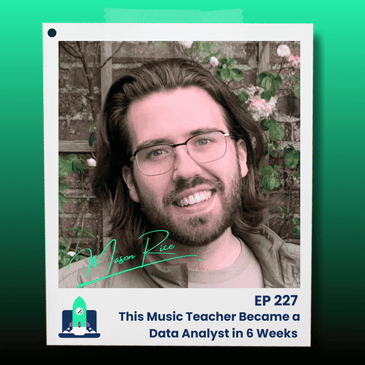
Mason went from teaching middle school choir to a financial analyst job at Humana in 40 days. I asked him how.
💌 Join 33k+ aspiring data analysts & get my tips in your inbox weekly 👉 https://datacareerjumpstart.com/newsletter
🆘 Feeling stuck in your data journey? Come to my next free "How to Land Your First Data Job" training 👉 https://datacareerjumpstart.com/training
👩💻 Want to land a data job in less than 90 days? 👉 https://datacareerjumpstart.com/daa
👔 Ace The Interview with Confidence 👉 https://datacareerjumpstart.com/interviewsimulator
⌚ TIMESTAMPS
00:00 – Choir teacher to Humana
09:03 – Teaching stopped working
12:33 – Go meet people
16:12 – Apply before you feel ready
20:06 – Fake it a little
24:30 – Get a referral
🔗 CONNECT WITH MASON
🤝 LinkedIn: https://www.linkedin.com/in/mason-rice-a98559330/
🎵 Follow his new choir, Voices of Kentuckiana 👉 https://www.instagram.com/voicesky/
🔗 CONNECT WITH AVERY
🎵 TikTok
💻 Website
Mentioned in this episode:
Win a FREE spot in my Data Analyst Bootcamp
I'm giving one lucky podcast listener a spot in my data analytics boot camp. All you have to do is register, and you'll have your chance at joining my boot camp for absolutely free. Go to web.datacareerjumpstart.com/giveaway to register. GOOD LUCK!
https://web.datacareerjumpstart.com/giveaway/
💙 Thank you for subscribing & leaving a review
Thanks to YOU we recently became the most popular data podcast out there. Thank you so much for listening. If you haven't subscribed yet, hit subscribe. It costs $0. If you enjoy the show, leave us a 5-star rating on Spotify or Apple. It helps people like you find the show AND it helps us land better guests. Thank you so much for your support.
I was a middle school choir teacher, and now I'm working at Humana as a financial analyst. I knew I was done teaching when I prevented a murder in my classroom Because I wasn't considering it at all. I didn't even know it existed. And so I found this journal entry that I wrote after I got my job, okay? And it says, "On October 25th," this is 2024, "October 25th, I started the Data Analytics Accelerator. I learned Excel, Tableau, and SQL. On December 4th, I accepted a job as a financial analyst at Humana." So it really was, like, 35, 40 days. The job offer was $75,000, work from home four days a week. There were probably 300 applicants on the first day. But I think important point was the job that I ended up landing was the 24th job that I applied for. It's not all about the techniques. Sometimes it's about who you know. I have a healthy amount of delusion. This is Mason Rice. He's a choir director and conductor that pivoted out of the classroom and into data analytics in less than six weeks. He didn't have a fancy tech degree. He didn't have a data background, and six weeks before he got hired at a Fortune 50 company as a financial analyst, he didn't even really know what a data analyst was. So here's exactly how Mason did it through the full story Mason, welcome to the Data Career Podcast. So I'm excited to hear about your journey from going from a choir teacher to financial analytics. So tell us where you work right now and, uh, how long you've been there. Sure. Uh, I'm so excited to be here. Um, you know, when I was going through, like, the Data Analytics Accelerator, I listened to probably every o- episode of this podcast that you had. So this is really so full circle for me. Uh, I'm really excited to be here. Um, so what I did before, uh, I worked at Humana, um, I was teaching choir. I taught high school choir for several years. I taught middle school choir for a short time here in Louisville, Kentucky. Um, but today I am working at Humana. Um, I'm a financial analyst in the risk adjustment department, so you can catch me reporting on, uh, Medicare star ratings and how they impact our company financially. Okay, that's crazy. So you were, like, teaching, like, eighth graders, like, how to sing and doing, like, performances and being, like, the, like, the conductor, and then suddenly, like- Yeah, allegedly Okay, that's awesome. And then suddenly you're, like, on spreadsheets and, like, crunching numbers. That doesn't seem like a very natural, uh, career transition. So, uh, like- No, it wasn't, and it didn't really feel like it sometimes either. Yeah, I- It wasn't, yeah I can imagine. That's, that's such a, a, a crazy, a crazy story. Um, so, like, do you use Excel at your job right now? What type of tools do you use at your job? Oh, yeah. Um, I would say Excel is probably the majority of what I use. Um, SQL is really high up on that list, too. Um, I am also using Power BI, um, to a degree. I had to learn SAS on the job, um, so I didn't have that skill before I took the job. Um, but I've had to learn how to write some SAS code. And then, um, a- now we are moving into Databricks, so learning Databricks and a little bit of Python has also been, um, on my plate. Wow. So you've learned quite a bit since you've been there and you, you know, you learned some of this stuff before you landed the job. I love that you're learning on the job. I think that's important that people recognize that. Um, but, but if- Mm-hmm I guess you had to choose the top three in order, it'd be Excel, SQL, Power BI? You got it. Okay, got it. Um, and what type of data are, are you looking at? You're looking at, like, Medicare data? Is that what you kinda said? Yeah, for sure. So, um, generally looking at member-level data. Um, just trying to figure out, like, I'm looking at county rates, I'm looking at star ratings, I'm looking at, um, how many, how much money we're getting per member per month, per person. I'm also, like, looking at the enterprise as a whole, comparing data from competitors to see kinda where we stack up, um, in terms of performance on s- star ratings. And there's a really complex system of how the government pays out for Medicare, uh, which is constantly changing and evolving, and they want to pay us less and less money as time goes on. And so it's kind of a, uh, uh, a challenge to keep up with the changes, but also to stay ahead of competitors in a way, in a field where, like, margin percents can be really, really low. So every, every penny really matters. Um, and so we're kinda just looking at that data and trying to stay ahead of the game. That is kinda crazy to hear, um, that, like, margin's small in, in healthcare 'cause you often think that healthcare is kind of ripping you off. It feels so expensive in America. And we should, and we should mention that Humana is, uh, like a healthcare, uh, company in the US. It is, like, one of the biggest ones. Mm-hmm. I think you guys are, like, you're at least a Fortune 50 company. You guys might even be bigger than that. Right. Um, so this is, like, a huge healthcare company, um, in the US. We should mention that you are, uh, located in Kentucky, which, which is kind of, like, kind of close to the middle of America. A little bit, a little bit to the east of the middle. Mm-hmm. Um, okay, very cool. And, like, tell us a little bit about what your work situation i- is like. Are you in the office full time? Are you remote? How does that work? Sure. Yeah. So I'm in Louisville, Kentucky. I've been living here for two years, and, um, Humana's headquarters is in Louisville, so they have remote workers all over the place. But my specific team is a hybrid team. So I go into the office on Wednesdays only. Um, so Monday, Tuesday, Thursday, Friday, I am working at home. Um, and so that has been super nice balance for me 'cause I love having some face time with people, um, and getting to get out of the house. But, um, the working from home is also really, really nice. Though there are people even on my team who are fully remote. But generally, like, for Humana, if you live within, you know, a 30-minute, 45-minute drive, you're probably coming in one day a week, if not a f- a few more. That's something that I think is so interesting. Everyone wants a remote job, and, uh, I've started to see some, I don't want to call it backlash, but some pushback to remote jobs where it's like, I don't know how healthy, uh, completely remote jobs are just because I think you, I think you get better training when you go into the office 'cause it's just, it's hard to train people online. It's, it's hard to, like, schedule meetings. Um, I think you get better opportunities, uh, like, to get raises and promotions just 'cause, like, you actually are forming a relationship with an actual human being, like, with your boss, versus just, like, talking to them online. And I just think, like, mentally and emotionally, we were meant as humans to interact with people, like, actually interacting with them. I think, I think there's so much to be said about a hybrid job like what you're talking about, where it's actually worlds better than a remote job. 'Cause, like, really, it's hybrid, but you're, you could just call it 80% remote. I mean, that's what, that's what it is for you, right? Mm-hmm. But that 20% feels so important. You've enjoyed the 20% in office? Oh, yeah. And I completely agree with you. I mean, in fact, like, I was I mean, I was working in a school, right? I mean, it doesn't get any more in person than that. No. Right? You're hands-on dealing with people all the time. And so I was so ready for the pendulum to swing the other way. I was like, "Oh, no, let's be totally remote. Let me, let me get, you know It seems so nice to be so convenient. And as time has gone on, I kinda wish I had two or three days in the office to go in and work, just because I feel like that energy exchange between people is so important. And what you said is exactly true. Like- The way you connect with somebody in person is so different than the way you connect with them online and, and I find online connections are difficult sometimes. They can be really awkward. You know? You can't... It's harder to have a give and take on a, on a Zoom call, right? Because you, you can't listen and speak at the same time in the same way that you can in person. Yeah, it's like when you're really making eye contact with somebody, and you can notice their breathing and their body language, and you can read the room when everybody else is... When there are other people involved too. I think it's so valuable, um, something that I've really missed. Um, and I would also say, like, working, working remotely can be lonely. It can be, it can be depressing. Um, it can be really repetitive. It can be very comfortable, but it, it's also... You know, it's, it comes with its cons as well. I hope, I hope everyone just listening kind of internalizes that and maybe instead of applying to remote-only jobs, try some hybrid jobs. 'Cause the other thing about hybrid jobs... I, I'm gonna call them 80% remote jobs, 'cause that's what, that's what yours, that's what yours is right now. Those 80% remote jobs, like, they're just way less competitive because I can only, you know, like, I can only... Okay, almost. You did say there were some people that are fully remote on your team. But the majority of the people on your team, you know, have to live in the Louisville area. And so when a job opens up, uh, for your team, it's like the whole entire country, the whole entire world can't apply for those jobs. You know, only people in Louisville, Kentucky. So your application pool is just so much smaller. So I... Anyways, everyone listening, start to apply to hybrid roles. Um, okay, I wanna talk about- Oh, yeah that in-person job you had, the choir teacher. You're, you're right that, like, other than, like, being a doctor or a nurse, like, teaching is, like, one of those jobs that is, like, in person, hands-on. Um, so you're teaching, you know, all these students music. You're, you're, you're, uh, a choir teacher. Um, like, at what point were you like, "Uh, I don't know if I wanna do this the rest of my life"? Like, what was, what was so hard about that job? Sure. I mean, in my first job, I was fresh out of college, and I mean, and any first-year teacher can, can commiserate with the energy and the, the crazy, uh, amount of effort it takes to just get started as a teacher. It's really just kind of unbearable at times. It's really emotional. It was, it was emotional for me. I'm an emotional guy. I teach music. What can I say? But it really, it just requires so much effort and so much investment, and there's so many factors that are unpredictable. These kids, they bring in their own baggage and problems to the door, and it's so often you have to check yours and just be a caregiver Uh, much more than a teacher. And I taught through the pandemic. I, uh, I only got, like, a year and a half of, you know, in-person instruction before I was teaching with a mask for two years. Um, and for me, it's always been about mentorship and connection, uh, with, with people. And so, uh, the mask kinda took that away for me for that kind of level of connection. So, uh, that's when I left to go get my master's. But, um, when I went to go teach-- When I go- went back to go teach middle school, I just found that it was a totally different landscape. I found that I wasn't really able to teach the way that I wanted to teach or teach, um, primarily, um, because in that role, I definitely was m- m- majorly a caregiver and a, and a therapist and a babysitter and a, uh... Yeah. Th- thi- But I wanted to teach choir, and so I kinda felt like in a way that was not available to me, um, anymore, or at least where I was and Yeah, I, I was getting, I started having nightmares about this, going into work and waking up as late as possible and going home and not saying a single word, and was just really struggling at the time that I was looking to pivot ca- uh, pivot careers. I had just gotten to a really low point. I mean, probably some- one of the lowest points I'd been in, uh, was just be- this because of teaching and just because of all the, all of the things going on. I mean, I was dealing with lots of violence in my classroom. I was dealing with lots of, uh, some really troubling home lives with students, and that... What it, it is a beautifully compassionate job, um, but it is incredibly taxing. And so I think I had reached, I, I had reached my limit with what I could handle. Do not blame you one bit, and I think everyone who's listening, one, loves teachers, and we're thankful for you teachers, but also recognizes how sucky of a job it is and how hard it is. My mom's a teacher and, uh, you know, we're, we're recording this kind of, uh, during the, during the summertime, and my mo- I was like, "Mom, when do you have to go back to school?" Well, she's like... And she's like, "The official day is this, but I'm gonna go back a week early to prepare." I'm like, "Mom, you're just working a week for free for, to, like, you don't get paid for that. You're just doing it out of the goodness of your heart. Mom, I love you. You're a good person, but no one should have to work a week for free, especially, you know, teachers in America." But alas, that's the, the system we're in. Okay, so you're like, "I, I gotta get out of teaching. This is, this is too much, you know, taxing on, on my wellbeing. This is, this is very difficult. I wanna try something new." How did you decide on data? Like at what point were you like, "Oh, I wanna become a data analyst"? Okay, it's actually wild because I wasn't considering it at all. I didn't even know it existed. Um, but what I was doing was going out and trying to find community. Um, I was just out and I joined some choirs. I was singing in this group called the Louisville Chamber Choir, and I had made some friends, and had started like speaking into the ether that I was like ready to change, ready to s- do something different. And, um, a woman by the name of Erin Sheena comes to me from across the room and is like, "Hello. I know we have like friends in common and we've been singing together in this group." And she... I kind of asked her what she did and I was like, "That sounds like what I wanna do. Can we get like coffee and talk about what you do for work?" And so Erin and I, we got, we had like a, we had a get together. We kiki'd and we talked about... 'Cause she had changed from music therapy to this job and I was like, "How did you do that? Uh, point me in the right direction 'cause I need a change," and I knew I wanted to work in something with money. I knew that I enjoyed, um, like working in Excel, and I thought coding was interesting. As, as she was explaining it to me, it sounded really intriguing. So yeah, she pointed me in the direction of the DAA and I, uh- Yeah, I, I really, I put my all into it and really didn't look back. Um, so I watched the YouTube videos and listened to the podcast and, um, knew that I would give, give it a shot. Okay, this... There's so many cool things here that I, I need everyone in the audience to, to pay attention to and r- and remember. So if you've been a listener to the podcast for a while, you'll know that Erin Sheena, we've interviewed Erin on the podcast before. Uh, it was a few years ago, though, so some of you guys who are OGs might remember. Mm-hmm. I did a, a, a rerun of her episode maybe about a year ago, so some of you guys have probably heard it. But yeah, she was a music therapist, uh, like Mason said, and she joined my accelerator program, was able to pivot, uh, to a, a pretty similar role, uh, to Mason's role, we'll get to that in a bit, um, and become a data analyst. Okay, so you, so you met Erin, and she was like, "I'm a data analyst. I used to be a music therapist. Music therapist was really, you know, taxing and a very difficult job, and I was able to pivot into data." And you're like, "That sounds fun. I like Excel. I'm interested in coding." Did you like puzzles, like, growing up? Like, did you always like numbers, or was, like, math something you didn't enjoy? Oh, yeah. I mean, full disclosure, I did get my minor in math- Ah, okay. That's good to know in my undergrad. My mother was a math teacher. And, um, I mean, really, music and math do have lots of overlap, um, intellectually. So I, uh, I've alwa- yeah, I love puzzles. I love games. I'm a big board gamer. I'm a big video game nerd anyway, and so I find things like that really interesting. But yeah, I, uh, independently was applying for jobs and, and Erin ended up being my reference. You know, our desks, by the way, are, like, right next to one another. I saw her yesterday. We see each other all the time, but she was really my, my in at Humana, and is one of my dearest friends and, um, I kind of followed her path in, step by step, to be honest. Like, I listened to that podcast episode with her and was like, "Yeah, I wanna do that." And so I probably listened to it, like, four times until I made it happen, so. And that's, that's my, my next question exactly, is, like, how did you make this happen? So you're, you're at this, like, uh, singing event, and you meet Erin, and she explains, "Yeah, I was piv- able to pivot from music to, to data." You go get a coffee chat, you know, you explain what you wanna do, and she's like, "This is how I did it. You know, I joined Avery Smith's Data Analytics Accelerator, was able to pivot out." And you're like, "Okay, I'm just gonna follow that." So you, you end up joining the accelerator, and, uh, how long- Mm-hmm did the whole process take from, like, deciding you want to become a data analyst to your first job offer? Okay. So before this interview, I went and I g- I grabbed my diary. And so I found this journal entry that I wrote after I got my job, okay? And it says, "On October 25th," this is 2024, "October 25th, I started the Data Analytics Accelerator. I learned Excel, Tableau, and SQL. On December 4th, I accepted a job as a financial analyst at Humana." So it really was like- 35, 40 days. It was a whirlwind of a time, um, but it happened really, really fast. And, uh, the job offer was $75,000, work from home four days a week, which was, like, already more than I was making as a teacher, by the way. Um, and a lot-- and better benefits, so. You were in. Yeah. That's it. Um, so I- when I started the program, I, uh, I'm an all-in kind of person, and so I was like, "Okay, I'm doing this." I made-- I, I think I finished the first module in a day. You know, I woke up at 8:00 a.m., and I was like, "I'm doing this." And every little strong arm emoji, I was like, "I'm doing it. I'm doing it." I made my LinkedIn. I had all my photos fig- figured out, and then, um, I was just like 100% gung-ho. I was listening to the podcast on my way to school. I was listening to it on the way out of school. I was listening to it in my, uh, in my, what is it called? Planning period. Wow, sad that I've already forgotten what that was. Um, and I even-- I also had, like, 27 Sick days that had just been accrued, I was cashing those in. I was like, you know, I- if I'm gonna leave this job, which I did, I'm gonna forfeit all of those sick days, which I did. I ended up forfeiting the rest of them 'cause I left my, left my job. So I was using all the sick days as, like, project time. So I had my portfolio with, like, in Excel. I probably did the first five or six modules in two weeks, in a week or two weeks, and I applied... See, I also pulled up my job tracker, 'cause I u- I used that job tracker that you posted. I applied for my first job October 31st. So within a week I was applying for jobs. Okay. That's crazy. How many jobs did you apply for total? Okay. So the... Of, of the ones that I put on the tracker, which probably wasn't all, 80. I applied for 80. Yeah, that's a good number. Um, yeah. I, I, I think I was probably pushing 100, 'cause I did have a low point where I was going through all of the, like, LinkedIn quick applies. I mean, obviously I didn't get any of those jobs. Um, but I think an important part, or important point was the job that I ended up landing was the 24th job that I applied for, and I didn't hear anything about that for several weeks. Um, I had already applied for many, many other jobs by the time they finally got back around to me, and then I fi- I accepted it on December 4th. So it was about a month of interviews- Wow and stuff before the job. So many cool things there. So, like, in six weeks you were able to be like, "I wanna be a data analyst," to having an o- a job offer. Uh, that's amazing. Congratulations. That is so cool. Thanks. Um, and, and that 24th, so it was the 24th job you applied. For first, so first off, I wanna say, like, you, if your first job that you applied for was, like, almost on Halloween it sounded like, that means it was, like, a week into the- Mm-hmm accelerator. And I think that's such a good point, that so many people... Like, you had only heard about data analytics for, like, maybe a m- maybe, like, three weeks, a month before applying to your first data analyst job. And I can't even tell you- Mm-hmm um, how many people wait years before applying to the job, 'cause they never feel like they're gonna be ready. So, like, what was your thought process of, like, "You know what? Screw it, I'm just gonna apply to jobs." Like, h- how did you feel ready? Oh, I have a healthy amount of delusion. I- and I think that is a very important thing to bring into your life. Just a little bit of I can do anything energy. Um, and, and actually I would have like, I would have a little... Before I have, would have an interview to like talk about this thing that I had never done before, um, I would just like have some mirror moments with myself where I would just like make eye contact and say, you know, "I'm a data analyst. I can do this." You know, "I have what it takes to like, get this job." So honestly, it was kind of like a mindfulness practice in a way, um, while it was happening. And I was doing lots of yoga and drinking lots of tea and just trying to remain calm because, you know, my job was so chaotic. Um, it was so chaotic and I really, um, was coping with that in a way by, uh, by spending all of my energy trying to make this happen. Um, but yeah, I, I think a healthy amount of delusion can serve someone pr- pretty well. I mean, 'cause on my, on my resume, I put... I would tailor the title. I would just put Mason Rice, data analyst or business analyst or financial analyst, whatever the job posting was, and put it on there and add my... You know, and I kept my, uh, teaching experience on my resume, but I put my data analytics stuff at the very top and all of my portfolio and stuff and skills at the top and tried to like push the s- the teaching stuff down a little bit. But, um, but yeah That's, I mean, I love that, having a healthy delusion. I think that's, that's a great thing. And, and one thing, one thing I try to talk about in the program is, like, one, I don't think anyone's ever ready to become a data analyst, especially 'cause it's always changing. A- and two, it's like if you don't think you're ready to be a, a data analyst or apply to data analytics jobs yet, well, can you at least fake it till you make it? 'Cause I promise you, like- Period like, you're more ready than you realize. And a lot of the times when, you know, you're getting rejected, you know, 'cause that happens, 'cause, like, what? There's, I don't know how many interviews you got out of, out of those 80 or 100 that you applied for, but, like, over, over 75% of them, 80% of them, you probably got ghosted or rejected, right? And- Oh, yeah and I think that s- people think that means, "Oh, I suck. I suck as a data analyst." And it's like, no, you're normal. That's how it is when you're applying for jobs. It's like, it's like, for instance, a Hall of Fame baseball player, if they hit the ball one out of three times, they're a Hall of Famer, right? And it's not like, "Oh, I missed it two out of three times. I suck." It's like, no, that's par for the course. That's, like, what we're supposed to do. And I think some people get s- so discouraged with that. Um, so how were you able to stay optimistic when you weren't hearing back or when you got rejected? Well, for me, I think I, I kinda knew what I was up against in a way. Like, when I applied for my job, there were probably 300 applicants on the first day, you know? And every time a role gets posted at Humana, that's kind of the story, you know? There's always all of these applicants. So my strategy was always, you know, what can I do, what, what can I do that's gonna make myself stand out? Um, the number one thing was apply for hybrid jobs in Louisville. I mean, I was exclusively applying for hybrid jobs in Louisville because I knew that my... If I could just get my foot in the door and get an interview, I could, I could land it because I could talk my way to it. Uh I would make, I would somehow be able to convince those people, or at least, like, to have a, to start making connections in a way. Um, so- Applying for hybrid jobs, uh, also just knowing that applying and then moving on. Like, if I never hear... I don't expect to hear from most- for most of these jobs that I'm applying for, so I'm gonna give them, like, the time that the job speaks to me. You know, if I'm not that excited about the job, uh, I'll, I'll fill out the application. But if I'm really excited about it or it seems like I could really have a shot, I'll spend a lot of time on this. Um, but I kind of had, like, drafted my elevator pitch. I had drafted my answers to, like, common questions and just learned what applications were looking for, what they were asking for, and it made it a lot easier. And yeah, I d- I definitely didn't take any personal offense by not getting a job because at some point, you know, they never see your face. You know, they never get to speak to you until you're in an interview, and so it's like if you say no, you're missing out. Dude, that, that is a great attitude. Um, how else did you stand out? So one of the things that you mentioned earlier was you were able to secure a referral for this application, and that was Erin- Okay um, who had joined, you know, my accelerator program, came and did data analysis at Humana. You found this opening at Humana, you apply for it, and she was a referral. Did... Was that helpful in the interview process? Like, was... How did that process go down? Oh yeah, absolutely, because my boss had a desk right next to Aaron, you know? Um, I mean, I would say that it's probably the primary reason I got an interview, um, because Aaron was willing to vouch for me. Um, but once it was the interview, you know, it was really up to me, um, to talk about my projects 'cause they, they were specifically asking about my projects, my, the experience that I had at Sequel. Um, I had a, I had a few technical questions in there, you know, about join types and, uh, what the most complicated thing in Excel I had ever done was. Um, oh, and this is totally off topic, but my Excel project was on iFood. Is it still the iFood- Yep Excel project? Yeah. I got that in a tr- I got that as a trivia question last week. Like, what is a Brazilian, like, food delivery, uh, company? And I was all on that. Um- That's awesome. So I thought about you just, like, two weeks ago. Oh, good. Um, but yeah, I, at that point, like, to stand out, I was just gonna lead into my humanity. I was like, I was just gonna try to show them who I was more than what I could do. Um, like I, every opportunity I had to talk about my friends and my family and my loved ones and things that I loved, I did. I really tried to lean in to just being a hard worker, um, loving collaborating with people. Um, I talked about my master's mentor from my conducting degree. I talked about my favorite principal 'cause u- 'cause all of those questions like, uh, for the two interviews that I did, the two different companies, they both asked me, like, "Who's your favorite boss been?" And that was my opportunity to talk about my experience. Like, I'm gonna talk about my mentor. I'm gonna talk about my principal. Um, or what, like, all of the questions that they're gonna ask you from like a per- personal standpoint, you can use your experience, uh, to talk about. And a lot of those things are gonna tell the story of who you are more than, like, what you're able to do in Excel, 'cause they can teach you what they want you to know. Because it, I, well, I would say starting at any new company is always gonna be a learning curve anyway. I mean, I had a million different acronyms to learn at Humana just because I'm not part of that culture, and I had to learn-- I mean, I've learned things about finance, I've learned things about healthcare, but I didn't know any of that going in, and that's okay. Like, I think at the end of the day, what m- what at least the people on my team were looking for was somebody who was willing to learn, someone who would be a good person they could get along with, um, and that brought, uh, at least a, a willingness to give it a shot, um- To a table. Uh, I, Mason, I just think you, you brought up so many good points there. Um, and, and one thing I think you're really good at... So, like, guys, undoubtedly Mason's a, a smart person, a capable person. Um, like, good, good technically. Um, can understand data and make it easy, communicate it well. But, uh, if you, if you listen closely to this story, like, you're really gonna find that he landed this job because of his social skills and, and his networking. It's like Mason was brave enough to, you know, he was new to a city, and to go to these awkward events where you don't know anyone, and you're like, "Hi, I'm new to this city. Uh, like, nice to meet you." Like, you, you were social enough and, and brave enough to go to those things and meet people like Aaron. And then you were brave enough to know, "Hey, Aaron, do you mind if we go get coffee so I can learn more about your career?" Uh, and then, you know, you're able to say, "Hey, Aaron, can I use those a- as a referral for this job application?" And I think so many people are, are scared of that, are just not willing to do it. Or, or maybe it's just they don't see the value in it because it's, it's kinda like planting a seed, right? It's like you don't see the benefit- Mm-hmm the immediate benefit of doing these social things. 'Cause a lotta times social things or networking doesn't actually lead to anything valuable ever, or it's, you know, many weeks or months or years before it actually is something in- valuable. And I think people get so addicted to the dopamine of, I just learned, you know, something new in SQL. I hit execute on the SQL query, and I got the results- Yes immediately. And they're like, ooh, dopamine hit. Mm. I'm, I'm making progress. And, and I think some- p- people get so addicted to learning skills is how I land a data job. And it's really, they're getting distracted is learning skills is how I get a, a dopamine hit. It's like there's no correlation- Mm between how skilled you are at SQL and how quickly, uh, you land a job. 'Cause, like, I mean, you, you, like you said, you dove in headfirst, you did the modules, you, you did the SQL modules. But it's like you couldn't have been that good at SQL after six weeks of learning what SQL even meant, right? Compared to someone who's been doing it for a year. But you were able to land a job in those six weeks because you followed the full SPN method of learning some skills. Like, there was a bare minimum amount of skills you had to have. You had a project with SQL in your portfolio, and then your networking. Like, really it was all three of them landed a job. And I think some people get so addicted to the, the skills part of it that they kinda forget the other two. Like, do you agree with me that, like- Oh, yeah Absolutely. I mean, I think you're touching on something that's affecting our entire culture, uh, generally, is that, you know, we have a dopamine hit in our pocket, like, all the time. And so it's kind of like we're chasing that all the time. But the humanity and the person to person has really been my whole career. I mean, the through line of my tr- trajectory in all of my jobs has just been connecting with people, getting to know people, working with people. How do I get this group of people to do what I'm asking them to do? And now, how can I use this group of people that I know to help me get to the place I wanna go next? Um, I completely agree. And yeah After like the first two weeks on my job, I was like, "Yeah, no, I actually don't know anything." I was like, "I don't know what I'm... There's so many things that I don't know." You know, I was handed my-- I inherited some codes and my first job was just like, "Okay, go learn the code." I didn't know how to comment things in SQL. I didn't know that you could like hit the little green button up at the top of SQL Server and like take a line of code out. I didn't know that you could run like little chunks of code at once. I didn't know like really how to join anything. I knew what the joins were 'cause I knew what those little Venn diagrams were enough to say like, "Yeah, a left join keeps the first table." But, uh, I didn't know the practical application of that or what questions were really trying to solve. I just knew the skill. Um, and so yeah, I think all the other stuff comes and, um, you know, and I was okay with it coming on the job. And, you know, I, I, I was very straightforward, uh, after I, after I got the job to say, "Look, I'm gonna make mistakes, you know. I anticipate that. Just be patient with me. I'll figure it out. You know, I, I am best friends with Google. I, I am best friends with, uh, my coworker up, up the cubicle, and, uh, I'll ask her, you know, if I, if I need some help." And, and I, I was able to figure it out as time went on. Um, and I'm still... I mean, to this day, I'm still figuring stuff out, you know. Like I have... Th- there are codes that I have lived with for a year and a half now, and I look at it and I think, "Is this really, is this really what I've been using? You know? Uh, or maybe I should do something about this part at some point." Um, but you know, also when I took this job, they had documentation that told me step by step what I needed to do. You know? They had it l- they had the job written on paper for me. So every time, every time it came around to I, where, when I needed to make my reports or whatever, I would go down the checklist, do number one, do number two, do number three. And by the th- fourth or fifth time of doing that, I was like, "Okay, I kinda know what the checklist is." And I'm now like looking at how to validate this data and how to make, make sure that it's exactly what we want it to be, and maybe ask some more intelligent questions than just doing the job, uh, which is what I think they... Is, is where, you know, I, I've been headed in my journey now. Um, but yeah. And I, I think it's just being open to having, having those relationships, being okay with failing a little bit, being okay-- And not even failing, just making mistakes, um, and being okay with Not knowing and just take, I honestly, I, I'm all for taking the leap and just going for it. It, it can be messy. I've certainly had some messy moments, but, um, yeah, I still have a job doing the thing that I wanted to do. And you're getting paid to learn. Like, that's, that's the whole goal is, like, we try to get you, uh... We teach you the, all you need to know to land your first job, and then you can go get paid to learn the rest on the job. Because that's the best way to learn anyways, because that way you're maximizing your time, you're maximizing your wallet, and honestly, like, it's just the best place to learn because you'll actually use everything you're learning at work versus you probably won't use everything you learn in a school environment. So, um, I love that. One of the things you mentioned is, like, you were, you were working, um, while you were trying to, you know, pivot to data analytics, and you, and you talked a little bit about listening to the podcast. I don't know if that's, like, the publi- public data career podcast or the member-only podcast that you're listening to- Mm on your commute to work. Right. You talked about utilizing, you know, your holidays, your sick days, those types of things. Um, what else were you, like, kind of studying, getting these job applications? And was it early mornings for you? Was it late nights? Was it kind of all over the place? Uh, it was mostly in the evenings, um, because I mean, my school would start at 7:20 AM, so I, I would wake up at 6:30, which is late to be waking up to go to work. Um, and I was listening to the members only podcast and the public podcast as well. But I was thinking about it all day at school and trying to like, you know, plan what's my, what's my goal for today? If I can get through this SQL module in the next two days, um, 'cause I guess my goal was to at least have five projects, two S- I wanted the two SQL projects, I wanted the Tableau and the Excel project for sure. Um, and then go from there. But yeah, I was using the evenings mostly. Um, and the weekends. I mean, I blocked off my Saturdays and Sundays as well. Uh, was calling in, um, to like miss choir rehearsal a couple times 'cause I, at that point I was just still a singer and, um, I was using every free minute I could to just, to make it happen. But yeah, I mean, I really can't stress enough, like if you don't use your sick days, you lose them. So just use them. Uh, that was probably the biggest thing for me, was just taking the time off, um, to, to devote. We, we should also mention that, um, you know, you're talking about the time to do all of this, that, um, if I'm correct, you still haven't finished the program completely. Which, which I freaking love because my, my, my point here is like, my job is to land you a data job. I don't care about you, you know, finishing the program. The... If you finish the program when you land a data job. Um, so like you're, you, you have a certificate, like we, we celebrate you like, because you got a data job. You did, you did the hard part. Um, and I, I just wanna make that clear because I think it's important that, you know, people realize, you know, we're, we're all learning data for job purposes. We're not learning it for funsies. We're learning it to, to have a job. And you've, like you said, you've done, you know, all of the, all of the SQL, and I think you've done all of the Tableau as well. So like- Mm-hmm you did everything you were supposed to land that job. You learned everything on the job and, uh, I think that's fantastic. I wanna talk about moving forward from you, because by the time this episode comes out- Sure it'll probably be public knowledge that you're, you're taking a, a different job, kind of like more of a, a dream passion job for you. Um, you wanna tell us a little bit about that? Yeah, absolutely. So here we are yet again with another career pivot. Um, but I am actually stepping into the role of artistic director for our local LGBTQ+ chorus, Voices of Kentuckiana, here in Louisville. Um, it's been in the works for a while, uh, but I will be going back into music full-time. Um, so I, I, I'm also gonna be, um, teaching choir temporarily at Bellarmine University and working as a pianist at the University of Louisville. So, um, while I've been, you know, working at Humana, I've also been continuing to invest in music and invest in my network here in Louisville, and those have kinda come around and, uh, now I'm stepping into this dream job. I mean, I'm gonna get to conduct a chorus of, like, 110 adults, um, who perform all year long, um, music of all types, and an advanced chorus of, like, 28 singers. Um, it's, it's kinda, it's, it's the kinda job that people retire into, you know? It's like this is the job that is just comfortable and fun and mission-driven and, um, it's in the nonprofit sector as well, so I've got a lot of 501[c][3]3 and grant funding paperwork that I'm gonna have to learn. Um, but, um, it really is a great, uh convergence of all the skills that I've gained over my time, um, both at Humana and teaching, teaching chorus as well. Um, yeah, I, I'm like so thrilled that this is happening in my life, and it's really kind of cosmically an unbelievable thing. So yeah, I'm excited. That's amazing. Um, I think, I think it's important to, to always reflect that, like, for... I, I love data. I think data's very interesting, but if you told me that I could, like, have a comfortable life doing sports stuff or Pokemon stuff, I'd probably choose those things uh, o- o- over data as well. It's not like data's my p- like, I love data. Data's really fun, but it's not like if all things were equal in, in my life, like, if I could like... For instance, uh, I have a, a, a friend right now that just moved over to Europe to play soccer. Um, they're not making very much money- Oh, wow and, like, I couldn't support my family doing that. But, like, I'm super jealous. Like, I wish I could just go, you know, play professional soccer, you know, somewhere, somewhere else. So I think, I think it's awesome, like, you're, you're following, uh, like, what your, what your true passions work. Like, I just think that's, that's great. Um, and, and one thing I wanted, I wanna talk about was, like, you worked for, uh, a really big company, a really big company in the US, like a behemoth of a company, and I did as well. I worked for, for ExxonMobil, which is, like, one of the top 10 biggest companies in the United States. Um, and there's something to be said about, like, corporate work, no matter what you do, sometimes can be a little soul-sucking. When I was at Exxon, there was times where I felt like I was, like, this tiny, tiny gear that, like, just keeps spinning no matter what in, like, this huge, like, wall of different gears. And often it felt like even if I stopped spinning the gear, everything kept moving on and that my work felt a little meaningless. Um, do you wanna just talk about, like, what it was like to work for a big company and maybe how it differed from working from, like, for instance, a choir or a school? Yeah. I mean, I think you hit the nail on the head already. Um, you know, a job is a job, is a job, is a job, and it's always gonna come with pros and cons. And I found that moving from teaching to this large corporation was quite a culture shock. Um, I really struggled. I, I have struggled with that the whole time I've been at Humana. Um, and Humana overall, and my, my team in general, they have a great culture. Everybody gets along really well. It's a very, very positive environment. However, there is just a, an element of superficiality that comes with working in a large corporation. Um, lots of like, "We're doing what's best. We're doing what's best for our members. We're doing what's best for our people, for the world, for..." And sometimes it's really hard to buy into that. Um, sometimes I've really struggled feeling like my work actually mattered, um, that my voice was being heard, um, that I, even if it would matter if I left. Um, at, at the end of the day, I don't think it i- I think, I don't think it does. Um, I think that's just been something that I've struggled with. Like I, like you said, I, I'm kind of just a cog in the wheel. I'm definitely a low man on the totem pole in that company. Um, you know, I Find it difficult sometimes to connect with people who are higher up on the ladder than me, 'cause they're playing an entirely different game than I wanna play. Um, yeah, just to, just to actually watch people play the corporate social ladder game is really exhausting. Uh, it's really kind of scary. Um, you know, I could... And, and, and this is not speaking to everybody at the company for sure, um, 'cause there are gems that work in that, uh, building. But, uh, but yeah, sometimes it's really challenging. It's really challenging to watch people put themselves through, like, a whole rigamarole and pretend that things are really exciting and that transformation, the transformation that our company's going through is so cool when, like, thousands of people are being laid off, you know? So it's just kind of a really strange culture at times. Um, so I mean, that's why I find it really important to, like, connect with people who are on your level and just kinda commiserate with what's going on and try to find the people who you can really, like, be yourself with. Um, 'cause it's not always everybody. I mean, that's why it's so cool that you're, you're taking on the, you know, this dr- new kinda dream job 'cause it's like you're definitely gonna feel the impact you're making. And before I worked for, for ExxonMobil, I worked for a really small, uh, biotech company where I was, like, the 10th person hired, and it was, like, the exact opposite there, almost to a fault, where it was like everything I do really matters, and if I, like, and if I mess up, like, the company feels it. Uh, so there's... And, and that, that sucked in some ways because it was, like, very, it was almost more high pressure. Um, but I definitely felt my work was more meaningful. So I guess this is just to say there's, there's pros and cons of big companies and small companies and, you know, try to figure, figure out what's, what's right for you. Um, Mason and I both decided we like kind of a smaller company, uh, standpoint. Um, but just something to be thinking about on your job hunt. Okay, Mason, what would you say to maybe someone that's a teacher right now, um, who's listening, or maybe someone who's just an aspiring data analyst and they're like, they've been, like, struggling. Like, maybe they've been stuck in tutorial hell or maybe they've been, you know, grinding- Mm all these tutorials but not really making any true progress. What would you, what advice would you give them? I would say just make sure that you prioritize. You know, if, if finishing those tutorials is something that you wanna do, make it happen. Um, I kind of fi- found that I was letting my exhaustion from teaching get in the way, and it's easy to be exhausted. But, um, I think if you need to take some time for yourself to like-- or just take a time for a break, you should do that. Um, you should take some time off. You should invest in yourself, uh, because at the end of the day, like, you're gonna be the one looking out for you, and really you're the only one that knows what's best for you. And, um, you know, when I, when I think about, you know, transitioning my career, like I thought that moving to Humana was gonna be what's best for me, and it was, and then it wasn't, and now I'm moving on to something else. And so I feel like life is just a big series of decisions, so make some. That's it. Uh, if you were to talk to someone who's maybe like been listening to this podcast quite a bit, been listening, been looking at joining the Data Analytics Accelerator, but hasn't pulled the trigger yet, what advice would you give them? Like, would you feel like it was worth it for you in your journey? Um, I would say If you want it, keep going for it. And don't be afraid to change it up. Don't be afraid to change tactics. You know, uh, the amount of times that I tweaked my resume, the amount of times that I ran it through that Skill Syncer, um, to see if it would pass the AI test, um, the amount of times that I tried to change wordings to make myself seem more fun or more financial or more logistical or whatever, um, I just kept throwing stuff at the wall until it worked. Uh, and I would just say keep changing, and, a- and if s- if it's not working right now, change it. Change, change what you're doing and, and try something else. Um, I- it's definitely possible, um, to break in to the field. Um, it's, it's hard just because, and it's mostly gonna be about who you know, so, like, apply for hybrid jobs and stuff and, and go network with people. But, um, keep doing it. Just keep doing it. And honestly just... But also invest in the things that give you joy. Um, go out and join a dodgeball team or a kickball team or go sing in a choir. Come sing in my choir. Um, like, just go out and do something fun because you may meet the person that's gonna, you know, help you find something new. It might not even be data. It may be something you don't even know about yet, you know? Um, so just go out and meet people and I, 'cause I think people are the best part of life. So invest in your people and go find new ones. Amazing advice, Mason. Your, uh, your zeal for life is infectious, and I hope everyone listening today, uh, takes even just a sliver of, of your energy and your mentality. Guys, if you wanna change your data career, it's 100% possible Thank you We have a bunch of links in the description down below that can help you get started, including we'll have a, a link to, uh, Mason's LinkedIn profile. You guys can kinda check out his story and connect with him on LinkedIn. Mason, thank you so much for joining The Data Career Podcast and sharing your story. I think it's gonna inspire a lot of people. Thank you. Thank you for having me. I mean, again, this is truly crazy incredible. Um, yeah, reach out to me on LinkedIn if you want, uh, any advice or whatever. I'll do my best. I honestly, I haven't been on there in months. But you should also follow, um, our chorus at voicesky.org, um, on Instagram and Facebook as well, Voices of Kentuckiana. Um, that's where I'm gonna be moving, so, uh, you can keep up with, with me there.