Help us become the #1 Data Podcast by leaving a rating & review! We are 67 reviews away!
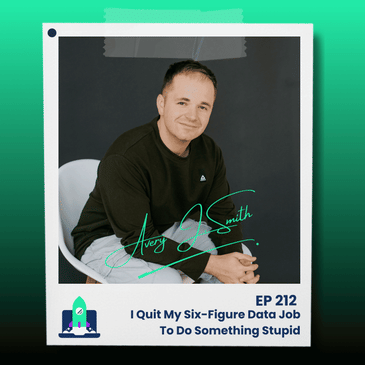
Five years ago I made the scariest decision of my life. Here's the full story.
💌 Join 33k+ aspiring data analysts & get my tips in your inbox weekly 👉 https://datacareerjumpstart.com/newsletter
🆘 Feeling stuck in your data journey? Come to my next free "How to Land Your First Data Job" training 👉 https://datacareerjumpstart.com/training
👩💻 Want to land a data job in less than 90 days? 👉 https://datacareerjumpstart.com/daa
👔 Ace The Interview with Confidence 👉 https://datacareerjumpstart.com/interviewsimulator
⌚ TIMESTAMPS
00:27 – Six figures and still unhappy
03:09 – The day I quit
10:45 – The Bloomberg article
17:15 – Starting over from scratch
19:42 – Five years later
🔗 CONNECT WITH AVERY
🎵 TikTok
💻 Website
Mentioned in this episode:
October Cohort of The Accelerator Starts on October 12th
Land your first data job ASAP with The Accelerator. And for this cohort only, get a discount PLUS our premium job board software PLUS our live AI workshops on how to analyze data Learn more here: https://datacareerjumpstart.com/daa
https://datacareerjumpstart.com/daa
Live "How to Become a Data Analyst" Webinar
Come learn the EXACT roadmap to landing your first data job: https://web.datacareerjumpstart.com/webinar
And, um, I'm gonna be resigning from ExxonMobil That was me quitting my six-figure data science job almost five years ago to do something ridiculously stupid, and it was almost the worst decision I ever made in my entire life, and somehow it's ended up being the best thing I ever did. Today, I'll tell you the full story that I've waited to tell five years on exactly what happened, why I did it, and was it worth it in the end. I started my career as a chemical lab technician, and I absolutely hated my job. I learned about data science and got immediately hooked. I was like, "Wow, this is the coolest thing ever. I wanna become a data scientist." And I worked really hard to learn all the stuff I needed to learn to become a data scientist, and I ultimately landed this six-figure job at ExxonMobil, which utilized my chemistry background to be a data scientist. I moved from Utah to Texas to work at their headquarters there, and it was a great job. It was awesome. I got paid over six figures. I got a really cushy desk job. I literally never worked over 40 hours a week. Um, I liked my coworkers. I liked the campus that we were on. Everything was really great, and I had my dream data scientist life. And that's how everything was until it wasn't, and everything went wrong, and I was absolutely miserable. Although everything on the outside looked amazing, and it was, I really wasn't fulfilled at my job for a couple different reasons, but basically, I thought I was a really good contributor. I thought I had really good ideas. I thought I was bringing a lot to the table, and, uh, not a lot of that was getting reflected at the company, and I grew really tired and sick of it. For example, earlier, I had built an app that they, not me, had deemed worth over a billion dollars, and yes, that's B with a billion dollars, and I don't feel like I was getting the ownership or the credit that I did on this entire project. I had also started to post a lot on LinkedIn and become kind of a thought leader in terms of data analytics plus oil and gas, and I... My posts started getting recognized by people at Exxon. So for example, a VP of Exxon saw one of my posts, reached out to me, and was like, "Hey, I wanna talk to you about data analytics at ExxonMobil." And I said, "Great. My manager and I would love to do that with you," because keep in mind, I'm an individual contributor. I'm not a manager. I'm a nobody. And the VP says, "No, I don't want you to bring your manager. I just want you to come." And I said, "Okay." And so I told my manager, I'm like, "Hey, this VP wants to talk to me. I'm gonna go talk to him," and my manager wouldn't let me. And I was... felt like I was being trapped, basically, in my role, and that got really unfulfilling in this, like, corporate bureaucracy that I really just got sick of, and I knew I was miserable because I started tracking how happy I was to walk in the door every day. And instead of, you know, sevens and eights on how happy I was, it was, like, twos and threes, and at that point, I knew something had to change. But to what, I didn't really know. I was always interested in being an entrepreneur. I had tried to start some businesses in high school and college, and none of them had worked out whatsoever, but I was always fascinated by, you know, owning your own business and trying to do something on your own. But I'm, like, extremely risk adverse. I'm pretty cautious, and starting my own business seemed way too much of a risk for, for me to pursue. And honestly, I would have never have pursued it had it not been for my loving and supportive wife really encouraging me to try it out. She knew how much it meant to me. She thought I could do it, and she believed in me more than I believed in myself, and so with her confidence, I- I went ahead and I did this: Hey, what's up? And, um, I'm gonna be resigning from ExxonMobil. Um, it's a super hard decision. Um, I just think I, I see myself going in, in different directions than, than the company Um, yeah, it pretty much has. Okay, sounds good. Thanks. Bye I did it. Oh my gosh, that was so... Crazy. And you might have sensed a little bit of emotion at the end of that last clip, and it's because I had just done something that terrified me. I was really scared. I didn't know what I was doing. I didn't know how I was going to bring income to my family. I didn't know if this was gonna work. Heck, every indicator of me being an entrepreneur previously proved that this wasn't going to work. I had no track record, no idea how to actually run a business, and you can hear a little bit of my thoughts from this journal entry of my last day driving home from work. I'm just grateful beyond belief to my Heavenly Father for, for giving me that experience, um, and giving me my next experience. I don't know much about my next experience. It's, it's new, and it's scary, and it's, you know, not something I've truly done before, and there's a huge risk that I'm taking. Um, but definitely leaving your corporate job to set out on your own is huge, and I thank God for giving me this opportunity. I really feel lucky and almost unworthy of this experience Um, but instead of feeling unworthy, I'm just gonna feel grateful and lucky. And yeah, we'll see what the next six months bring. Today is January 20th, 2020. I'll see you in a year or six months. The next six months were some of the craziest months of my entire life, and I was scared out of my mind. I was scared to be doing this whole business thing. I didn't know what I was doing. Um, but I did it, and I did it scared, despite being scared. So basically, I was doing consulting work and freelance work, where basically companies would reach out to me for d- doing different data projects, and I would do the data projects for them. So I worked for a cybersecurity company analyzing their data, and it was lots of fun. I got to analyze data, kind of be on my own terms, and be a little bit more useful and helpful to these companies than I was previously at my last job. And then one day, a LinkedIn influencer, Kate Strachnyi, reached out to me, and she's like, "Hey, I'm looking for someone to make these data visualization courses," and I love data visualization. And I was like, "Sure, I'll be the author of those courses." So I made a Python data visualization course and an R data visualization course. And at one point, she offhandedly said, "Yeah, well, maybe someday you'll have your own academy, your own data academy, and you could do more courses like this." And I was like, "Who, me? I don't think that's the case." But as my time went on with freelancing and consulting, I actually realized I love to teach. I reflected back on what I did at Exxon and what I actually really enjoyed there, and I actually led basically a data nerd club at Exxon, and I loved it. I loved teaching them. I loved learning from other people. I loved, you know, just helping people do data projects. And I realized, man, I love this. This is something I actually wanna pursue. And I thought, well, I pivoted from being a chemical lab technician to a data scientist. What if I made a course all about pivoting your career into data science? I think that would be really interesting, and there's not a whole lot like this on the market right now. And for the other 20 hours a week, I'd work on my education product, this course I was building that I was gonna call Data Career Jumpstart because it was all about jump-starting your data career. And after working on that course for about four months, I launched it on August 18th of 2021. And I was really nervous 'cause I had literally just spent three months of my life making this course, and I made $0 from it so far. So I was very nervous because I had to make that money up, because otherwise I just wasted all this time. And I was like, "I don't know if anyone's gonna join. I don't know if I- this is worth it. I don't know if I did the right thing or not." And looking back on it, I would change a lot of things that I did differently. But the course launch came along, and, uh, it went okay. It was a little bit worse than I expected, but not terribly. I was, like, kind of in the middle of like, "Okay, do I spend more time on this, or do I go back to contracting?" And I, I ended up picking up a few more contracting, uh, agreements because I was like, "I don't know if this course thing, uh, is for me. I don't know if I'm good at it. I don't know if, uh, you know, how this program is. Let's just see these first batch of students, how they do, and we'll go from there." Now, this program was designed around landing your first data job, pivoting into data science at the time, by building projects. I've always been such a big believer in building projects. Um, and at the time, you know, now I have the famous SPN method. At the time it was the PPP method, the 3P method, uh, which was to build personal projects on your portfolio. And the idea was that in this boot camp you'd come to, we'd build personal projects that we'd put them on a portfolio. What made them personal projects? It was all using your data. So, like, for instance, we'd use your Spotify listening music data, your Apple Watch or Fitbit fitness data, um, your screen time data from your phone. And we built projects in Google Studio, in Python, in R, all with your personal data. And of course, I still had all of the resume and the networking, the cold messaging, the actual, like, how do you talk to hiring managers and recruiters aspect of the SPN method now. But I just didn't call it the SPN method back then. I was also doing weekly office hours with our students and meeting with them one-on-one to make sure that they got all the help that they possibly needed. Now, in that first batch of students, some of them did land jobs, but many of them really struggled to land jobs. And when I looked back at, like, who had success versus who didn't have success, I learned something really important. Number one, although doing personal projects was really cool, I think it held a lot of students back for two reasons. One, using your personal data is often hard to collect Especially if you haven't been trying to do it for months. Like, if you're not collecting your screen time data, there's not, like, a magical button on your iPhone that just exports it. You have to kind of be thinking about it, how to get this data out as you go. Getting your Spotify data required using an API and also for you to be using Spotify. Maybe you don't have a Fitbit or maybe you don't have an Apple Watch, so some of that analysis was hard. Personal data is really cool, but you have to be really deliberate on collecting it over a long period of time to get any meaningful analysis. And number two, although I really believe that personal projects are great, I figured that doing more industry-focused projects would be better. Because although analyzing your own screen time data is cool, and, like, obviously that shows that you can gather, clean, analyze, and visualize data, and that can be applied to any industry, doing, like, more industry-specific data would perhaps make a better portfolio project for a more generic student. The second thing I learned when I looked at who had actually landed jobs is the people who landed jobs weren't landing data science jobs like I landed. They were landing a little bit lower-position jobs, like data analyst or business intelligence engineer. And I realized that teaching people to pivot from, you know, a non-technical space into a data scientist role was way too big of a jump, especially to do that in less than six months. It made a lot more sense to do a smaller jump of from whatever role that they were in to a data analyst role, and then eventually from a data analyst to a data scientist, you know, a year or two down the road. And so I had a big problem. I had built out all this curriculum where I was teaching people to go from, you know, a chemical lab technician or whatever non-technical, non-data role that you were in to a data scientist role by building personal projects. And that method didn't really 100% work because personal projects were hard to make, and the jump from wherever you're at to data scientist was too big. Around this same time, I had a really interesting professional/personal, I don't wanna call it a crisis, I'll just call it an event that went on in my life that, uh, was pretty traumatizing. And this event is basically the reason I haven't talked about this for five-plus years now. I didn't really feel comfortable talking about it. And now I feel like it's been long enough in the past that hopefully no one else cares and everyone else has forgotten about me at Exxon and it's all in the past. But I'm fingers crossed on that. And to be honest, I don't even remember exactly how it started. My guess, if I had to remember back, is when I left Exxon, I made a LinkedIn post in front of the famous ExxonMobil cube, you know, announcing my departure from the company. And I guess a journalist must have seen that picture and reached out to me on LinkedIn wanting to interview me for a story or something about, you know, leaving ExxonMobil. And in my head I was just like, "Okay, sure. Whatever. I don't... I go- I'm happy to talk about leaving Exxon, no problem. Not a big deal," right? But I really wasn't paying attention to who the journalist was or who they worked for or what they were doing. I was... It was all just kind of on the side for me and I was like, "Hey, maybe some exposure would be good for business." And honestly, I pretty much forgot about it because it was just, like, a one-time interview, and then they sent a photographer to my house. They're like, "We might use photos, we might not," right? And then a few months go by, I forget about it, and then I, uh, basically get a magazine with Elon Musk on the cover. And look, I'm in the freaking- Bloomberg Businessweek magazine. So they published this huge article about people who were leaving Exxon, and I was one of the only named sources. In fact, I was one out of two named sources in the article. And like I said, I didn't really know what I was doing. I was young. I was just kind of doing this as a side piece, and I was like, "Oh, maybe some extra exposure." And that article went extremely viral. It was posted on Bloomberg and Reuters and Yahoo, and picked up by dozens of different outlets and posted all over the internet with my happy face on the front page. And this kind of opened a can of worms that I wish had never been opened before. But basically, on a corporate forum called The Layoff, people started posting about this article and specifically posting about me. Now, this forum is completely anonymous, and so it's kind of like Reddit, where people can say whatever they want with no accountability, responsibility, or reliability on if it's actually true or not. So in one of these forums, the article got posted, and basically people started commenting. I'll go ahead and read some of the comments that people left. All right, number one, "Avery Smith is a worthless data scientist." Hmm, great. Number two, "For all the fact-checkers out there, Avery didn't leave. He got pipped." I was in his group. He continued to miss deadlines for projects and barely logged in during the work from home era last year. So that's 100% false, and if this person was in my group, you know better than that. If you don't know what PIP means, I used to think it was an ExxonMobil only term, but I've seen other people use it as well. It stands for performance improvement plan. It basically means you weren't doing good as an employee, and they warned you by PIPping you, by basically saying, "Hey, you need to get improved quickly. Otherwise, we're gonna let you go." And then they let you go. Now, there were layoffs at ExxonMobil happening around this time. In fact, they told us in July that layoffs would be happening in December. And truth be told, I kind of did wanna get laid off because then I'd get a three-month severance package of pay. And I already knew that I wanted to quit my job, so yeah, sure, I would've loved to get PIP'd. I did every project I was asked to do, and I did a good job, but I wasn't gonna be mad if I got laid off. I unfortunately was not laid off, and I had to quit in January and only get two weeks vacation paid out instead of the three-month severance plan. Comment number three. "Wow, that one pump chump Smith left to start his own company. Must be one of BK's hot shots." I don't even know what that means, but thank you? That's offensive. Comment number four. "No telling how inflated Avery Smith will get seeing himself featured in an article. Cringe." Yeah, to be honest, that was probably the case. I was probably pretty stoked to be, like, the front page of Yahoo for a day. I wish I wouldn't have done it, to be honest, so... Okay, that of itself, not really a big deal. I- when I chose to do content and put my life on the internet, I knew these types of comments would come. However, things continued to get worse. A few days later on the same forum, this post was left here. "What happened in Energy 3 today?" Energy 3 is one of the buildings on the campus at ExxonMobil. "Got a stand down meeting invitation but suddenly canceled. Rumor said something obnoxious happened." So basically this means, like, the campus was put on emergency mode where there was some sort of threat on campus. And this comment was left there. "A former employee, he was mentioned in some article that was posted on here last week," that's me, "for creating a data science company while working at Exxon last year, came back onto campus and caused a scene in E3." "I suppose the attention the article got caused ExxonMobil lawyers to look into it. And then there was a bunch of comments that I started my company on ExxonMobil time with ExxonMobil computers, and I should be stripped of my company. And that wasn't true at all, but I just didn't like the rumors being spread about that because you just never know in corporate world what people will say and what companies will do. 'I suppose the attention the article got caused ExxonMobil lawyers to look into it, and they seized ownership of his company since it's technically company property as it was created during ExxonMobil time on an ExxonMobil computer. And today he came back to express his rage. Not sure what it accomplished though. Long story short, if you're going to create another company during ExxonMobil time on an ExxonMobil computer, don't advertise it.'" And the comments went on in that forum to basically insinuate that I, like, jumped in an Uber and snuck onto campus 'cause the campus there is super high security. You basically can't get in the campus, and then you can't get in any door, and then you can't get up any elevator without, like, two different keys basically to get in. That I somehow snuck through all of that and started throwing papers all over the place and trashing the office because I was mad at ExxonMobil. Now, obviously, and I shouldn't even have to say this, none of that is true. And honestly, it felt like a smear campaign. It felt like someone was out to get me. And I honestly just got kinda scared because I just didn't like people talking about me in untruthful ways. So this is where my risky bet of quitting my job and starting my business has gotten me. In a boot camp that half works, and this whole newspaper written about me and everyone writing mean things about me online. Was it worth it? At this point, I didn't think it was. My wife and I had also decided at this point that we wanted to have kids and bring in some babies into the world, and, uh, I was in a position where it didn't feel like I was ready to add the extra responsibility into my life because look at my business. It's not doing as well as I hope it would do. And so truth be told, I honestly felt like giving up some days. I wanted to go back to the corporate world. I wanted to stop doing the boot camp. I wanted to stop doing consulting and just do a normal job because that was normal and boring, and no one would get mad at me, and, uh, it would be easier. And honestly, thanks to God and some other mentors, I did not give up, and I redid the entire Bootcamp. From beginning to end, I redid everything. Now, the core concepts of projects and networking and learning the skills were, were still there. In fact, that was the whole basis of it. I sat down on a piece of paper and pen for days trying to come up with the method name, and eventually landed on the SBN Method. Learn the skills, build the project, and do the networking, and that is the formula to landing your first data job. I redid the entire curriculum, redid all of the projects from scratch, focusing on industry projects, not personal projects, and put greater emphasis on skills that were actually being used by the general practitioners of data analysts, not data scientists. I no longer was trying to help people go from, you know, whatever job they had to whatever data job. Specifically, I wanted to help people land data analyst jobs, because those are the people in my first bootcamp who had success. I would do 10 modules. Each module would have a project, each module would have a skill, and each module would have a networking activity. And I launched that at the very end of 2022, and I renamed the whole thing Data Analytics Accelerator. And the results, well, they've been unbelievable. We've had 1,000-plus students in the accelerator program, and we've helped so many people land their first data job. I made enough money to support my family and my new babies into my family's world, and I got immense fulfillment out of helping people get out of careers that they felt miserable, like I felt at my chemical lab technician, and help them get into careers that they truly and actually enjoyed. Just as one example, my friend from my LDS mission called me one day. She was a special needs education teacher, and she said, "Avery, I can't take it anymore. I know you help people become a data analyst. I wanna become a data analyst." And I said, "Great. Let's get you in the program." And a few months later, she called me and left me this voicemail. Avery freaking Smith. I... Sorry I'm bothering you right now. I just had to call you because I just got a phone call from Chase. The interview went good, and they would like to move forward with the hiring process, so I am beyond excited right now. Holy cow. Um, anyways, they said they would send official offers in probably three days. So I'm just, phew, literally so excited I can't even, like, think straight right now. Um, I just wanna tell you thank you. If anything more, this whole process has made me extremely, extremely grateful for the people that the Lord has blessed my life with. So I wanted to call you and tell you thank you so much, and I am excited to keep learning and growing, and I'll message you and fill you in on where it goes from here. But I just wanted to tell you thank you. I really appreciate you. It's been a heck of a ride the last five years, and it's 100% worth it for voicemails like that. The opportunity I've had to help people shape their lives and shape their careers is truly one I don't take lightly, and I'm really grateful and humbled that I get to be in this situation. So that big risk, that stupid decision, that reason why I quit my data job five years ago, 100% worth it, and I've got a good feeling it's only going to get better. So if you wanna experience the next five years of this data journey, please hit Subscribe, and I'll see you guys in the next episode.