Help us become the #1 Data Podcast by leaving a rating & review! We are 67 reviews away!
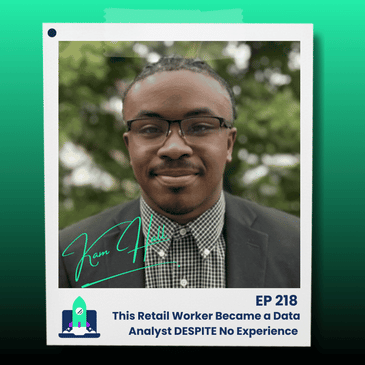
Kam was at Home Depot for five years with a sports management degree and zero data experience. Three months later he landed his first data job.
💌 Join 33k+ aspiring data analysts & get my tips in your inbox weekly 👉 https://datacareerjumpstart.com/newsletter
🆘 Feeling stuck in your data journey? Come to my next free "How to Land Your First Data Job" training 👉 https://datacareerjumpstart.com/training
👩💻 Want to land a data job in less than 90 days? 👉 https://datacareerjumpstart.com/daa
👔 Ace The Interview with Confidence 👉 https://datacareerjumpstart.com/interviewsimulator
⌚ TIMESTAMPS
00:00 – Sports management to data
04:03 – Tutorial hell is real
06:54 – How he found the job
16:54 – Domain knowledge wins
19:18 – Challenge yourself
🔗 CONNECT WITH KAM
🤝 LinkedIn: https://www.linkedin.com/in/kam-hall/
🔗 CONNECT WITH AVERY
🎵 TikTok
💻 Website
Mentioned in this episode:
October Cohort of The Accelerator Starts on October 12th
Land your first data job ASAP with The Accelerator. And for this cohort only, get a discount PLUS our premium job board software PLUS our live AI workshops on how to analyze data Learn more here: https://datacareerjumpstart.com/daa
https://datacareerjumpstart.com/daa
Live "How to Become a Data Analyst" Webinar
Come learn the EXACT roadmap to landing your first data job: https://web.datacareerjumpstart.com/webinar
I've been at Home Depot for about five years. I had been stuck in tutorial hell for, like, like, months on end, so... And I just, yeah, like, applied to a lot of people, like, probably 15 different people a day. Come September, you actually had a job offer. You're top 1% if you know Python. But, like, your domain knowledge matters so much more than your technical skills. And for you, has it been worth it, do you feel like, this, this whole transition? Yeah, 100%. This is Cam, and a year ago, he was bouncing around a Home Depot, five years deep, a sports management degree, and absolutely zero data experience. And he was stuck in what he calls tutorial hell, months of online courses, just going in circles, making no real, true progress. And then he joined my boot camp, the Data Analytics Accelerator, in June, and by September, he had a data job offer. No fancy CS degree, no years of experience, and in one of the toughest markets we's ever seen. And he still did it in about three months. In this conversation, he breaks down exactly how he found the job, the one outreach move that he did that no one else does that got him in the door, and the thing that surprised him the most about actually landing a data role, and it has nothing to do with how technical he was. Let's go ahead and get into it. All right, Cam, you are now an inventory analyst at Incon, but you didn't start that way. You had some other jobs before you became a data analyst. Tell us a little bit about what you were doing before you joined my boot camp, before you became a data analyst. What were you kind of doing for work? So, um, yeah, I was at Home... I'd been at Home Depot for about five years. I was just jumping around the store. I was in freight. I was in customer service. Basically anywhere they needed me or I wanted to be. And then, 2024, I joined grad school, uh, for master's IT after graduating from Kennesaw with a sports management degree. And, uh, yeah, I mean, that was really the gist of it. I just, once I graduated from sports management, it just didn't feel like a, the right fit for me. I, I don't think I challenged myself enough in undergrad. The stuff I ended up applying for anyway was, like, similar to being in an office or being in IT, so I just kind of pushed myself to the limits and just got a degree in something completely outside of my realm and just considered it to be a huge learning curve, so. But the whole time, yeah, I was at Home Depot working. Okay, that's amazing. So you graduate college with a sports management degree, and, uh, that was kind of your background. You did- you play a little, uh, collegiate football in college. You were kind of in the sports world. You graduate, and you're like, "Ah, what type of job do I want?" Maybe not one of these sports jobs, so you're like, "Ah, I wanna go into IT." You enroll in a master's program in January of that year. You know, obviously you're at Home Depot at the time. And for those who are not familiar with Home Depot, it's kind of like a home goods, like, a hardware, a get-your-stuff-done store. How was that? Like, did you like working there? Did you like the job you were doing? Did you want to leave? Obviously, you wanted to leave a little bit 'cause you were, you know, pursuing these, these degrees. I think it was more of just being- I don't know. I did wanna leave, but I just wanted to do something... I, you know, I pictured my life a certain way as far as just consistency and living a certain way and, and working in a certain consistency as well. Tech and the people around me have allowed that, being in data especially. So yeah, I would say I did wanna leave, but I think it was less of leaving and just wanting something new. 'Cause Home Depot has been good to- I, definitely, I, I can't complain about that. But yeah, I definitely did want to, uh, be where I am now It makes sense because, you know, yeah, once again, like nothing wrong with Home Depot at all, but obviously it's a very different... It's not a desk job. You're, you're up- Yeah you're working, you're working with, uh, customers versus- Right like as a data analyst, you're working with graphs and- Yep visualizations and, uh, stuff like that, so very different lifestyle. Okay, so you- you're working at Home Depot. You enroll in this master's program in, in January, and then come June or July you end up enrolling in the Data Analytics Accelerator, my boot camp. I'm curious like why you made that decision, 'cause a lot of people will tell me, you know, like, "I'm already in a master's program, like I don- I don't need your boot camp." So I'm curious why you thought maybe the boot camp was a good decision for you. So, you know, growing up playing sports all the time, like, you know, things can get really competitive just as far as a mindset. And the coolest thing about Data Career Jumpstart was, like for me, it definitely seemed like a, like it is what you make it situation, what you were, you know, providing for all of us and what you're selling us. And I never thought that like a master's degree was bigger than anything else. I think you can learn in any capacity. And for where I was at the time, like I had been stuck in tutorial hell for like, like months on end. So I definitely felt like Data Career Jumpstart was something that was gonna allow me to just... For the way my brain worked, like it was just gonna allow me to move, like move the right way. I didn't have to know everything all at once. I didn't have to, you know, know the whole world and, and memorize every formula, every function, every concept right then and there. You know, you kind of preached that to us a lot, and I think that was like the big thing for me that sold it. Like I kind- I remember like watching the, um, like the prelude before even like enrolling. I was sitting there like contemplating like if I even wanted to do it, if it was gonna be the right investment, and it definitely was looking back. But yeah, Data Career Jumpstart to me was just, it really worked for how I am as a person in my brain. Like, I'm somebody who kind of needs good structure and, um, I don't... Now I think it's a lot different. Like, I don't mind being off the rails or trying to figure out something out of nothing. But at the time, like structure for me was huge, and that's what Data Career Jumpstart was. So yeah, that's a good point. So in the tutorial hell, you were doing, you were trying to learn a bunch of things- Yeah uh, online. Like how long were you doing that for, and where were you kind of learning those things, or, or what were you doing? It was mainly Udemy. I was just... I didn't even know what type of role I wanted to pursue yet. So at first I started with like DBA stuff, so I just tried to learn SQL in general, and then it applied to like some like different little projects of like setting up a database and setting up users and roles and granting access and permissions. And then I kind of slowly went to analytics, but it seemed harder at first because a lot of people on social media were pushing, you know, "You're top 1% if you know Python. You're top 1% if you know Python and Power BI. You're top 1% if you know, if your stack only grows to the highest it can." But Data Career Jumpstart, you know, obviously wasn't that. Like it's kind of more of just kind of like I said in that post, like first get going, then get good. Step by step, baby steps. Yeah, like I was definitely trying all type of different little stuff though, mainly around SQL at the beginning, 'cause that's the only thing my brain can understand. That's part of the problem these days, is there's like, there's so much, so many resources out there- Yeah that it's like when you kind of choose your own adventure, uh, you could end up basically just going in circles over and over and over again, not really making any progress- Yeah 'cause it's like so many options. And then it's like, "Oh, no," like- Someone just gives you like, "Hey, do this and then this and then this and then this and then this and then this and then this." And that's, that's like, oh, and then you look back, oh, I made progress. I made more progress, you know, over these last 12 weeks, which is one of the things I wanna mention because I actually found a roadmap that we, that I made for you when you joined the program. And on that roadmap, uh, one of the things, you know, kind of the... I kind of gave you some milestones, which was basically, you know, you'd study. We talked together and we were like, "Okay, you can study from 11:00 to 3:00 every day, so you're gonna try to study every day from 11:00 to 3:00." Mm-hmm. And basically, the program will take you about 10 weeks if that's the case. And, you know, you started mid-June, early June, and then you'd be done by, you know, mid-August. And then, you know- Yeah come September, you actually had a job offer. So it's like you made some serious progress in, in those 12 weeks to go from feeling like you were stuck in tutorial hell to actually landing a job offer. I wanna talk about, you know, how you found that job because it's a tough market. It's been a tough market for a while now. So how did you find your first data job amongst the sea of, you know, thousands of data jobs? My initial approach, regardless of the role, was going to be if it felt right for me, then apply and make sure I reached out to someone, regardless of the title or the company or whatever. Just because, I don't know, I feel like it's good to be personable regardless of what the title is. You never know what you're actually a fit for. But considering I was in the master's program, like we kind of talked about, I just kind of tried to get an internship. Like, this was still a jump into a new realm for me, so I, I didn't feel like it was necessary to just close off certain options. I just kind of used LinkedIn, used Glassdoor to my advantage, and applied for anything I felt like was gonna be good for me as far as base level experience. And I just reached out to every recruiter that was around the department of the, you know, like what I reached out for, like that... Like if they were the HR for that team or whatever, I just made sure I reached out to them whenever I applied. Like, if it wasn't that same day, the next day. And I just, yeah, like applied to a lot of people, like probably 15 different people a day, but that's it. Wow. Or companies a day, yeah. And, you know, I think the turnover wasn't really that long. It was probably like six weeks- Yeah from the time of me finishing the boot camp or something. Not, or where I was like at the halfway point, like module six. Yeah, basically from when you joined, which in June, you started in September, so Right um, pretty, you know, June, July, September, so we're talking, you know, three, three, four months, two, three months. So that's absolutely amazing. So you're applying for, for like 15 jobs a day. You're focused probably a little bit more on internships than most people because you still are a master's student. Yeah. We should say that you are a part-time master's student because you're working full-time. You know, you're working 40 hours a week. You're doing your master's program, you know, o- on the side. You're doing my program on the side, so you're a busy guy. You're applying to these jobs, and one thing that you mentioned that I think you're making it sound like it was no duh, second nature to you, is reaching out to these recruiters for these jobs, and I think most people don't do that. So tell me about what the process of like reaching out to these recruiters was. Why were you doing that and what would you say? Yeah so I mean, just applying, I mean, everybody does that, you know? Like that's... It doesn't matter what your resume looks like, that's only like so much. Like there's a lot of people just applying who may be a better fit than you, and they still might get passed up, or you may be a better fit than them and they get, you know, a chance. I just feel like it was really important to be, to reach out and just, you know, get your face and name in someone's eyes. Not that necessarily you get a better chance because, you know, that might not even be... It might just be a ghost job or... But it's just the fact of building connection and learning how to talk to people, which was huge for me. That was a big part of the process. Just applying felt like, like going through the drive-through and like, you know, somebody just hands you your food. Like that's it. There's nothing really after that. Not that something needs to be said, but in this case, I mean, you never know what pops back up. It's more likely that they'll point you in the right direction. For example, with Income, like the person I reached out to was not the person I actually needed to talk to, but he pointed me in the right direction. So I think stuff like that is very important. You- Just applying is like, in my opinion, it's very like just- Base level. Yeah, that's, that's... You can't really just do that No, unfortunately in today's market you can't. It's a, it's a low bar to clear, and especially now with AI, it's like people can just auto apply to so many things, and these jobs are just getting flooded. These ATS, ATS systems, that's kind of a, an oxymoron 'cause it's applicant tracking system. These applicant tracking systems are getting flooded with candidates, and, uh, it's really hard to stand out if you're just, you know, relying on your resume or your LinkedIn to actually get you a job. So doing something proactive like reaching out to a recruiter makes a lot of sense, so that's really cool that you did that. And so for this, you find this incon- income job, this company that ends up hiring you. You apply for it, and did you message someone? You said you messaged someone. You messaged the wrong person for this particular job? It wasn't really the wrong person, it was somebody who was on, uh, the talent acquisition team, but they were like a, they were a higher up. They, like, directed me to the person who was in charge of the intern program, and then it kind of went from there. Uh, I talked to the intern program person, her name is Jaylana, a couple days later actually, like that same... Or no, it was a Friday that I reached out. SJ is the person who responded to me. He responded a couple minutes later, like 20 minutes later, and then like that next Tuesday I had like a prelude interview, just kinda get to know me, and then I met with the actual manager of the team I was interning for like later that week. So the process itself was pretty fast for what they were trying to do and what I was trying to do, so yeah, it was probably like a week Very cool. I like that you reached out to someone. And, uh, one of the strategies we actually talk about in the boot camp when we talk about the cold messaging and how to send cold messages and who to send cold messages to, it's almost a good thing sometimes. You have to get lucky, but it's almost a good thing when you message- Right the wrong person and you ask, "Who's the right person?" 'Cause then you can message the right person and be like, "Hey, this person told me to talk to you." And then you're not only just like, it's not exactly a cold message, it's kind of a little bit warmer where you, like, have a name to say- Yeah. It's great that they know, you know? Yeah. Right. So that's cool that it worked out that way. What was the interview process like? Was it difficult? Was there lots of interviews? Did they ask you really hard questions, or was it kind of a little bit easier than you maybe expected? I wouldn't say it was easy. I think it wasn't technical, though. It was really, really, like, a big personality thing, for the internship especially. They definitely knew where I was at skill-wise. You know, luckily, the cool part was, like, having my portfolio. I think that at least allowed me to show something, considering the interview wasn't super technical. But it was very, very personable. Like, my manager at the time, her name is Lisa, she's on another team now, she was very, very, like, adamant about getting to know who I was and the way I was answering stuff. That was kind of the, the whole interview process. It, it was... So yeah, it was pretty, like, what would that be called? Soft s- I forget. Yeah. Soft skills or- Yeah. So- behavioral interview. Yeah. Correct. Yeah. So that was the case there. It wasn't really technical considering it was a internship. And then the, for the job I'm in now, considering I was, like, already in the company and I was just moving to another team, it was, it was kind of the same way. Yeah. The manager even I have now, he's great, and he's like, he was really big on the same thing. I think I just got really fortunate there. But yeah, it was, it was behavioral interviews for both of them. I think a lot of people listening would be surprised at how often that's the case when you're landing your first data job. Yeah. A lot of them, I would say over 50%, aren't really that technical at all. Yeah. And it's more behavioral, especially if you have a portfolio. Because really- Mm when, when someone's doing a technical interview, they're trying to figure out how skilled you are, you know? Right. Can you actually take a data set and find meaningful insights, you know, from that data set? Right. And when you give them a portfolio, you kind of already answered that question for them. Yeah. So it's like, ah, we, we, we know Cam can actually, you know, use Tableau or do some sort of a SQL query. We're not as worried about that. We're more worried, is he going to be a good learner? Is he gonna be a good fit for our team? So I think it makes sense that you had a lot of the, the behavioral interviews. And then that is something that we should mention. So you, you landed this role. It was a business intelligence analyst internship with Income Payments. You were there for, like, eight months or something like that. Is that right? Yeah. Okay So yeah. And then just recently you got the full-time job, because you're finishing up school, as an inventory analyst. Now, tell me the difference between these roles 'cause inventory analyst, some people might look at that and be like, "I mean, it has the word analyst in it, but it doesn't have the word business intelligence. It doesn't have the word data." So I'm curious, like what did you do broadly speaking as a BI analyst, and what are you doing kind of now as an inventory analyst? So the BI analyst role was very heavy in reporting. We mainly used ServiceNow, which was so interesting to me. Did not expect to be using ServiceNow and tickets and management, IT process management, but it was mainly through reporting. Like, we just made sure reporting daily was good for other parts of the company. We used SQL to kind of like set up... We have tables for what is now a new report. Like, basically all the tables were set up for different reports in SQL, and we just kind of maintained them as far as what was getting sent out daily to different teams. That was the gist of that whole role. But inventory supply chain now, like this inventory analyst role, w- is more of supply chain. My bad, I kind of misspoke. But yeah, now it's mainly a lot of auto replenishment. So we keep up with everything that's like on hand, on order, in transit for different like stores and the products at the stores. So we work with account managers across a bunch of different teams. We have a bunch of different merchants that I work with that I share with my teammates as well, and it's, yeah, we just keep up with the inventory of everything. It's mainly just the upkeep of auto replenishment. So I know where, you know, everything's being tracked as far as sales and shipments going out for products that have like out of stock. Yeah, what you're trying to say, you're doing inventory levels basically. Yeah. Basically, yeah. Okay, sweet. That's actually really cool because when I worked at Exxon, I basically only worked in supply chain essentially. So i- there's lots of analytics to be done in supply chain, keeping track of where stuff is, where it's from, where it's going next, lots of analytics opportunities there. In this new role, like what type of tools are you using? Are you still using a lot of SQL or has it kind of changed? It's changed a lot. It's a lot, it's really heavy Excel, which surprising enough I did not thought... I, I knew way less of Excel than I thought I did from the time now. And we also use a order management system, so it's not super technical. It- I think it will be though in the future. My manager's definitely pushing for that, which I love. But right now it's, it's very, uh, conceptual, and the order management system is like the thing we use like the most. I touch it like daily w- outside of Excel. And then I u- we use SQL for a few things, mostly like data auditing, um, and data checks. Um, but that's really it. That's like my current stack. I think cr- like as we move forward, I just kind of talked about it with my team earlier this week that Power BI and using... Oh, we use AI a lot too obviously, uh, like Copilot. We use Copilot a lot, um, for automation. But yeah, that's kind of really where it is right now, like for me. But it's gonna change in the near future, which I'm excited about. Very cool. Yeah, I think people would be surprised as well how much of like, I don't want to call them internal tools, we'll call them like third-party external vendor tools, niche specific tools that people use for, for analytics. Yeah. A lot of people have gone out there and, you know, created analytics platforms for specific verticals like gift card inventory management or oil barrel- management, and you use a lot of those tools a- as well as, like, some of the basic ones like Excel. So I think that makes a lot of sense that, that you're using those t- those tools. What do you feel like you've learned in your first year of being a data analyst? What are some things that maybe surprised you, didn't necessarily expect? I kind of forgot that, you know, having the concepts down was gonna be super important. When I first came in, it was just, like, everything's gonna be like, "Do it this way. Do it this way, do it this way." Like, you never have to... I never really initially realized I would have to, like, learn on the fly. As far as combining the business with what I do know technically, that was, like, huge. Like, I kind of focused more on that in the past year than trying to, like, learn new skills. Because I feel like a data skill, or not a data skill, but, like, a technical skill is easier to pick up if you know the business. So that's something I'm, like, still actively working on, but that part was, like, huge. Like, the people that I've, and l- that I've encountered, like, so far are very, very, like, in tune with the business. Like, they know it almost better than whatever ad hoc requests or tasks they're being asked to do. That's the point I'm trying to get to. That was what surprised me the most. That's, like, almost more important than like, learning how to use something. It's crazy that's the case, but, like, your domain knowledge matters so much more than your technical skills. Yeah. Um, I've told this story probably 100 times on the podcast now, but when I was at Exxon, I used to enter these hackathon competitions where you'd compete against everyone in the company to analyze a data set. Oh, yeah. They would just crowdsource it. I watch them a lot, so I've heard you talk about this. Well, sorry, sorry for boring you No, no, no. It's funny. Yeah but basically, I, I won one of them- Yes and not because I was the best data scientist at the company, 'cause I definitely was not the best data scientist at the company. I was not the smartest. You know, I didn't have a PhD in computer science. Yeah. I didn't have a PhD in, in mathematics. But I understood the business, 'cause I was a chemical engineer. Uh, so I understood the business pretty well. Um, I had another friend, uh, hire- who's a hiring manager now, and he was hiring recently. He narrowed it down to two candidates, one that had way more, you know, data experience than the other candidate. But the other candidate had the domain background, and he went with the domain candidate. And so it's just like once you get to the industry, your skills are obviously important. You have a baseline of competency to actually do analysis. Yeah. But if you c- like you said, bridging your technical skills with, like, your business understanding, if you can do that, I think that's what really sets you apart. So I'm glad to hear that that's, like, what you've been focusing over the last year. I think that's gonna bring dividends to your career. I think it's gonna bring dividends to your company as well. Because it's like we don't do data analysis for data analysis sake. We're not doing it for funsies. It's, it's- Right to make an impact on, you know, our products, our customers, save lives, whatever the use case is. So that makes, that makes a lot of sense that you've been focusing on that. I think it's gonna really pay off for you well. What advice would you give to maybe someone that was sitting in your shoes, you know, uh, a year ago you hadn't joined the accelerator yet. You were thinking about it. You'd maybe watched a few of the YouTube videos or podcasts or something like that. What would you say to someone that was, like, the younger version of Cam before they joined the boot camp, you know, before they landed their first data job? If there's a young Cam out there listening right now, what advice would you give them? I would just say challenge yourself. If you think about, you know, what you want your life to look like, the type of people you wanna hang around, what you wanna be doing day to day, like, that's, that's the type of stuff I was thinking about. I grew up playing sports, so it was just really a thing about, like, always trying to just get better at something Tech was like the, we're not even tech, but data now I would say was like just the one thing outside of sports that I felt like I could really try to like just get better at. And you know, that comes with being around the right people or trying to be around the right people at least, and having someone push you. I would just say maybe put yourself in a future bubble of what that would look like and just make action to whatever that is. Even if it's not data, if it's finance, hos- nursing, whatever, it's definitely gonna take another level, and it's gonna take you getting outside of your comfort zone. So just picture yourself doing something you've never done before that's really hard, I guess is the best way I would say it. That's really it, like that one sentence. Yeah. 'Cause that's what it's gonna take. I'm feeling, I'm feeling a bit hyped 'cause it's like, you know, go out there, picture what you want your future to look like. For you, like, you know, growing up in the sports world and, um, you know, studying sports management and, you know, playing some college sports- Mm there's not probably a lot of them out there who are like, "Yeah, I wanna get into like data and tech type of a thing." So- Right you had to be like, "Okay, I know my current world and understand what's around me, but I have to think bigger. I wanna be like, okay, this is what I want my life to look like." And then I love what you said. I wish I could, I could remember exactly what you said, but you're like, you have to be around the people that are gonna help you get there. And- Yeah you said something like, "Get a coach, basically, that's gonna get you there." And I hope that your master's degree and the accelerator was kind of that where it's like you have a, a path to follow, you have peers to, to follow it with. You have people to push you, people to hold you a little bit accountable. And ultimately, you reached your goal. You did exactly what you said you were gonna do, and it was hard work. You had to put in the hours, right? But you- Yeah ultimately let it. And for you, has it been worth it, do you feel like, this, this whole transition? Yeah, 100%. There's still a long way to go, obviously. 100%. I loved it. I loved even just, I loved even being stuck in tutorial hell, looking back at it. It was just new, you know? Yeah, it was great. When I first started trying to learn in general, like I remember like being in the library for like hours on end, like falling asleep trying to learn something because it was just new and my body wasn't used to even, even sitting down, you know? Like I gotta move around. I'm fidgety with my hands. I gotta... So I had to get comfortable with that, and once I got comfortable with that part, just like you move on to something else new, you know, you've never seen before. But the whole journey in itself so far has definitely been worth it, 100%. Okay. What's next for you? Like, in terms of, of your career and growing, what are you kind of focused on right now? I say now that I am a little better with the business acumen, I do wanna become more technical. I've already kind of started in the background on outside of work. It's mainly just been getting better at using prompting in general, but now I'm kind of... I finally can say now I understand, like, the basics of Python. I think learning Excel, like, in a actual real-world setting helped with that as far as the logic of it. But overall, now becoming more technical, kind of building my stack is most important to me. Python, Power BI, kind of fill in the gaps where need to. And, uh, I've gotten better about prompting too, though, but basically just getting more technical to kind of supplement now. Yeah, that's really it. I think that's a, that's a great choice. You know, I love the fact that, like, first off, Python is infinitely large to, to learn, so I love... We could all get better at Python, but I also love that, like, you didn't, like, wait to become a Python expert to start applying for jobs, 'cause you don't need it. Everyone, newsflash, you definitely don't need to know Python to land your first data job. So I think that's great, you know, going back and revisiting some of the Python, getting better at that. And I, I agree with you that Python and coding at the end of the day is just getting logic in the right syntax and thinking logically and getting it in the right language, basically. And so any, like, working in Excel for a long time can help you get better at Python. Um, so I think that makes a lot of sense. And then I, I like the last thing that you mentioned of just, like, how do you tie it all in with AI, because AI is definitely here. It is here to stay. I don't think, personally, I don't think it's here to take our jobs, but I think we need to be good at using AI, um- One system, yes to improve our jobs. So I think that career path makes sense for, for you, and I think I'm pretty excited. I think you're gonna go great places 'cause, like you said, you got enough of the technical. I think you're a fantastic communicator. I think you learn a lot about the business quickly. I got big hopes and, uh, I got big visions for you, uh, and comment for the rest of your career, man. So I appreciate you coming on the Data Career Podcast and sharing your story. We'll have a link to your LinkedIn in the show notes down below if you guys wanna reach out to Cam. Is that okay if they reach out, Cam? Yeah, of course. Yeah. Okay. Perfect. We'll have your LinkedIn down there, and thanks so much for coming and sharing your story, man. We really appreciate it.