Help us become the #1 Data Podcast by leaving a rating & review! We are 67 reviews away!
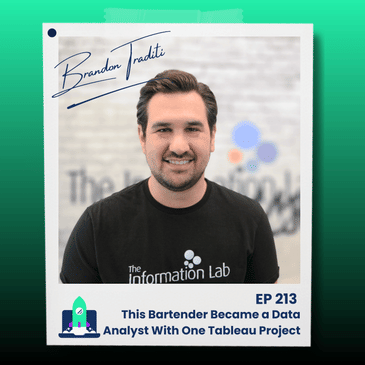
Brandon was bartending when he found this podcast. Two years later he's a data consultant at one of the best Tableau shops in NY.
💌 Join 33k+ aspiring data analysts & get my tips in your inbox weekly 👉 https://datacareerjumpstart.com/newsletter
🆘 Feeling stuck in your data journey? Come to my next free "How to Land Your First Data Job" training 👉 https://datacareerjumpstart.com/training
👩💻 Want to land a data job in less than 90 days? 👉 https://datacareerjumpstart.com/daa
👔 Ace The Interview with Confidence 👉 https://datacareerjumpstart.com/interviewsimulator
⌚ TIMESTAMPS
00:48 – Bartender to data analyst
02:54 – How he found me
11:39 – Networking event
15:33 – 100 hours on one dashboard
21:15 – Get paid to learn
28:45 – You'll never know it all
🔗 CONNECT WITH BRANDON
🤝 LinkedIn: https://linkedin.com/in/brandon-traditi/
🔗 CONNECT WITH AVERY
🎵 TikTok
💻 Website
Mentioned in this episode:
October Cohort of The Accelerator Starts on October 12th
Land your first data job ASAP with The Accelerator. And for this cohort only, get a discount PLUS our premium job board software PLUS our live AI workshops on how to analyze data Learn more here: https://datacareerjumpstart.com/daa
https://datacareerjumpstart.com/daa
Live "How to Become a Data Analyst" Webinar
Come learn the EXACT roadmap to landing your first data job: https://web.datacareerjumpstart.com/webinar
I love Tableau so much, I probably spent close to a hundred plus hours on easily, late nights just going crazy. But I was hooked.
Avery:That's Brandon Traditti, and he was bartending in New Jersey when he stumbled onto this very channel and podcast. Two years later, he's now a data consultant at The Information Lab, one of the most respected Tableau shops in the world. And here's the wild part. He got the job with just one Tableau project. No resume, no cover letter, just a simple dashboard. But before any of this even happened, there was a networking event in New York City he wasn't supposed to be at.
Brandon Traditi:it was sold out. And I was like, no. So I showed up anyways. They were like, I don't see you here,
undefined:Today, Brandon's gonna break down exactly how he did it, the project he built, the networking event he crashed, and the mindset that got him hired. Let's get into it.
Avery:Brandon, you were able to land your first data job being a data consultant a little bit about your transition. What you doing before bartending and up doing bartending?
Brandon Traditi:Yeah, absolutely. Um, well first off, all thanks to but before bartending, studying my master's in cybersecurity. Right after that, I got a job at the New York State Department of Education with them I was a cybersecurity analyst and it, day to day involved just kind of waking up, reading some reports, making some calls, helping people update different types of systems, to a point where I was really looking at it and just trying to think, is this what I wanna do for the With that being said, I made the bold move to kind of just leave that job, leave that industry. It wasn't where my passion was. always had background in the hospitality industry, I decided to just take a jump, go in, go back to bartending, um, and try to figure out what that next move was. Funny enough, bartending and setting up the bar, and if anybody's in the hospitality industry, they'll know this is, you know, it takes about an hour to kind of set up the setup shop. I would always listen to podcasts. one day, lo and Beholds kind of came through and saw Avery Smith Data Career Jumpstart, and I was like, oh, I wonder what this is. I, I put it on and I was hooked. I, at that time. starting, I wanna say in the, the first couple months of bartending, you had about 105 episodes out. And I wanna say I watched through almost 85, it was just every morning I would plug 'em in, I would set up everything on autopilot, and I would just be listening to all these success stories and all these different, how to crack into the data world. And having that background in tech, I was like, you know, I never really knew this was kind of a possibility. And then it opened up the floodgates and I said, you know what? Let's, let's give this. Give this a go. So I joined DAA, I started exploring with different tools that I had never touched before. I had heard of sql. I, you know, knew of R but I never really got in depth with them. And one day sitting down. It was, I think it's one of the first modules in DAA of the Massachusetts school. dashboard and I thought it was the coolest thing And I thought Tableau was awesome, and it, from that moment on just got me So going with that, finishing, this was in about the summer of 2024. So it took me a little bit longer than I think it's scheduled for. It took me about six months to kind of get through the course. Um, and through that time I'm sure we'll touch on was my favorite part of it was the capstone, which was my NFL vetting dashboard, ultimately used as an application for my current role with that. The place that I work now is I'm a data consultant for the information Lab. And the information lab is a little different than a traditional job, in the application process that is. lab is built off of purely in aptitude based application process. There is no resume attached to it, which SP lights there, you know, they don't care. cover letters. It was you submit a Tableau dashboard the team will take a look at it and then they like it, if they think you put a lot of effort into it, you know, you can see things with a different eye view in the data world, they'll bring you in for an interview. that second interview is a little more of the behavioral interview process. So that was where I got to present that NFL dashboard. I got to really show the true colors of what I thought about data and how my mind worked with the things that I was interested in. From there, once you get past that round, it turns into one last round, which is they give you a data set and it's, you have about a week and a half, two weeks to build out another dashboard, Then present to the board at the final interview. And looking back, I remember just being so nervous. I love Tableau so much, and I think that NFL dashboard between your program and that time, I probably spent close to a hundred plus hours on easily, late nights just going crazy. But I was hooked. Uh, and I think that's what they saw in me, and I think they, they saw that intro of. really wants to be here and he, he really loves it. So I ended up getting the job. I have now been there. We just hit our one year anniversary with my cohort, so just over a year now.
Avery:Congratulations. That's absolutely amazing. Uh, incredible that you're able to go through this journey and. so many things right, that I wanna our listeners and watchers can learn from your journey. off, I think to be said about your job, the systems, cybersecurity role where you were like. kind of hate this. I want to be done with this because I've heard that time demanding. burnt out a lot. People get really bored with it wanna do this the rest of my life. I'm curious, like, why didn't you go job to just like this intermediate job and I, I don't know the answer, like one thing I've, people are pitting their careers. trying to get out current job, bootcamp or of videos current job, very demanding, very taxing, do the data stuff on top of it. a lot of people get burnt out doing that 'cause they're already burnt out. That's why they want a new career. curious, kinda like where you were at and you're like, what, I'm just gonna, uh, I mean you weren't taking a gonna go to a job that maybe you requires less demand and stress on your life ultimately have careers. Is that, is that true or kind of just saying that
Brandon Traditi:Yeah, no, that, that's totally true. I think at the time, uh, it was more of, I didn't know what I wanted to do. Uh, after being a cybersecurity analyst, I, I just knew that at least bartending I had flexible time. You know, I, I at least still had my day and I would work at night. that daytime I knew I could at least take that and explore. And there were so many other options. Honestly, I was looking into, Social media marketing, like starting an agency or, I was looking into, at that time blockchain was even blowing up too. I was like, oh, should I be a blockchain developer? And I just, and I think that's how the text side of things started and then that's how I found your podcast. And then once I started learning and the possibilities of a data career, I was a little more inclined of like, this sounds fun. 'cause it brings in the, the logical side, the computer side, the tech side. But it also brings in the creative side Was what I was searching for was that, that creative side of letting that out in data.
Avery:Okay, wanna become a data analyst and you're like, listening to Smith guy. Uh, a lot. took you 105 episodes finally like, pull the trigger and joined the accelerator, I say on the hundred was so important?
Brandon Traditi:I, it's no test to you and, and honestly, anybody who knows me know I do just so much research before I do anything. Like even the Mac that I am talking on right now, it took me over two and a half months of research before I knew this was the exact model, makeup, everything. So I, I wanna say in it, it was just hearing other people's success stories and how, and if anybody's listening to this and they're in that type of stuck feeling. It's not until you hear other people who were in your spot that made it out that you actually get like, oh, I can do that too. Because after a while you're, you're kind of sitting there and you're like, well, maybe this isn't for me, or, you know, nobody that I heard of came from hospitality. But it was hearing teachers, it was hearing, I believe you did have another hospitality worker or construction worker. And I was like, if they can do it, why can't I? And, and I think that was finally the moment where I was like, let's, let's do this thing. And if we're gonna do it, we're gonna commit
Avery:to now we're, we're And you're on the podcast, in, your shoes. let's dive into a little bit more how you did it. So to the podcast. the accelerator. follow the SPN but you learned the building the projects as we go. and I guess, the really Tell me about like what in Tableau.
Brandon Traditi:Yeah, so I think what it was was it was, it's low code, but it's still enough that you can do some really creative things with it. but I think the barrier to entry is, it, it's a free tool online. Anybody can go download it and play with it today. Um, I think. Normalized data for me, and it was one of those things that just looked more familiar to a drag and drop type type feel to it, and being able to just go in and not even know what I'm doing, but be able to create something and just, like I just made a dashboard and I don't even know how half it works, but I did it and then it kind of scratched that itch of. Now I really wanna know how it works, and now I really want to get in depth with every intricacy of Tableau. And that's when things below surface level get really,
Avery:excellent points there is realize can literally download version of Tableau public, and it is really easy. Like the entry is so low, Excel, because most people they're familiar the next thing we touch is Tableau because. It's or R. just drag and I'm glad to hear that. Like you got in there and you're really know what I'm doing, but I'm charts and I'm, oh, I kind play as you go. Visualization is is so important numbers You were hooked there. you do the Tableau two Tableau You do the other projects. me about like your, your job hunting of interviews? Were the projects? How was that going?
Brandon Traditi:Yeah, so taking us back to that process. We'll start I was scrolling through LinkedIn doing. My normal posts and kind of trying to outreach and talk. And I saw an ad from the Information Lab and it was big title, said Meet and Greet, New York City. And I was like, oh, well what's this? And it was, you know, do you wanna become a data analyst? And it, it's one of those things that you look at and you're like, is this too good to be true? And it's say, come meet our team and see what we're all about. On X date. And I was like, and I think it was like a following Thursday and there was a signup. So I, I immediately went to the signup. I'm close enough to New York City and right across the river, uh, and it was sold out. And I was like, no. Like, uh, I want to go, I wanna know what this is all about. So I showed up anyways. Um, thankfully, I, I sent my name. They were like, I don't see you here, but just go on up. It's fine. And I had shown up and there was probably about a hundred people. they, now do this regularly where they basically bring in everybody, you get to see the office, you're in the office, and they put on a presentation of just who the information lab is, how they came to be, they do, kind of the program behind it. Um, so once I saw that, I got out, my girlfriend, I said, Hey, I said, this is where I wanna be. This is what I And I think from that moment, I didn't really look anywhere else, which is. different than most probably DAA students. But I, I was just eyes focused on the information lab. This is where I wanna be, this is what I wanna do, these are the people I wanna work So from that time, I wanna say that was probably around, um, August-ish, because I wanna say I was finishing up your program and then the next application process was that December. So I saw the applications open. I had finished our capstone, and then even after finishing the capstone, I think I put another extra 200, 2 50 hours into it to make sure I can do the best that I can for this application process. But yeah, so I had, which is very not normal, I would say, is just one company. I sat on it, this is where I wanna be, this is what I wanna
Avery:perfect. I think that's way to approach it is like, I'm not gonna spray focus on, you
Brandon Traditi:one company.
Avery:And think that was a good option for one, accelerator has partnership with. information lab, maybe a wrong term, but like I known the Information Lab, Andy of the founders friends. podcast before, recruiters and some of the people who've worked there, I've LinkedIn. So it was good because like you not only. that networking me and knowing, people there, you. I think I have some messages from people. Yeah. Some of the interview to go in there and look. on Tableau, They're one of of the things they do is they hooked on also made sense. one downside to the information lab basically only. Mm-hmm. you don't live in New York for you. So it makes sense. You, you're niched down method there. And you applied the P part, right? Because I love the way the interviews where it's like, all we want is a us your best Pat Tableau project. And that's all we wanna very merit some emails with you, from Capstone also pop up your capstone project on take a look at it. But basically. Is your chance to actually do your first project on your own. So why don't you tell everyone what your project. Was and why you chose it? Yeah, so I did an NFL betting dashboard, and essentially where this all kind of came to be was I, I grew up playing football, loved football my whole life. And, uh, when I moved to New Jersey. They started out the legalization of being able to gamble and, and bet on sports, and I thought it was so interesting and I already loved watching football, and I would put some money here and there on a game, but the one thing I found was I, I would always lose. And I was like, all right, so I mean, I love football. I think I know football, but I'm just losing. So I wanted to see if there were any intricacies or anything that I could find that would give me a slight advantage. And then on top of it, to combine that with Tableau, I was like, this is, this is a home run. This is all I want to do. And it was really one of those projects that you kind of get into and you get lost into. 'cause you just get so in depth of like. Both loves of the NFL and this getting put together, and it truly, this day, still my favorite project I really wanna say it's a good project. And you ended up using this for DAA and then we ended up kind of workshopping it and you did a lot of I gave you a few notes about, and I think the Information Lab even gave you a few to make it the dashboard better. and this ultimately was your, your submission information lab and and then the jobs. one Tableau project. catching your job. I I would say single handedly, but also like you were really brave and networked you couldn't get a ticket to the event and you still a lot of it was credit to you. and, and this you did it, but Um, said you spent like hundreds of hours a ton of time on would bet if this was like. just go back Mm-hmm. spend hours on, on that spend hours no one wants to spend hours of getting paid so what kept you going?
Brandon Traditi:I think the first note I have never opened that workbook again. I'm scared to see what's behind the Um, I was still totally new to Tableau. I was still like trying to learn all the extra things, and I'm sure that a lot of things I did were a little more time consuming than they had to be. with that being said, want to say it was. Trying to be the best that I could and make things work no matter what. I think at one point, like a good example have DZV now, dynamic zone visibility, but back then I didn't know I, it's relatively new. I don't know if they had it when I was developing this project, but there was something called sheet And it was basically the concept of I had a filter and if you clicked a certain thing, I wanted a sheet to move. So it showed something else. I think it was like a time, like if you clicked like all time, it was like a little, another filter that popped up. And I wanna say even that took me like four or five hours just to figure out. But I knew I wanted it on the dashboard and I knew I was gonna do whatever I could. make it happen. And I, I think that's kind of that start line of, I have this in my head, I have this idea, I don't care how much time it takes me. Like I want to get to that end product. And I know that at the end of the day, and even if this didn't work out and I didn't get into the information lab, that it was gonna make me a better analyst and a better Tableau user at the end of the day. So me it was just. Nonstop resiliency of just how do I get what's in my head on this
Avery:a lot of, resiliency, but also like. because um, really liked Tableau, maybe if it I'm gonna give up, you really, like It was fun. Mm-hmm. So many people will choose like such boring projects with think really choosing you're passionate about Pairs well because when you hit those roadblocks hours to figure out, you figure it out and you I think you're really smart on choosing the settings basically to, to. bring a a, really good project.
Brandon Traditi:And I, I think that's a tribute to you too. I think that's one of the things that you stress in the capstone is like, pick something you love at the end of the day. 'cause you can pick anything you want and it's just pick something that you, you know, you wanna work with. And like you said, it ends up being fun at the end of the
Avery:Amazing. present this, dashboard an interview, leads to a second interview, uh, an offer ultimately, um, amazing of you to do now, working, you're data consultant inside of the institutions. Uh, in the world. I had you billboard in YouTube as well. It was an absolute I wanted to talk about your what you're doing. So I wanted to know what tools you're mainly using, at your job, and maybe like, lesson that you've kind of learned, since being on the job that maybe you didn't expect.
Brandon Traditi:Um, so I think to start off it, it might be good for. Me to explain how the information Lab Um, so you don't just come in day one and just become a consultant. the Information lab is a, it's a 28 month contract where the first four months a classroom setting. in a cohort with anywhere from six to eight other people, and you are just learning all different types of tools and learning how to not only become a consultant, but become a subject matter expert in the tools that we specialize So those first four months are relatively intensive. through sql, you go through Tableau, you go through Alteryx, you go through Tableau Prep, and. With that, you go through a little bit of the baseline of like Snowflake, DBT. And then one cool thing with that is that it's not, I guess just studying every day, but eight weeks of it you'll be on what's called a client project. we actually do kind of like a seeing is believing where, you know, we have companies where we're like, Hey, you know, we have this set of students who are, are. Learning and doing their best, you know how to about, we bring them in and see what we can do with some data problems that you have currently and then, you know, go from there so you actually get hands-on experience. We worked with some pretty cool companies when I was, when I was going through training and it gives you that. That hands-on experience of, okay, like I, I can do this. Like I, I see real world data problems and we come together as a cohort and we, we accomplish all these different things in a week span from there.
Avery:Sorry, I'm gonna interrupt. that is a really good point to bring up that the lab kind of starts as like apprenticeship. you're getting paid to learn. And that's one of the things I try to stress in the podcast and in the bootcamp learn for free. pay to learn. That's fine too, but the best get paid to learn. and so you are earning a data analyst salary, during was, eight literally get paid to learn. And I love the Information Lab for doing it that way and doing it kind of this like apprenticeship model. Obviously a a lot of companies don't do it that way, but. Everyone will have the opportunity at work to get paid to learn to know sorry for the interruption. No, keep, going. So you're, you're, you went through this the Information lab is training you keep going.
Brandon Traditi:Yep. Yeah, so I, um, just to touch on that point, it, it's funny you say the word apprentice because as of recent. year or so since I've been there, are actually registered with New York State. It's the second in New York State, first in New York City. it's, it is an actual apprenticeship program. So once I hit my required hours, I will be a journeyman in, uh, data, which is really cool. so it's funny that you say that. So it is technically the end of day an apprenticeship. Um, but yeah, so, so that training is, it's intensive, but it's fun at the same time. You're learning from smartest people that I've ever encountered. some of the people who are in the Hall of Fame for Tableau, you really get a very, very in-depth knowledge of a lot of different tools that we utilize. Once those four months are up, you move into four, six month contracts. being there just over a year now I'm in my second contract, large financial institution and you basically get, get kind of put in. With a, being a subject matter expert in any of the tools that we use. So we have some people who are in all Alteryx placements. like myself, I am mostly Tableau. and you know, we even branched off into, now we lean into the DVT space, snowflake, whatever it might be for me, current tech stack. And that was something, you had asked was it is almost 90% Tableau and 10%, uh, Tableau Prep. So their, their ETL tool, a very solid, I'll actually put down a couple notches for a little bit of SQL now, as of recent, so into the SQL thing, but one of the things that you asked was a tip, and I think this is the best tip that I can give and what I wish I could tell myself two years ago is that you're never gonna know everything. go for it. even with months of training, which equates to whatever it is, 500 plus hours of training, there's still things in Tableau that I am learning on a day-to-day basis and still things that I, you know, can't figure out for some reason and, and have to go and troubleshoot and I think a lot of people who are, were in the po uh, position that I was in have that little bit of a sense of imposter syndrome and it's, you know, I, I, I don't know everything about the tool and it's like you, you never will. And, and I wish I can go back and tell myself that and, just, to keep pushing and, and you are good at what you're doing. Just keep going.
Avery:love, Love, that. Um, will never don't know it all. Um. this is episode What? 216 data career podcast uh, two 13, I think. and, uh, I definitely don't know to, you Hall of Famers and people who in everything. to learn from people and I, it's really cool even after you going through. my bootcamp, you information like a year now? uh, you're you're still I think uh, really takes that to heart. Do enjoy being job?
Brandon Traditi:I love it I, I, I'll never forget it. It's like, and I, I commute into the city anyhow, it's. Every morning when I go in, it's, you know, you see a lot of people who are, who are in, you know, maybe positions that they don't want to, and they, they look a little down. It's every day I walk into that building with a huge smile on my face of just like, this is everything that I always wanted it to be. This is exactly what I envisioned when I said, you know, I wanted to get my dream job. I get to be creative. I get to, to be on the data side of things. I get to be logical and it's. Combined couldn't, I couldn't ask for
Avery:That's And, uh, I that's a testament to a are maybe in a job that they hate right now, that isn't greener on the other side. The grass is greener on the other side. And in in my opinion, everyone's in different if possible, like you're you're gonna live a long you're gonna third of your life. working, if not more, you might as well do something you enjoy. so take the steps necessary today to figure out how to get a situation where you can a smile on your face for that third. That's at least, at least my thought. Um, I'd be curious to hear like any other advice you'd have for aspiring data analyst listening right now. and you, you know, is like thinking about becoming a data analyst or trying to become a data analyst. What would you, what advice would you give them?
Brandon Traditi:Yeah, I think on the non-technical side of things, is a fun place to be in. But you, you have to be curious. Um, I think it all starts there. It's asking. of questions. that's something that we always emphasize is, you know, there, there is no stupid question. You should ask as many questions as possible and understand. you're trying to do with it and where, what route you want to go with it and just be curious the whole time in a technical side of things. I would lean in more if you wanna be a data analyst on to learning a tool. I'm a little biased when it comes to Tableau, uh, but there is Power bi, there is, uh, Sigma. all different types of tools and I think are becoming one of the. Leading front runners in, how to break in. the day, even being the job for a year, you know, I barely touch Excel other than to look at a file. I never do any formulas, anything. Um, very lightly touch sql, but it's nothing that we don't cover in DAA, uh, but 90% of my time is at least, you know, learning the visualization tool, learning some type of ETL tool kinda. The background of data, you know, joins unions, pivoting, things like that, to get started and to, to break into the industry. I think that's the key
Avery:and what advice would you give someone who's considering the accelerator
Brandon Traditi:Do it? Do it. Um, it's a great community. Um, I, I look back and I, I wish I was a little more in it and, and a little more on the boards. I would, I feel a little more, I was behind the scenes and kind of, you know, did it. But it is, at the end of the day, a great community. Um, you are awesome. I wouldn't really be where I am today if I didn't start with DAA. honestly. You know, if I, if I never found your podcast, if I never found your program, I don't know. If this ever happened or where I, I am today. So I would just say, do it. Do it. Have fun with it, do it, and enjoy yourself.
Avery:Well, I'm glad that, uh, that you did it and, uh, I'm excited to have you come and be more vocal as an session, Tableau. now that that than me for sure. That's, that's for Uh, Brandon, sharing your story. Uh, we'll have a link down below and you, it from him. that okay with you, Brandon?
Brandon Traditi:Yeah, absolutely.
Avery:Well, thank you we'll see you in the next episode.
Brandon Traditi:Thank you so much, Avery.