Help us become the #1 Data Podcast by leaving a rating & review! We are 67 reviews away!
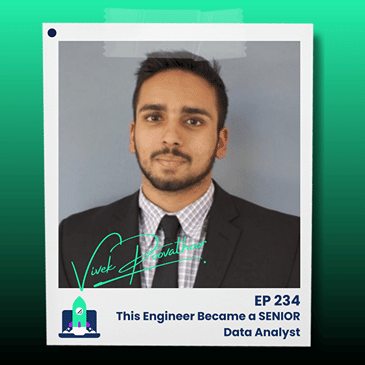
Vivek went from electrical engineer to senior data analyst, and networking is what got him there. Here’s the whole story.
💌 Join 33k+ aspiring data analysts & get my tips in your inbox weekly 👉 https://datacareerjumpstart.com/newsletter
🆘 Feeling stuck in your data journey? Come to my next free "How to Land Your First Data Job" training 👉 https://datacareerjumpstart.com/training
👩💻 Want to land a data job in less than 90 days? 👉 https://datacareerjumpstart.com/daa
👔 Ace The Interview with Confidence 👉 https://datacareerjumpstart.com/interviewsimulator
⌚ TIMESTAMPS
00:00 – He got left on read for a year
02:42 – Why he left engineering
11:15 – Research engineer vs engineering analyst
20:27 – Luck you create yourself
26:21 – Senior analyst, fully remote
31:18 – His advice
🔗 CONNECT WITH VIVEK
🤝 LinkedIn: https://linkedin.com/in/vivekpoovathoor/
🔗 CONNECT WITH AVERY
🎵 TikTok
💻 Website
He ghosted me, left me on read Vivek met a hiring manager at a data meetup and messaged him the next day, but didn't hear anything back. Not for a week, not for a month, and even for a year. "Hey. Hey, Vivek. Are you still open for a job?" That message became a fully remote senior financial analyst job, and Vivek wasn't even a finance guy. He was an electrical engineer. Debugging hardware in the lab, in a lab with no windows. So now he has a new career, new industry, and no pay cut whatsoever. In this episode, you'll learn the one word that he changed on his LinkedIn that flipped his interviews around. But then I changed it to engineering analyst. People go like, "Oh, you have some analytics experience." How a side project for a doctor that he met at a running race, a 5K, got his new boss's attention. "Would you be interested in joining my team?" And why it wasn't just luck. Sometimes you have to create that opportunity for luck to happen. Let's get into it. Vivek, you were able to go from being an electrical engineer to a senior financial analyst, a jump that seems kind of wacky 'cause engineers don't really do finance, and now you're a senior, senior financial analyst in the data world. Um, we wanna learn about everything that you did to make that jump, but first, tell us a little bit about your background. What did you go to school for, and then what did you kind of do for work after school? Sure. Thank you, Avery, for having me. Um, it's awesome to be on this podcast that I listened to so much when I was looking for my data analyst job. My name is, uh, Vivek Puvathur. I went to school for electrical engineering called... It's called Engineering Science at Trinity University, and I got a job doing embedded systems and le- electrical engineering at Southwest Research Institute in San Antonio, Texas. So for the first six years of my career, I was doing, um, C programming, uh, debugging hardware in a lab with no windows, um, with very... doing some data ana- data analytics, but not really working with databases or SQL, and doing Python, but not, not like the new Python, doing, like, old, outdated practices and stuff. And I really wanted to get my hands dirty with data and, um, after some time, I found Avery's boot camp, followed through the modules, and I was able to land my role, which is in healthcare revenue as a senior analyst. Amazing, and so happy for you. Uh, well-deserved. Um, I'm hoping that people who are listening, um, you know, they see that, you know, electrical engineering isn't the same as being a financial analyst. Those are very different roles. However, um, you know, electrical engineering is kind of like a, a STEM degree. It's a more technical degree. So I think there's, you know, some part of our, our watching and listening audience who are more technical and, you know, we talk about teachers who are pivoting or, uh, Uber drivers who are pivoting, or maybe people don't have degrees. But you're someone who has a technical degree. Right. Um, I guess at what point were you like, "Hey, I don't know if electrical engineering's for me. I want to get into data analytics"? What was the breaking point? Um, I think after I completed my first big project at my old job, um, we got the next project, and then I saw the project after that, and it was a bit repetitive work. Um, so I wasn't, it wasn't as... I, I got spoiled with my first project. It was super challenging. There was some creative problem-solving in there, and I worked with some really smart scientists who know their hand, the, like, they know their data like the back of their hand, further hand. Like, and I got to see what analytics can really do in debugging systems. But after that first project, I wasn't really given that opportunity. I was kind of pigeonholed, and I, I really wanted to use my math, stats, and programming skills in a different light and to either build systems that move data or actually analyze data itself and solve more tricky problems. Um, and so that's when I started looking around and how to pivot into data analytics. Okay. So you're like, "You know what? Data analytic- data's really fun. I wanna get more into it." Right. You look into data analytics, and then you find this podcast. Is that kind of what happened? So yeah, before I even bought your bootcamp, uh, I found your YouTube channel. I saw your videos, and then I was sitting on it for, like, six months. It was, uh, longer than I'd like to admit. I, I listened to every episode on that podcast, and then in around, in 2025, I bit the bullet, and I was like, "I need to bet on myself." So I, you know, I found your webpage, signed up, and then I started following the modules. Even then, I wasn't consistent at the beginning, but after, like, two months of, like, trying to do it myself again, I kinda locked in with your bootcamp and followed every step. But yeah, that's how I found your podcast. I mean, that's how I found your bootcamp through this podcast Okay, awesome. Very cool. Um, glad to hear that the YouTube is still finding people that, that want to become data analysts. Um, it's really interesting that you said you listen to every episode. There's a lot of people who say that, and thank you for everyone who's listened to every episode. I hope you guys aren't sick of my voice yet. Um, but you said you sat on it for six months, and I'm, I'm looking at your, I'm looking at your profile right here that I have. Mm-hmm. Um, my secret way to ke- keep tabs on the students. And, um, I think you joined in September-ish of 2024. Mm-hmm. And you landed a job April 2025. So I'm reading, what's that? One, two, three, like, yeah, seven months. So you sat on it for six months, and then from starting to, you know, from starting bootcamp to actually starting your first job was seven months. So it was almost the equal distance of you sitting on the program and actually landing your first data job. Yeah. I just think that's kind of interesting. Yeah. I thought I could, um, multitask. There was other things going on in my life, and I probably, I thought I could multitask way too many things, and I got humbled really quickly. Um, but then I, I just kind of, I saw the wins that the other, my other classmates at the time were getting. And that was like, you know what? If I just lock in and I just kind of do what the bootcamp tells me to do and nothing more, and not try to be extra, I will, I'm, I'm sure I'll get different results on LinkedIn. I was getting interviews- Oh um, but I wasn't passing them. And- Oh and I was following your messaging advice on LinkedIn, and I was getting responses, but not as much as I'd want, right? That was back in '24, '25. Um, so yeah, like once I really kind of cleared out my distractions and my focus, my, you know, everything that was surrounding my calendar, I just locked in on data and finding a data job, then I, I made headway, and I was able to post an update. Interesting. Yeah. Interesting. So what do you feel like, what do you feel like was like the... I'm curious to hear, like, what do you feel like was the light switch from sitting on the fence to joining the program? And then I'm curious to hear what you'd say was like the switch from, you were landing interviews it sounded like, but you weren't really getting offers. Like, what, what changed? What were you doing differently? Mm. I would say to, what switched to landing interviews, I think I spent a more intentional time catering these messages. 'Cause I thought I was doing, like, social media, um, in between my job before, so I thought I had that knowledge already. But I kind of, I didn't. I wasn't catering to the LinkedIn world enough. And I also, like, took time to really rewrite my resume and the, and I used your link that we got for that website, that card.io website. Made a profile page- And I got more traction on LinkedIn. I saw my analytics on LinkedIn go up, and you made us track how many impressions our posts got on LinkedIn. And once I started posting my projects more, completing them and writing about it, people started-- You know, fellow classmates supported, but also strangers on LinkedIn started supporting me and gave me some cred, you know, in the space. So that compounded over time, and then I also coupled that with in-person meetups, which is how I met my current manager. Um, I coupled that with in-person meetups, and I had a portfolio ready to show him, um, when he was ready to see my, um, profile, and everything was already optimized as is. So that's-- It's, it, it's like a lot of little things in the bootcamp compounded, but yeah, that's, I think that's what clicked Uh, I think that, I think that ring- rings true. I think that makes sense. Um, like obviously to get, you know, a, a bachelor's in, in engineering, and then we forgot to mention, I think, I don't know if we mentioned, that you got a master's- Yeah in electrical engineering. Mm-hmm. Like, that's not easy to do. You have to know math. Y- like you said, you already knew how to program. And, you know, sometimes people, people think that the, the accelerator program, it's like we don't go in depth into Python, we don't go in depth into R. We, we, we cover a decent amount of like intermediate SQL, but definitely not advanced SQL. Mm-hmm. So a lot of people think, oh, this is... In fact, I just had a s- uh, a student recently reach out to me and say, "You know, Avery, I think this is too basic for me. I have a computer science degree." And it's like, well, how skilled you are really doesn't affect how quickly you'll land a job. Like what you talked about earlier, the networking you just mentioned, like that really is what ends up making the difference in landing a job and not landing a job. Yeah, I think so. Um, and if you just try to focus on skills, you're gonna miss out on the networking. Mm-hmm. So I wanna hear, I wanna hear more about your, your LinkedIn experience. What was your LinkedIn like before the program, and then what was it like when, you know, you were actually reaching out to the hiring manager who ultimately hired you? Yeah. I think before the program it was... I'm scanning through it right now as we talk. It's, I can scan through my LinkedIn right now pretty easily, and even then, my current experience, I need to optimize that to fit what I did for the other experiences. But it's a lot more like, oh, who's this guy about, I can kind of gauge quickly. Um, I have a better header description. Um, honestly, the profile picture's not a lot of date, could be up- updated but, you know, I know you gave advice on how to do that in the bootcamp. But my LinkedIn is a lot more catered and it gets a lot of more views for people looking for, um, data engineers or data analysts, and I think it's very succinct and it's, I don't know, it's really easy to skim. And then on to- on top of that is my portfolio, which shows like projects I've done in the past. Um, to be fully honest with the audience, it needs to be updated for the past year's work I've been doing, um, because work's been so busy I haven't had a chance to update it. But once I do update it, it's gonna reflect more of a data engineer's, and we'll get into it later, but a data engineer's, uh, portfolio. But yeah, um, I never had that outside of college. Like, no one really spent time to go through that, through that with me, you know? So, yeah. Yeah. Even, I don't know about your experience, but like in my master's program, we actually both got master's from Georgia Tech. I don't think they ever mentioned LinkedIn once. I mean, I, I must have missed it if they did. I don't think they ever mentioned a portfolio once. Um, maybe they did, but it was, it was just like, "Have a go." Um, and even my undergrad, like the career resources were pretty poor, if I'm being honest. So, um, yeah, one thing I noticed about your LinkedIn is, you know, y- if people go look at your LinkedIn, they're gonna see that like your roles at Southwest- uh, research institute read engineering analyst. Um, that's something, that's one of the tricks that we do in, in the bootcamp we talk about, where it's like, "Hey, it's your role. You had these roles." Roles are very flexible, and there's lots of names to describe the same role. Mm-hmm. So previously, that used to be research engineer for you, and research engineer is great. But when you're trying to land data jobs, having something like the word analyst in there is really key. So s- switching to engineering analyst I think is really key. And then, like you said, I think having your, in your featured section, having your portfolio and your projects, um, is, is a really good thing to actually get, you know, optimize. Oh. And in terms of not having everything up to date, I just have to say, that's one of the luxuries you have now. You've landed your first data job and, like, you're, you know, you're enjoying it there. You're, you're working hard there. You're doing good things. It's like, you can relax. But for all the rest of us who are still grinding, that's, that's not a luxury or that's not, that's not something we can do. Bad things happen when we don't keep our LinkedIn and our resume and our, our portfolio up to date. So I just wanna give you a, a little bit of a break there. Gotcha. So you don't have to worry about it. I'll add, I'll add one more thing about the research engineer bit, Avery. So one time, I... When you mentioned it right now, I remember getting a rejection from, um, a hiring manager. Said that, "I think you're too of a technical person for this role," and it was for a data analyst role. But it's because the job said research engineer, and they saw a bunch of, like, engineer-y lingo- And but they didn't really see the fact that I kind of like built data systems and I analyzed data. But because it biased them to research engineer, I think in their head they're like, "He's probably way too technical. We need like a person who can talk to clients and also do data at the same time." But then I change it to engineering analyst, and people be like, "Oh, you have some analytics experience. We see that. Um, do you have experience in these technologies?" Blah, blah, blah. That's what, that's what that conversation became. It's not like it- it's not the only magic bullet, but it's a contributing factor, um, just for the audience. It, it's, it's a key, it's a key point to mention that the title and the bullet points you have there really shape what people think of it. Mm-hmm. And a lot of people don't know, you know, what a research engineer does. I mean, I probably wouldn't. Um, when I worked for Exxon, one of the roles I had at Exxon, uh, was optimization engineer- Mm and that doesn't sound very data-y either, but every day I only touched Excel, SAS, Python, or SQL. That's pretty much it. That's all I ever touched, and I was making, analyzing data and making dashboards and doing lots of regression models and prediction and stuff like that. Um, so like changing it to something like data scientist, that's, that's typically what more people would think of what my bullets were. Mm-hmm. So it is really important to make sure your bullets and your titles are shaped to what you did and kind of what you want to do as well, 'cause, um, there are, you know, parts of all of our jobs where we get to analyze a little bit of data probably. Um, I wanna talk about, you know, what you did after, um, the Southwest Research Institute. Mm-hmm. And this is kind of when you were in the program as well, um, where you kind of did these, um, freelancing and consulting, uh, type jobs. I was wondering if you could t-talk a little bit more about what you did and like how you landed those. Sure, yeah. So the first thing I did was I had my own venture. Um, it was like a product that me and my sister developed, and then we sold online. But the beauty of that is that in order to have any amount of success, and we didn't have a lot, but we had a moderate amount, you'd need to know your numbers, like un- unit economics. So that's a lot of modeling that's involving data, sales revenue from your Shopify store, um, knowing your COGS, cost of goods sold, and modeling that in a way that's easy to maintain. Um, and then I also look at social media analytics. Um, but I wrote some programs to keep our margins up to date whenever we order new material from overseas, and we build new products and sell them. Um, so I got to really learn like the lingo of e-commerce, like gross margin, contribution margin, um, EBITDA, like ROAS, all that stuff. Um, so I built some basic spreadsheets on that, and that's what I did to kind of keep my data brain engaged when I was kind of losing that during my job. Because my job became super monotonous, and it was less analytics, more hardcore engineering, which sounds fun on paper, but the day-to-day work was a lot more tedious than like stimulating. Right? But then after that, like while I was in the boot camp, I reached out to a doctor friend of mine, um, and I asked him, "Hey," um, he started a new venture to help diabetics, um, and cr- like create alternative, like healthy lifestyles for diabetic patients without prescribing medications. So he was trying to capture like how successful his patients were. So I, I, you know, with his permission, he gave me some information on his patients, and I built a dashboard for him. Um, and once I built that for him, that project was pretty much over. Um, and I was expecting to do more, unfortunately, for him, but he was kind of happy with what I gave him, and he ran with that. The good news about that is because I put that on LinkedIn, and I didn't mean to, but it posted to the public as work experience. And then my manager today, he saw that I worked for this company for a little bit of time, and he said, "Hey, you look like you have technical experience, and you worked recently with a healthcare company. Would you be interested in joining my team?" And that's how I landed my current role as a senior financial analyst Okay. We have so many things that we need to talk about here. Yeah. Um, I, I wanna talk about the, the, your own venture first. Yeah. Because one, I mean, you were probably just doing that for the venture sake of it. But for everyone listening, like, there is no reason that all of you can't start your own business. You know, Avery Smith LLC. It doesn't have to even be a formal, you can just be a sole proprietor. Mm. Avery Smith Analytics, and you can hire yourself as a data analyst. Like, there's no reason that all of us can't do... Um, now obviously, if you're gonna put it on your resume and your LinkedIn, someone's gonna ask about it in an interview, and you're gonna wanna be able to have a response of something you've analyzed or be able to showcase something in your portfolio. Mm-hmm. You don't wanna just make it up. But like, for instance, if you're like, "I don't know what I could analyze," your own finances. Like, you are your own, your personal finances, like, you are your own business. Like, you're your own accountant or your own personal data analyst. Like, what if you hired a data analyst to make a budget for you and that data analyst happens to be you? Literally everyone listening to that can do that today, and you all of a sudden have experience on your resume and your LinkedIn. So good job on doing that. That's, um, Samantha Paul, who I've been trying to get onto this, uh, podcast for a long time, but she is just a, a happy working data analyst. Um, she was a stay-at-home mom for, I don't remember how many years, seven or eight years. Mm-hmm. Um, and then when her kids went back to school, she's like, "I want to go back to work." And she had been a teacher previously. Um, but during those, you know, before kids, but then so those seven, eight years, her and her husband had run, uh, an e-commerce company like you mentioned about, and she had looked at the numbers, so she wrote data analyst for like five years on her resume. Yeah. And then she got hired. And so you can kind of create your own experience that way. Yeah. You obviously don't want to ever be like, say you're a data analyst and never analyze data, but that's a really good option. So- I mean, uh- good on you for doing that. If you also do that- Yeah, go ahead. If you also do that too, you're also gonna do your own books at some point, or you should be doing your own books at some point. So in order to properly assess your tax debt or whatever you owe, you need to do the reconciliation stuff. Like, that's, that teaches you a lot. Like, it's more than I, I- Yeah only during the interviews, even though I got rejected, did I really know how much I knew about product finances, and then later it translated into healthcare revenue as well, because I work with accounts receivable. So, like, that, that lin- that lingo translates over pretty easily, especially if you've been in the trenches with your own business, no matter how big or how small. Like, so you shouldn't feel insecure about how big or how small it is. And I used to feel that way until I, it translated into a bigger role Okay. This- That's, that's a great point. I feel like, I think, like, the IRS... Then I'm like, why can't everyone just start a company and, like, write off, like, every purchase they ever make? Like, "Oh, my computer's for my business." I think, I think the IRS doesn't like that, so don't, don't do that. Okay. But in the data world, we don't care. Create your company and, and hire yourself as a data analyst. You don't have to be profitable. You don't have to be big. Yeah. It's good. Um, okay. So I wanna talk a little bit more. So you're kind of doing these, this little freelancing stuff kind of for you, for some other people. You reach out to this, this doctor friend of yours. Mm-hmm. So was that, was that just like... What was that message like? Uh, like, were you just like, "Hey, do you want, have some data for me to analyze or..." Yeah. So I-- He was, um, looking for people. He was asking me like, "Hey, um, I started this new venture. I've had this many cohorts of patients," blah, blah, blah. And I just, I just met him at, like, a 5K, like, random. Like, we, we cross, we crossed paths. And so I was like, "You know, like, if you ever need, if you ever need these..." And he's a very eager, like, an entrepreneur as well, so he's, like, open to new ideas. He's not like your typical doctor. So I kind of lucked out there. He's open to bringing me on. But he was like, "If you can analyze for me, like, how do... I can narrate the story of my patients' success in, like, using numbers, and I can measure how much I lower their A1C levels and blah, blah, blah, and translate to them how their markers, because not a lot of them get it. If you can do that for me and build the dashboard, that would be super awesome." And I was like, "Okay, that problem's already defined for me. Let me just go ahead and do it." So I, I, I didn't know how to start, to be honest with you guys. Like, I never done data freelancing. I was not a data freelancer. I was, like, a good employee at an engineer company. And so I went to one of my college buddies who's, like, a really good data engineer, and I asked him for advice. I was like, "Hey, how do you do this?" And he's like, "Use, you know, use this open source tool, use that open source tool, and, you know, don't spend too much time on the tooling and just get something out there." And then I had, like, few back and forth with-- Um, but his priority, he got-- He's a, he's a doctor, so he's not only doing a business, but he's also seeing patients. So after I got him the initial two deliverables, he kind of ran out of time with me. So that, that didn't pan out to, like, a lucrative client. But the beauty of that is that turned into experience. I worked with, like, Postgres. I learned a new dashboarding tool, and I put that on my Link- you can go see it on my LinkedIn, and, um, that led me to my-- Like I said, it led my hiring manager to find that out about me, and he gave me an interview. So even though it wasn't the most successful client, even the-- it was a good, uh, lead for my interview that I have right-- that I-- for the job I have right now Yeah, I wanna hear, I wanna hear more about that. So you had met this hiring manager before you had posted this project, is that right? Yeah. So, um, just like with anything, sometimes, like, ti- it takes time. So I met him before I joined the boot camp in a data meetup in San Antonio. And I- Okay, nice I, I sent him, I sent him a message the day after I met him. I was like, "Hey, so and so, it was really nice meeting you. You know, I'd love to hear more about what your team is doing." He left me on read. He got super busy. Now that I, now that I work with him, I know how busy he gets, so I'm not, you know, it's nothing personal. Yeah. But like, um, he didn't reach out to me until, like, February of 2025. So like a whole year and two months later And I was already in the data, data job hunt. I was talking to a big company here in San Antonio. I was had-- I had things going. He reached out, and I was like, "Oh, this is aw- like, what are the odds?" And only because I posted on LinkedIn, right? If I hadn't been posting on LinkedIn, he would not have probably given me a shot. But because I posted on LinkedIn and I had my portfolio ready, he saw that I had SQL Python, and he was looking for someone a little more technical, more so than a fi- pure financial analyst. He wanted me to join their team. So that's how that happened. It was... You know, it's, it i- it sounds like luck, but I... And it is luck. It is luck. Because, like, but I'm, but it also, I also got to the platform, and I'd been posting for, like, six months before that, right? So sometimes you have to create, create that opportunity for luck to happen, you know? Yeah, yeah, exactly. I feel like you create your own luck. Like, of course it was lucky, but you have to think about all the effort that you had already put in beforehand. Like, you'd already listened to every episode of "The Data Career Podcast." You had gone to a data meetup in person and been brave enough to, like, network with people there- Mm-hmm and actually talk to people there. And then you took the next step and was brave and sent, you know, a message afterwards, even though you didn't see any fruits from that labor for months la- months later. Um, and you'd already had your portfolio. So, like, if you had not done any one of those steps, it probably wouldn't have happened. So there, it was luck, but there was a lot of effort involved on your end, so that's amazing. When he... So, like, you sent that initial message, and then he just replied to that message months later? Yeah. Yeah, I can f- um- Wow. I, I was going to pull it up while we were talking, but I can, I can just recite from memory. I sent a message that's, was essentially, like, your typical, like, "Hey, great meeting you at the event," yada, yada, yada, right? Like, something to connect later. And then seriously, months later, hon- I think almost a year later, he was like, "Hey, hey Vivek, are you still open for a job?" Like, that's how he responded. Like it, but it's because he saw my, um, experience. The, you know how LinkedIn, when you update your experience or you post a project, it appears on people's timeline? Oh, yeah. He, he saw that. That's why he was referencing that. He saw me up- Oh. He saw the update, the, the, the contract position. He sa- and I completed it from January to February of 2025. Oh. And so he saw that, and he was like, "Hey, I, I see you are at this contract fractional position. Are you still looking for a job?" So that's why he reached out. Yeah. Oh, interesting. So, so yeah, that's like LinkedIn's, like, automated, like, "You changed your experience. Do you want us to tell everyone in the world about it?" Yeah. Um, and it sounds like it was you closing that position. Mm-hmm. Right? Mm-hmm. Oh, that's really interesting. We should make sure all of our... I don't know if you've seen, we've been doing an internship now. We should make sure all of our interns actually close their internship and noti- notify their whole- Good um, their whole community. 'Cause then everyone... They're literally sending a, a notification to everyone in their network that, "Hey, I now have data experience. I'm looking for my next, my next job." Um- Yeah. That's a- All right. Totally do that. Totally do that. Yeah. We're stealing that. Uh, thank you for that nugget. That's perfect. Okay. Um, and then how was the interview process after that? I imagine it was probably a little bit easier because, like, they seemed like they liked you already. Yeah. I was, I was actually surprised. Um, not all my interviews were ea- I failed, like, three or four of them, and I got passed up for one. Like, these are all my failures, guys, before I... Um, this one, because they saw my technical experience, and they need us- They were actually kind of intrigued by my Python experience 'cause from my previous job. Um, they saw that. They asked me some SQL questions, and they were like, "Do you know this? Do you know that?" Okay. And then, "What about healthcare, uh, revenue do you know?" And I did, I did read a few, or prep articles before that to understand what accounts receivable is, why they care about accounts receivable, what that means, et cetera, et cetera. But they were looking for someone more technical, so they didn't get too much in- Mm. Then they asked me... Then it became more about team chemistry. Um, that's what they cared about. Um, how would I solve these problems with a team? How would I take care of onboarding? 'Cause I'm also responsible for teaching people, um, new skillsets as well. So I kind of teach them the basics that Avery covers in the bootcamp, which is, like, Python, Git, all these things, right? And so I teach them that as well, and how do I handle mentoring. Um, I'm trying to remember what else. Um, and then everybody on the team had individual questions for me, but it wasn't anything super technical and out of this world. They just needed to know that I knew SQL, I knew what databases were, I knew how to handle things that go wrong when the data goes bad, right? That's pretty much what my job is, is ETL management. Um, projects that I had on my resume from my previous job. So that was it, I think. That's what I remember. Well, I think I- every interview gets easier when you've already done the networking legs and you already, you've done the portfolio legs. 'Cause it's like they already know you, and they've already seen some of your work, so they kind of already know what to expect. So it's really just doing some, you know, crossing their T's and dotting their I's type of a thing. Let's talk about this role. So this is... Well, and one thing I should actually mention is you said you failed a lot of, uh, interviews, which, which is fine. I think that's, I think that's expected, and I've failed interviews in my, my career, and I think people shouldn't necessarily get depressed when they fail interviews or when they don't get selected in a, in an interview. Mm-hmm. One thing I will say, and just about, like, maybe some of the more technical tests that you had, is you landed a senior role. Like you said, like, you're expected to teach other people. And so the more senior the role you're applying for and interviewing, the harder the technical interview gets. So for those of you who are listening and you're like, "Oh my gosh, this Vivek guy seems really smart, and he failed all these interviews," just know that Vivek was going for senior roles, and the junior roles are a little bit easier in the interview process. Mm-hmm. Um, okay. Let's talk about this, 'cause you kinda got the coveted job Of your senior financial analyst, so senior, and you're fully remote, and this job is not an engineering job, it's a healthcare job. So it's not even in your, in your domain or your, or your industrial experience. Um, so, so I guess tell me like what you're currently doing there right now because senior financial analysts, you know, you mentioned accounts receivable and, you know, looking at financial forecasting and, um, you know, some financial analysts do a lot of like, like accounting type work. Um, but you're also mentioned ETL, which is a data engineering term. Mm-hmm. Um, so tell us a little bit about what your role is and like is it like a normal senior financial, uh, analyst role or is it a little bit different? I would say it's a little bit different. So like it, the title can be a little misleading, and this is what you'll see, guys, when you come across different job applications. Like an a- a financial analyst in one team is not the same across all teams, even though the title is the same. Um, so what I do is I support a lot of accounting. So I do... If I do any e- data analytics, it's to diagnose issues in the accounting systems that we have, the various healthcare revenue systems, and but my main, my main responsibility is making sure, that's why I mentioned ETL, we make sure that our data goes from the various source systems that different hospitals have, down to the databases that the analysts use to crunch numbers for the hospital CFOs every single month, to make sure that that reporting is accurate. Because we're talking about millions and millions of dollars, um, for probably a single hos- hospital, right? So imagine that across various hospitals across the country. Um, so we're making sure that the data is accurate, it's delivered timely, and it's reliable. And so trust is like a big thing that we have to maintain. They can trust the data that they're getting. And so believe it, even though it doesn't sound like analytics, like I'm in SQL a lot. Like I'm looking to diagnose issues in SQL. I'm doing complex joins across different tables that involve patient data to find discrepancies in the accounting. Um, it gets really granular really quickly. And then, um, I got to leverage my Python skills to build out custom ETL to add additional data capabilities to our team so that the accountants can save a lot of time and they don't have to do things by hand as much, right? So it's a technical role. Um, I found that out when I landed it. It's a lot more technical in ETL management, but you combine that with the financial lingo and the know-how when you deal with your co- stakeholders, which are mainly accountants and CFOs. So- Hmm does that make sense? Yeah. Yeah. Super cool. So you, you have the finance domain that you kind of have to know and, and learn about, which, which you didn't know a whole lot other than like your own accounting, I guess, beforehand. So you're learning on the job the domain. Right. And then also a lot of this data engineering or analytics engineering where it's like you're building... You're not only doing analysis, but you're building infrastructure and pipelines to do analysis. Mm-hmm. You know, it's not something we cover in the bootcamp. It's not something that a lot of data analysts do. So you're kind of learning that, you know, on the job as well. So really you're getting paid to learn, and you have a, a cool role that's, you know, half infrastructure, half analytics, half finance kind of all mixed together. So, um, that's gotta be a, a fun problem to get to solve. Yeah. It's, it's a lot of... They, they depend on lot... A small, we're a small team So they depend on a lot, a lot of our capabilities every single day. So we get pinged, messages a lot. We do on-calls, which is, you know, it is what it is. But we, we support, like, a lot of different teams in the hospital systems with our data. So it's very cool. Um, way more engaging than I hoped for. Like, it was... I, I couldn't have asked for, like, a good, better fit because it's not too- Mm it's not too analytic, it's not too businessy, but it's just the right amount of technical complexity for me. So I, I enjoy it. Yeah. That's very cool. Yeah. I wouldn't necessarily think, yeah, based off what you described, that that was a typical senior financial analyst role. Um, but it actually gave me an idea for our job board for findatajob.com. I think I wanna do some K means clustering on all of our jobs, and then you can, like, search for, for jobs- That's good in, like, the space of, like, of, like, a, a principal component. That'd be interesting 'cause, like, you know- That, that role probably could have been called, like, a senior analytics engineer role- Mm-hmm or it could have been called, um, maybe just a regular financial analyst role, or maybe it could have been called a senior technical business analyst. Like, there's, there's so many different names in the data world, and none of them really mean anything. They kind of all mean the same thing. Mm-hmm. Um, that- that's not necessarily 100% true, but, uh, there's a lot of overlap, I guess. Um, okay. And one thing that we did when you landed a job, um, that I wanna bring back soon, was, uh, we were, we were, uh, getting everyone on a billboard, uh- Oh, yeah in Times Square- Yeah to celebrate them landing a job. So we'll, we'll pop that up on the, the YouTube for people, people to watch. Um, but I remember you watched on... I mean, you weren't there in person, but you watched on the computer, I remember. Um, it g- kind of fun. I wish Sa- Okay San Antonio had an equivalent. Yeah, yeah. But, um, yeah, we should bring that back. Okay, sweet. Um, tell me, like, what advice would you give to former Vivek, you know, someone who's sitting there, they're like, "I wanna get into data analytics, but I don't know how," or, "I'm just kind of waiting to see what's gonna happen." What advice would you give aspiring data analysts? Yeah. Um, I remember being at my job, not super, um, fulfilled or engaged or happy. Like, I felt stuck, and I, I would've told myself, like, you know, the longer you kind of... Even though I really enjoyed listening to the podcast, the longer you kind of consume content and stand and kind of twiddle your thumbs, the long- the harder it's gonna be to get that job, right? Because even though there's a lot of content out there that's doom and gloom, even two years ago in 2024 and 2025, like, the, the doom and gloom content was already there, right? Like, the, the narrative, if you remember, Avery, was like, "Data analysts are out of a job now because AI can do analytics." And yet, like, there's a company here in San Antonio, uh, called H-E-B. They... I see-- I, I connected with the VP. Even though I didn't get the job, I still maintain good contacts. They post for an- financial analysts, like, every month. So, like, there's- Yeah there's not, not every company is trying to, like, um, automate away their analytics because they need to trust people, right? So all that being said, like, once you-- The sooner you can get into, like, being on LinkedIn, posting, messaging, couple that with in-person meetups now, um, y- the, the sooner you start getting traction, the easier job hunt will be. And it's always better to start earlier now while you have a job if you, if you don't like it, than it is to, like, quit and then start because then, then the q- then the pressure is on at that point. So I would say start sooner Yeah. That's, that's great advice. It, it is always harder It's really hard. So start really, start sooner rather than later. Reach out to, you know, former, um, uh, like bootcamp alum. Like, I'm always willing to help, and I try to help people that reach out. And, um, you know, just start networking. Like, even if you don't think you need to right away, like still always be networking because, like you heard m- what I said, like you never know from a year from now where that connection will take you, right? So that's the magic of networking. And that's what I really benefited from the bootcamp is the accountability to not only finish a project, but to post it on LinkedIn and get that done. Because if you don't post, it just sits on your computer somewhere. No one cares. No one knows about it, right? So yeah. Yeah. Okay. That's awesome. Okay. Well, great, Vivek. We'll have your, uh, LinkedIn in the show notes down below. People can check out your, your journey. And, um, yeah, uh, if you guys enjoyed this episode, leave Vivek, uh, maybe send him a connection on L- on LinkedIn or leave a comment and say thank you for sharing his knowledge. I know I enjoyed it. Um, I got some good ideas to take back to our bootcamp students- Great and encourage them to do. And, uh, yeah, Vivek, we'd love to have you, um, come talk to the bootcamp sometime and tell, tell a little bit more about your journey. But thank you for sharing, uh, your story and, uh, we're glad to have you on the podcast. Anytime. Thank you, Avery. Appreciate you. Thank you