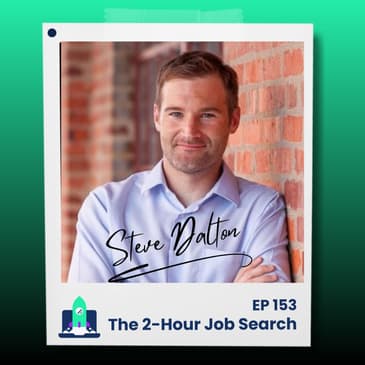
I talk with job search expert Steve Dalton about his radical approach to landing your dream job-- WITHOUT applying online! As the author of 'The Job Closer' and 'The 2-Hour Job Search, Steve advocates for a networking-based strategy and explains the importance of asking for advice rather than referrals.
💌 Join 10k+ aspiring data analysts & get my tips in your inbox weekly 👉 https://www.datacareerjumpstart.com/newsletter
🆘 Feeling stuck in your data journey? Come to my next free "How to Land Your First Data Job" training 👉 https://www.datacareerjumpstart.com/training
👩💻 Want to land a data job in less than 90 days? 👉 https://www.datacareerjumpstart.com/daa
👔 Ace The Interview with Confidence 👉 https://www.datacareerjumpstart.com/interviewsimulator
⌚ TIMESTAMPS - How to Become a Data Analyst w/o Applying 1000 Jobs
00:00 - Introduction
02:18 - Steps to effective job searching
05:06 - The 2-Hour Job Search
10:54 - Asking strangers for advice vs. applying online
18:35 - Earned referrals vs. online referrals
20:24 - PremiumDataJobs.com and DataFairy.io
24:37 - Effective outreach messages
27:18 - The Role of AI in Job Searching
28:16 - The 6-Point Email
34:00 - Ed Bernier's "Three-Hour Rule"
38:57 - Advice for job seekers
🔗 CONNECT WITH STEVE
🤝 LinkedIn: https://www.linkedin.com/in/daltonsteve/
📸 Instagram: https://www.instagram.com/dalton_steve/
🎵 X: https://x.com/dalton_steve
💻 Website: https://2hourjobsearch.com/
🔗 CONNECT WITH AVERY
🎥 YouTube Channel: https://www.youtube.com/@averysmith
🤝 LinkedIn: https://www.linkedin.com/in/averyjsmith/
📸 Instagram: https://instagram.com/datacareerjumpstart
🎵 TikTok: https://www.tiktok.com/@verydata
💻 Website: https://www.datacareerjumpstart.com/
Mentioned in this episode:
Live "How to Become a Data Analyst" Webinar
Come learn the EXACT roadmap to landing your first data job: https://web.datacareerjumpstart.com/webinar
October Cohort of The Accelerator Starts on October 12th
Land your first data job ASAP with The Accelerator. And for this cohort only, get a discount PLUS our premium job board software PLUS our live AI workshops on how to analyze data Learn more here: https://datacareerjumpstart.com/daa
But you have an interview with every company you've ever wanted. And the round one interview is this find somebody in your job of choice at that company and have them recommend you to another person at that company. That's it.
Avery Smith:This is Steve Dalton and Steve is the author of the two hour job search, and he's been helping people find jobs for the last 20 years. And in today's episode, he'll explain his rather radical philosophy on how to land a job. Without even applying online. So if you're sitting here and you're listening and you're like, man, I feel like applying online is pointless. Steve Lokey kind of agrees with you.
Steve Dalton:There is no way to systematically beat online job postings.
Avery Smith:Okay. Okay. But what should you do instead?
Steve Dalton:The data supports networking is a better approach. Networked referrals are 12 times more likely to get a job than an online job applicant. It makes sense to go after the 12x versus the 1x.
Avery Smith:In this episode, Steve and I will teach you exactly. How you can ditch the black hole of applying online and instead network your way into landing your first data job. So let's go ahead and get into this episode. So Steve, you are the author of the two hour job search and the job closer, both of which were published by Penguin Random House. So that's, that's a big deal. You're kind of one of the only people who has like, like a go to thought leader in the industry for, for finding a job. Can you just give us like a big picture of like what your philosophy is? And, you know, what you'd kind of do if you needed to find a job.
Steve Dalton:Absolutely. I think there is no shortage of tips on job searching. What I do is not tips. I do instructions. I was a former chemical engineer, so I like process, but it was really the 08 financial crisis when I realized people were overwhelmed. They were losing their jobs, getting laid off. When you're stressed and concerned about your welfare, you don't have the ability to curate tips into a usable format, but you do have the ability to follow instructions. If you want someone to bake you a cake, you don't hand them a list of ingredients, you hand them a recipe. And I figured that made more sense for job searching than just giving people tips and telling them to figure it out themselves.
Avery Smith:That makes a lot of sense because B, when you're looking for a job, you're usually like very stressed and almost frantic, right? It's, you're not really thinking coherently, and so it makes a lot more sense. Okay, like this is step one, this is step two, this is step three, so on and so forth. So I like that. It makes a lot of sense. Uh, what, what are those steps then?
Steve Dalton:Really, first step above all else is find a set of instructions that you trust and, and stick to it. I mean, that is the key. That is the answer to almost every problem you will face in your life. Like, find somebody who solved it before, ask them how they did it, follow that template. But largely, when it comes specifically to job searching, the first step is basically, before we spend dozens of hours looking, let's spend one hour deciding where to even look in the first place. That involves something called the LAMP list. Let's take the universe of all possible employers, put them into a logical subset, according to our tastes, and then put them into a logical order of attack based on most promising odds to least promising odds. Second step is once we've got our top targets identified, how do we reach out? to people at those organizations most effectively to get them to agree to interact with us in real time so that we might be able to convert them into a mentor. Then step three is what do you say to a person to convert a total stranger into a potential mentor in a 30 minute conversation that really the whole two hour job search process is born out of the realization that there is no data that supports that online job postings are beatable that customizing your resume in any way. Increases your odds of getting an interview. There's literally no data that demonstrates that, which is deeply troubling because people have very strong feelings on how important it is. But there's no expected, like. return on your investment, in my opinion, that's deeply troubling. So if there is no way to systematically beat online job postings, that leaves networking as your best result. The data supports networking as a better approach. Networked referrals are 12 times more likely to get a job than an online job applicant. So it makes sense to go after the 12x versus the 1x.
Avery Smith:I tried to experiment with this. And so I posted a job on LinkedIn. I made it very clear, no one should apply to this job. I said, don't apply to this job. This is just a test. This is only a test, a closed test. I wanted to test with some of my accelerator students to see like which one of them would rank the highest. Well, I got about 550 applications in about 24 hours before LinkedIn shut down my experiment. Um, so first off that goes to show that people, even, even when you see that there's like 500 applicants on a job, like I can guarantee you that 90 percent of those people didn't read the job description because I said literally over and over and over again, do not fuck this job. This is a test. But when I got the results, it was really interesting. It made no sense to me. Like the, the top candidate through the LinkedIn ATS was a terrible candidate. And for the longest time, I was like, I was going to make a YouTube video about this and I still have it. Cause I was like, I can't explain what happened here. Right? Like my accelerator students weren't ranking that high in the LinkedIn algorithm. I was like, what the heck is going on? And then I talked to a recruiter about it and they're like, yeah, the, the LinkedIn ATS is very bad. Like they hate it. So it's like, it's like, how are you even supposed to, anyways, how are you supposed to play a game when like there's no rules and it makes no sense. And anyways, it's, it's terribly hard with, with all this being said, like the title of your book, the two hour job search, is it possible? To land a job in like two hours?
Steve Dalton:I imagine theoretically, but the two hour job search that the two hours in the title does not refer to the amount of time it takes you to find a job. Uh, it refers to the amount of time that it takes to get as far as you can on your own before you simply need the help of others. So put another way, if it were noon and my boss were to tell me, Steve, you're fired. Start looking for a job right now. By 2 p. m. I'd have gotten as far as I possibly could on my own. At that point, I simply need other people to make any further progress. But in that two hours, I can set up a completely strategic and science based job search that maximizes the efficiency of an inherently inefficient subject, which is. Getting other people's help. But, and from that point forward, I can give exact instructions for what to do if then it's a massive flowchart. There's exact instructions for it if you follow the first two hours according to the recipe of the two hour job search. Uh, but a lot of people will, who aren't familiar with the book, will say that you can get a job in two hours or that you have to do two hours of work per day. And it's neither of those things. It's no more than a half an hour of work in most days, and you have weekends off. Uh, it's meant to be very finite, because usually if you're job searching, you have other responsibilities. Maybe a, a, another full time job. Maybe you're taking care of family members. Maybe you're in school full time. Like, you just don't have two hours a day to devote to this. Getting the most bang for your buck. That's really what the two hour job search is about, and the two hours has to do with how long it takes you to get set up to succeed in a, a, a, an advocacy based job search rather than an online posting based one.
Avery Smith:That's so cool, because I feel like most people would look at job searching as like a very solo, uh, and lonely activity, but you're saying, hey, two hours on your own, and then you got to go be social in your job search, essentially.
Steve Dalton:Yeah, it's, it's off your shoulders, like, people will ignore you, it just happens, but in two hours, you can get as far as you could possibly get. So there's, there's some feeling of success there, just knowing, okay, I'm, I'm set up for success. I'm going to have to ride some statistical waves in the future of people who choose not to respond to me and some who do, or some who, uh, pretend to be helpful at first, but then prove themselves not to be helpful. Like, but it only takes you two hours to set yourself up for a much more long game focused and increasingly Successful job search compared to that same amount of time spent online applying to postings ad nauseum.
Avery Smith:I think that is so important because I actually did a poll on LinkedIn and I said, you know, how do you, how do you search for jobs? And 80 percent of people said that, you know, they, they browse job boards and they, they hit apply. And then I did a poll the next day and I said, like, how'd you get your last job? And like 67 percent were either like recruited or, or referred. And so it's like, okay, we're doing like the reverse 80, 20 roll where we're spending 80 percent of our time on something that doesn't even get, you know, that gets literally like what I guess a little bit more 30 percent of the results. But what you're kind of saying is like the whole applying online thing is broken. And like, There's not even really a good chance that's going to lead you anywhere. And you're kind of saying to ignore it, right?
Steve Dalton:I use it very, very judiciously. I did a LinkedIn post myself where I asked readers to assume that online job postings interview rate was 0%. How would that change your search? And then as the conversation and comments kind of built out, I started saying, well, it's pretty close to 0%. So why aren't we doing those things already? Uh, because it's, it's kind of negligible. My deepest concern with online job postings and, and, and advice that guides job seekers to investing in that more effectively or more efficiently or, or with more volume is that you don't learn anything from applying to jobs online. You don't get smarter. You are no better a candidate tomorrow than you are today. If you, even if you spent eight hours applying online today, but when you reach out to smart people in your field of choice and ask them how they got so good at their jobs, you do become a stronger candidate day to day. You develop a better understanding. You become more conversant in topics you find interesting and would like to pursue a career in. So online job postings, there's a time and a place for them. Namely, for your top targets, when someone tells you you need to apply, or for your non top targets that you're not networking with, go ahead and apply when you have downtime. Uh, but that's the big benefit of having a LAMP list. It tells you, here is your benchmark, here are your top six that you should be networking with because they're that important to you. And outside the top six, do whatever you want. It's, it's your spare time. You could apply to job your bottom 34 or you could go see a movie or have a meal with a loved one. Things that will more predictably provide you a positive return on investment.
Avery Smith:Interesting. So I like what you said where you're like, you could apply for jobs online. You're not necessarily learning anything, but if you're reaching out to people, first off, you're meeting people, you're expanding your network. Second off, like you're going to have a conversation with them. You're probably going to learn maybe what they do at their job. You're going to maybe learn how they got their job. And so you can kind of start to get smarter in this process. Um, I can hear people in the YouTube comments already, and you know, they're, they're saying, okay, that's great. But like when I reach out to people, they don't respond. So it's like, that doesn't feel very fruitful.
Steve Dalton:No, uh, no, it doesn't at all, but it's, it's rather unfortunate. We as a society are so used to Equating success to something very close to 100 percent effectiveness. If you take a step back and you look at something like a baseball player, the best baseball players in the world get paid millions of dollars to only fail 70 percent of the time that they go on offense. There aren't any good non sports analogies like that people can really relate to though. Publishing, like academic papers I've heard. Not everybody does that. Uh, I was a chemical engineer, you were as well. Getting a 30 percent was an A on most of our tests back in the day. Uh, so it felt great to get a 30%, but most people don't see a success rate of 20 percent and think that's good. But it is absolutely good when you're reaching out to strangers to ask them for the gift of their time and knowledge. If you're hearing back 20 or 30 percent of the time, that's really good. You will have to kiss a lot of frogs to find your prince or your princess in this process. But the prince or princesses that you find are so dramatically worth the investment. You get smarter. You have more eyes and ears looking out on your behalf. You have people empathizing with you. You have mentors directing you on what to do next. So it's not all on your shoulders alone. There are just so many advantages to that, that approach.
Avery Smith:Uh, do you think that, so I think the term that you use and I'm, I'm like, I'm a data career coach. I'm not really a, a formal career coach. And, uh, I'm, I'm halfway in between like landing a job and teaching data analysis. So I think the, the, the, the term that a lot of people use in your space is like, is it the interview rate or the applicant rate? And that's like the total number applications you send out before you get an interview, right. Or the percentage that you get, is that the right term?
Steve Dalton:I. Can see how that would be a term. Yes.
Avery Smith:Okay.
Steve Dalton:I don't support it. I think that is an outdated metric. I don't think there's any correlation between the number of applications you submit and how successful you are in your job search,
Avery Smith:which is, well, that's exactly what I was going to say is, is like. People, people rather just apply online because they feel like it's more productive. But if you sent, let's say, let's say every time you apply for a job, you cold apply for a job online, you send also one of these like cold messages for an informational interview. Do you think the percentages would be pretty comparable for like the number of times you hear back?
Steve Dalton:No, I think you'll hear back from strangers far more frequently than you'll hear back from online postings. I also did another post on LinkedIn recently that challenged job seekers to imagine if applying each online job application, you. Submitted cost you 1. How would your job search change? And then again, over the course of the comments, people realized, Oh, wait, the cost is more like 20 or 50. If you factor in mental anguish, effort, time, confidence, all the sort of ancillary costs that go along with applying to jobs online. I think what keeps people away from networking with strangers, and I think it's comforting to think nobody will respond because that absolves you from any obligation to try it or to move. deeply invest in it. But I think what holds people back from pursuing it with rigor is that they've never been taught. I think a lot of people feel some embarrassment that they don't know how to do this networking thing. Everybody tells you to go network like it's self evident, but nobody ever actually teaches you how to do it. And that's just cruel. I think that's a failing of higher education to be honest. We It is a unique skill. I think if you ask a stranger on the street, if they're good at networking people, this surprises me, people often say, yeah, I'm good at networking. And I'm like, that doesn't match what my students say in my office. Tell me more. And they'll say, well, never. I'm placed on a new team at work or at school. I get along with my teammates and some of them become friends. And I tell them, okay, that's reactive networking, otherwise known as cooperation. We learn that naturally as we age to survive proactive networking is what I teach. How do you reach out to a stranger who's not expecting to hear from you or have a relationship with you back? That's a total unique skill set. You would never blame an adult who doesn't know how to swim if they've never been trained to swim. Or speak a foreign language if they've never been trained to speak a foreign language. Why are we so quick to blame people who don't know how to proactively network when nobody has been trained for this? The good news is it's a skill you can learn and I have exact instructions for how to do it.
Avery Smith:It's that's very fascinating. Um, remind me, do you still work at Duke or not anymore?
Steve Dalton:Not anymore. After 17 wonderful years, I left in 2022.
Avery Smith:Okay, good. That means I can, I can talk about, uh, colleges a little bit more, uh, freely here. Um, my point here is, yeah, you're a hundred percent right. That if, if we, if we go back and we talk about like, okay, most people are landing their jobs for being recruited or referred and we go to college to get a job. Like, why is that such a, like ancillary? If it even exists in college, right? Like I went to the university of Utah, there is career services there, but like, I don't, I hardly ever went. And maybe when I went, I didn't really find it all that useful. I do think if I went to Duke and I had, you know, you as a career resource, that would be really helpful, but it is, it is silly to me that like, if like networking is what gets you jobs. Why do we ignore it so much in higher education?
Steve Dalton:Considering how many classes we are required to take as core curriculum, I'm still stunned that the ability to pay off our debts and provide for our loved ones is not one of those classes. To me, this is a life skill. I think it's, it's, It's just, it's a moral and ethical failing on the part of higher ed to not ensure students graduate with these, with that skill, knowing how much money they've invested in the institution. I feel like genuine frustration and anger that it doesn't get more attention. I think part of the reason is that when you're a hammer, everything looks like a nail. Most universities are run by tenure track faculty whose job searches are nothing like their students job searches. It's a whole parallel system, but they don't have a lot of understanding for how that process works when there's not perfect infrastructure provided for you. And a fleet of recruiters helping you move from one organization to another. So to me, it's, it's, uh, it's a, it's a crisis of leadership. I do think schools who get this right faster will enjoy an advantage in the marketplace, but we're not where we need to be on this.
Avery Smith:If I was cynical, I would say that, uh, colleges have no true incentive to get you a job as they just want you to go to more school as, as a solution, but, but I don't think that's actually how it is. But Maybe. I don't know. Okay. With, with that, uh, I would like to trade my political science one on one for a networking class taught by Steve Dalton, but I think I'm a little bit too late. Um, okay, let's, let's give them, and I know in your books that you go into like a masterclass of how to actually do these, these reach outs and you know what to say, but in short, like if I have never sent a cold message before in my life, if I've never done like an informational interview, um, if I've never, maybe I've never even talked to a stranger before, like. What do I do?
Steve Dalton:Most important thing you can do first for this process is forget you ever heard the phrase sell yourself. Uh, it is so damaging. It hurts people. It's easy for career coaches to tell you to do it. And it's so counterproductive and outdated. When we sense sales pitches coming our way, our guards go up, but success in the modern job search means bringing strangers guards down systematically over time. Hey stranger, you don't know me, but here's 10 reasons why I'm awesome is not a great way to reach out to someone who didn't ask for that email in the first place. There's a great body of research on this topic. It's called switching from social norms to market norms. Where if you offer, if you ask a stranger to help you move a couch out of a moving van, this is an experiment by Dan O'Reilly that he talks through and, and predictably irrational. You are just as likely to get a stranger's help if you offer 0 than if you offer 50. But if you offer 5, you're far less likely. Then either of the other two scenarios and he calls the switching from social norms to market norms. When you ask for a favor, you are successful a fraction of the time. Uh, as soon as you offer compensation, it's not a good deed plus 5. That's not what motivates someone to do it. The good deed goes out the window and it's purely an hourly wage calculation. The people who help you find jobs are not going to get promoted for helping you. The stock price isn't going to shoot up the day that you start. The reason they're helping you is out of the goodness of their heart. And some people are wired that way. We just need to find those people. It is so much easier to ask a stranger for the gift of their time and knowledge in an outreach email than to sell yourself. So not only is the email easier to write, it's more successful and it attracts the right kind of Collaborator. Uh, so that's really the first step. Forget, sell yourself, forget you ever heard it. I wish that would die a fiery death, but people keep repeating it, but learn to ask for favors and again, it's a learnable skill. You've just never been taught how to do it.
Avery Smith:Very, very interesting. Um, I want to sit here for a, for a second here because I almost want to push back a little bit because there are some. I think many companies have like an employee referral program, right? Where, where if you help place an employee, um, you might make like 500 bucks. I mean, that is somewhat of an incentive, correct? Don't you think?
Steve Dalton:Uh, it is, again, it's another sort of dated type of infrastructure because I think when people are trying to game that system as an employee, you're trying to minimize your investment in a, uh, a job seeker. So job seeker reaches out. The person says, I don't have time to talk, but here, use this link to apply to your job online. Uh, because everybody kind of doesn't understand how powerful referrals are. They think that's a referral, and it is, but the problem is the word referral. The referral includes things like that, where there's no relationship form. Uh, it's, I don't have time to talk. Apply through this link, but I call that an online referral. Online referrals are points of parity. They're easy to get, so you get what you pay for. Contrast those. You have other people who will complain that referrals are, are, they just, uh, they're nepotistic. They help the rich get richer. Uh, and I, I agree it, some referrals are like that. You, your, your dad goes to the same country club as the CEO. That's also called a referral, but a very different kind of referral than just put my name down on your application or apply through this link. I call those birthright referrals. Yeah, there are no skill on your own. Like you just were born to the right family at the right time. So congratulations. Uh, and some people have these, they'd be fools not to use them. But most of us don't have those. So what is our option that I call those earned referrals? Do you have the ability to take a stranger at an organization you'd like to work for and turn them into an advocate? That is a real skill that will be useful in any job at any company. So you're actually demonstrating in the way that you approach that you have valuable skills that the company will will value. But ultimately, like, don't equate online referrals with earned referrals. Earned referrals provide lasting benefit and knowledge. Online referrals provide about what you'd get from not having an online referral, which is basically nothing.
Avery Smith:All right, if you've enjoyed this episode so far and you're like, Yes, networking is the way. I want to be networking to land my first day at a job. Then you're going to absolutely love these two things that I've built from absolute scratch. They pair really well together and this is like basically a cheat code. To actually doing what we've been talking about in this episode. The first one is premium data jobs. com. This is my premium data job board. It costs money. It's not free, but it's going to save you so many hours a week in a month. It's totally worth it. So it's just a normal job board, but the difference is here that every job that you look at here will have a recruiter, a hiring manager. An individual contributor that you can reach out to. So like, for instance, this data analyst job is pretty cool. If you're like a physical therapist, like this would be really relevant to you because it's a data analyst at a physical therapy company. Once again, just kind of looks like a normal job description, right? But when you click apply now, it's going to take you to a LinkedIn post where like the hiring manager, the recruiter, or someone has posted this job. Um, and we tried to do it really quickly. So you can see that this was posted. This was posted three days ago and we, this was posted online three days ago. So we were one of the first people to help you apply to this job. And what the cool part here, here is you can actually open up this person's LinkedIn profile and actually talk to this person, right? We can send a message to them. In this episode, we've talked about who to reach out to and what to say. And so when you're just getting started, what I highly recommend is checking out DataFerry. DataFerry, like, like a little magical nymph, right? Has this really cool tool. I built DataFerry, uh, as well. You can go to the cold message composer down here, and this is actually using AI and R framework in the background. So it's not just chat GPT. It's Chachapiti plus all of our knowledge and all of my frameworks on sending cold messages and select, you know, who you're actually, you know, sending it to. So in this case, a hiring manager, and that's going to ask you some questions. It's going to ask you to put in their, their LinkedIn profile so that we can get to know this person. And it's giving the AI bot a lot of context on who you're messaging and why you're messaging. And the combination of premium data jobs and DataFerry is honestly really deadly in your job search. So you can actually get started for free with both of these. The first one is going to be premium data jobs. com. The second one is going to be data ferry. io. Go check these out and at least get a feel for how you could possibly do this on your own. Let's get back into the episode. I like that what you said earlier that some people are going to be intrinsically motivated and we want to just kind of find those people. Um, I've definitely seen that in, in my students and when I was at Exxon mobile. And, uh, I was posting a lot of LinkedIn. I was growing a ton on LinkedIn at the time. People would reach out all the time. Hey, can you help me get a job at ExxonMobil? And some of those people were from like India. And I was like, sorry, I don't have a whole lot in common with you. I don't even know what it's like. I haven't been to India. I haven't, I haven't gone from India to the U S to work at an American company. Like, I don't really know a whole lot about that. And. For those people, I was one, to be honest, less motivated to help because I couldn't relate as much. But if someone at the time when I was at ExxonMobil, Exxon is really about like career hires. So they're very, they hired to retire. They're like what they say, right? So they're very like, they're in the college game quite a bit. And they don't recruit out of the University of Utah, which is where I went. And because of that, there's only, I was one of three people to, from my school to work at Exxon Mobile. And I was, I was really proud of that. Right. Cause that's like, there's not a whole lot of us there. So if someone from the University of Utah reached out to me, it was like, Hey, how do I work for Exxon Mobile? I was much more intrinsically motivated to help them because I was like, yeah, go you. It's like, I want a fourth person here. Let's, I know the exact journey that I did. That'll be really relatable to you. So like, here's what I did. Let's get on a phone call. Go talk to this person. Go talk to that person. And like, It's the same ask, but to be perfectly frank, I was so much more motivated to help another, another ute. I mean, it didn't have to be, you know, it could have been anything. It could have been someone that goes to the same church as me. It could have been, you know, someone that likes soccer, like whatever. They related to me in some way. All of a sudden I was like, Oh, I see myself in you. And I, I, my experience is kind of what your experience might be. So I have a lot more to offer and I'm also more motivated to help. Does that, does that make sense? Is that kind of what you're saying?
Steve Dalton:Yes and no. Commonality is great when you have it, but a lot of us don't have commonality with people. Like if we're targeting a small organization, they don't, a person can go to the same school. I don't have anything in common with them. What, what then do I just have to resign myself to never being employed again? I would say the better way to write that outreach email is not can you help me get a job at ExxonMobil? It's hey, do you have some time to talk about your experience in data science at ExxonMobil? Your, your insights be greatly appreciated because I'm trying to learn more about Uh, data science in the oil and gas sector. Okay, now I'm not asking you for a job. I'm asking you how you got so smart at your job, which is a much more fun conversation to take up, to take someone up on. I mean, obviously, you'd rather that person have gone to your same school so you can talk about the old times and life on campus, but barring that, I think, and I can't blame the students that were reaching out to you to ask, ask you point blank and, and starting from zero, like, can you help me get a job at your organization despite not knowing me? Because that, that involves risk on your part. That involves you spending social capital on someone that you can't vouch for. Scary. Which is dangerous. So, the better way, I can't fault people for doing that because again, they've never been taught how to do this. And that is on higher ed. That is not on job seekers making a, a perfectly reasonable assumption that I should. Be direct. I should tell people what I want. I should ask for the assistance I'm seeking. Uh, but it's not how you get a stranger to, to lower their guard enough to, to invest 30 minutes in you and see if you're someone they want to advocate for.
Avery Smith:That makes a lot of, a lot of sense. It reminded me, we, we had a, a, another career coach on, Daniel Botero. And one time he told me, um, if you ask for a referral, you get advice. If you ask for advice, you get a referral.
Steve Dalton:I, I had a salesperson give me their variant of this, which is if you ask for time, you get money. If you ask for money, you get time.
Avery Smith:Yeah.
Steve Dalton:Um, so, uh, a, a, a development person actually trying to raise funds for, for universities and stuff. Uh, same thing's true. I, I, it's a weird quirk of American culture. We're known the world around for being very blunt and direct, but we have a couple of weird exceptions to that. Negative feedback. We don't we're not very direct. We like the sandwich. Here's something nice. Here's why we're having the meeting. But here's another nice thing. And we're really indirect about job searching and coming from outside the U. S. I don't know how you're supposed to know that about the U. S. That we have these weird blind spots or exceptions to always being pretty direct, which The more heterogeneous your society is, the more you have to like put things in words because you can't rely on a pause or eye contact to convey meaning. Same way. People just, people need to be taught these things and nobody's teaching it and that really frustrates me. Which is why I wrote, I don't actually love writing, but I hated the idea that only students that were wealthy enough to afford business school and then happened to choose Duke could access this methodology that I developed to help people find jobs. So I wanted to put it in the hands of anyone at the library card.
Avery Smith:Well, we appreciate you doing that. We appreciate both those books and we appreciate you being here, giving us a glimpse into it. When people are starting to write these like messages and cold messages, do you think it's okay for them to utilize things like ChatGPT?
Steve Dalton:I would if ChatGPT were good at it. But ChatGPT is often garbage in, garbage out. People think to use ChatGPT on things it's not great at in the job search, like cover letters. Uh, outreach messages on the problem. There is cover letters. It learns on what's on the Internet. That's how chat GPT improves outreach messages that learns from what's on the Internet. And those messages on the Internet are very market norm based. Like here's all the value that I would bring to your organization. Here's why you should take me seriously as a candidate. So it's really not great at the things that you think it should be good at. It's great at other things in the job search, figuring out what you wanna do with your life, for example. It's surprisingly good at that. It's great at helping you understand what projects you would do if you actually were hired to do a company. It's great for helping you brainstorm companies that you'd like to work for in the first place, but it is not great at writing messages. Uh, so the, I teach something called the six point email. In the two hour job search. It's under. 75 words long. The body of the email is about 46 words long. This is not a long email and it's pretty formulaic. It's it's basically a fill in the blank exercise, but it's been evolved over tens of thousands of iterations of practice and and modification and a B testing. If you will, that is more effective at getting in touch with that target audience who is Intrinsically motivated to be helpful. Chat GPT is not thinking in terms of who is my target audience? Oh, it's people who are intrinsically helpful. What's the best way to get in touch with them? Oh, it's to ask them for the gift of their time and knowledge using social norms rather than market norms. So it doesn't have the whole philosophy of the two hour job search. That's why the two hour job search has a lot of philosophy and science in it to demonstrate here's why this makes sense. Here's the, the research backing this approach as being a more fruitful. line of investigation than sell yourself and spamming lots of people.
Avery Smith:I think that's true for everything you could almost do in ChatGPT is like, it's okay at whatever task you give it, um, but it's probably never going to be a proven framework. And maybe when you combine it with like a proven framework and, and some of the creativity to, to kind of get you started like a warm start, I think that, that can be, that can be powerful. But obviously like the, the most successful cold messages probably are plastered all over the internet. They happened in text messages and emails and LinkedIn messages. So chat GPT won't have access to, to that. What other, what other like tech can you use in your job search? There's. There's a, I don't know if you've seen, um, I just have one of my students in the accelerator ask about it. I can't remember the product name. We don't give them the plug, but like some, some sort of like AI tool that like goes out there and applies to like millions of jobs for you. What, what, what like technology can job seekers use that you think might have some use?
Steve Dalton:Honestly, I think it's, I would put it this way. Online job postings used to work back in the era of monster. com circa 2000. Online job postings were great. And then they started becoming less great as more people found out about them. And then AI came on the scene and companies were using AI to weed out candidates and candidates started using AI to apply to more jobs. So with more applications and more AI weeding you out using rules that you can't understand from the outside, I would argue that the success rate on online job postings has gotten worse over the last few years. There's just more applications out there. So by definition, like, okay, if, so if online job postings continue to get worse, and then we have ghost jobs on top of that, an estimate saying 20 percent of those jobs have no intention of being filled. A lot of those postings have already have someone earmarked for that position. So like if online job postings get worse, the alternatives have to become more attractive in comparison, even if they don't get better. And that's how I feel about networking. Like, yes, you can find bots that will apply to many jobs that you may or may not want. But wouldn't you prefer a job that you want to a job that you don't want? And wouldn't you prefer to be smarter tomorrow than you are today? All, like, mass applying just doesn't pass the smell test. If ever, if it works, everybody would do it. And if everybody did it, it would stop working. So it's not a protectable advantage. What is? Important right now is showing that you have that. It feels like we're going back to the future. Like networking was never this important for our parents because they had some geographical protections. They would look up for jobs in the one ads of the newspaper back when we had newspapers. So networking is more important now than it's ever been before. It's I call it a universal round one. You have an interview with every company you've ever wanted, and they all have this. They've all agreed to standardize the round one interview and the round one interview. There's no time limit and it's already started. So you can start whenever you want. The round one interview is this, find somebody in your job of choice at that company and have them recommend you to another person in that function at that company. That's it. If you do that, you've got a, you've got a first round interview the next time they have an opening. And I think people are just like, Oh, that sounds so hard, but is it? I mean, a, you haven't learned it. So assuming you've learned it. Is reaching out to strangers and asking them how they got so good at their job harder than the soul crushing work of applying to online job postings over and over or constantly trolling to see if there are new postings that have gone up in the last 24 hours because you read somewhere at one time that applying in the first hour makes you a more attractive candidate for some reason, is that really who companies want? Are the person who's living to see that the latest job posting in the last hour? There's, there's lots of problems with it, so. In terms of technology that I recommend, I love AI. I think it has its place in the job search, but you have to be judicious with where you use it. I really like Crunchbase for helping you brainstorm companies. I love Hunter. io for helping you identify email contact information for people at companies. But I really like the technology that I think is most important is. Technology in the knowledge sense. It's learning how to reach out to strangers and ask for the gift of their time and knowledge effectively.
Avery Smith:I read a tweet recently that said in the future, we might pay for AI less experiences. Like we might, we might like pay a premium for like, no, this has no AI. This is just human to human interaction. So I think that that definitely you, you can really stand out if you're able to. To make that human connection. I want to go to, to you talking about like, when you do these cold applications, it's a little bit like, like a black box. Uh, you don't really know a hundred percent why if you ever get an interview, why, and when you get rejected, you certainly don't really know why you get rejected. That's, that's really frustrating because if you're putting hundreds of applications out there and you're spending hundreds of hours, like into the system where the game is unknown, there's no rules to the game, uh, or, or, or maybe there are, but, but you can't know them. That's not really fun. Um, and that kind of leads you to kind of. Kind of your, your resume role, I guess it's, it's Ed's. I can't remember who Ed is, but this is Ed's three hour resume role. You want to explain what that is?
Steve Dalton:Sure. Ed was my supervisor, uh, my last supervisor when I worked at the career center at the business school at Duke. And he had this great phrase that I loved it. He said to whenever we'd have a new cohort of students, he said, assume that your job search will take you 100 hours. I want you spending no more than three of them on your resume. And I just, I love how succinct and how proportional that makes people see the, the role of the resume and in a greater job search. Again, it's free. It is free for every career coach out there to say something like you need to customize your resume for online app, any, every online application. I see that regularly. I, what I don't see is any data that supports that that actually works. So the upside is completely unknown and uncertain, but the downside is certain. That takes you time and effort to customize every resume for every online application, even when you know the online application response rate is pretty close to zero. So to me, that is malpractice. Uh, if there's no proof that it works, but the costs are certain, like, I don't know how you can sleep at night telling people that they should do that. Ed's three hour rule just provides some context. That 97 hours, a lot of people will brag about how long they spent on the resume. The problem is like nobody agrees on what a perfect resume looks like. What we do agree on is what a good enough resume looks like. The 80 percent resume. We kind of agree on that. It's error free that the formatting all lines up. It's easy to read. There's some white space. I understand clearly what the flow of your career was. But once you get to a point where feedback is subjective rather than objective, meaning it's a matter of opinion, not a matter of fact, like that margin is clearly misaligned versus I think you should move up your action verbs here. Like then we're getting to a point where you are exerting effort with no certain upside. And that's not a good value proposition. I just, it breaks my heart when I hear people work with professional resume reviewer, resume coaches, and they get their resume, what they think is perfect. And they think that until they show it to literally anyone else, because everyone's an expert on resumes. And then they feel like, Oh, did I just waste a bunch of money? It's really heartbreaking to hear that. My recommendation is do your best with your resume. Don't spend more than three hours on it. Um, I talk about this in my second book, the job closer. How do you get it done in three hours? There it's pretty easy. Actually, most people, when they stress out about their resumes, they're not They're not stressed about what actually matters. What I mean by that, there was a study by the ladders done a number of years ago that showed that 80 percent of, uh, human resume reviewers attention was on the following items, the companies you worked for your job titles, your dates of employment, and your school attended. What all those things have in common, they are the things that you can't change on your resume. They are objective info. What we stress about is not the objective info, it's the bullet points. And the bullet points in total, we're getting 1. 2 seconds, compared to 4. 8 seconds for all of the objective data. So nobody's reading it. And if they are reading it, they already like you, which means you've done some networking or have a referral of some sort, which is good. Uh, so because there's just no positive return on investment of hours and hours of effort, I recommend doing your best on your resume. I frankly recommend brainstorming your interview stories first and then using those to populate your resume. Chat GPT is great at condensing your interview stories down to bullet points. Um, that's one of its strengths. Uh, so, and that way you don't have to do double work when it's time to prep for interviews, but that's not how most people are taught to do a job search. It's always resume first, uh, cover letter first, then we'll practice interview skills once you start getting interviews. But I think the three hour rule is just a nice way to remind yourself, do your best. What they're, what they care about are the things that you can't change, not the things that you can change. So just do your best on the things you can change, and you'll get better at it over time.
Avery Smith:That's really cool. Um, yeah, really neat that like Cause, cause you're right, if you give your resume to literally any people, like someone's going to nitpick something and say, you should change it. So there obviously is no perfect resume and it's maybe more, maybe at the beginning, there's a lot of science to it. Like you need to try to get it past the ATS. You need it to make sense. You don't want to have misspellings, but like you said, maybe once it hits maybe like that 70, 80 percent mark, it becomes more of an art, uh, than the science.
Steve Dalton:It's attempting diversion, though. It's the devil you know. And I think the same goes for online job postings. There's some comfort in knowing that it's going to ask you to upload your resume and then type in all the stuff that wasn't in your resume anyway. Like, you know that you know the drill. Asking strangers for the gift of their time, you don't know that drill and it's scary, but it's Just a more human and humane way to go about job searching that makes you a stronger candidate over time. But that time has to come from somewhere. So you can't afford to spend 50 hours on a resume, even if it were perfect and everyone agreed it was perfect. You still need people to lay eyes on it. And online job postings don't do that. That gets a computer to lay eyes on it. And you don't know like how flawed the computer algorithm is. A lot of that. Data on early AI computer algorithms from ATS systems show they were racist or sexist or like biased in ways that we couldn't even predict. So like, yeah, don't wear yourself out on your resume. There are bigger fish to fry, but it does involve moving away from the devil, you know, to one you don't know.
Avery Smith:Okay, Steve, well, you've given us a complete masterclass of how we can network as aspiring data analysts. What is your last bit of advice that you'd give to, you know, anyone who's in the job search right now?
Steve Dalton:Gosh, just the best piece of advice I ever got from my favorite boss in strategy consulting was Steve, at some point in your career, you'll be asked to build a rocket ship. You won't know how to build a rocket ship, but step one is always the same. Find someone who's built a rocket ship before and ask them how they did it. If you're a job seeker, don't put this on yourself to figure out. I've done thousands of job searches. You've done one, two, five, maybe even 10, but I'm in a much better position to curate a set of instructions from all of the intellectual capital that's out there than you are. Why should you be expected to do that? Isn't that my job? Isn't that the job of people in my position? So don't blame yourself for not knowing how to do something you've never been trained to do, but do seek out a set of instructions that helps you get it done more effectively and, and humanely. Uh, that, that's the, the single best piece of advice I could give.
Avery Smith:I love it. Steve, thanks so much for joining us. We'll have all of Steve's links in the show notes down below, including both of his books, uh, which are very awesome. If you couldn't already tell by this, this episode, uh, as well as some of his LinkedIn and other resources. Yes. Steve, thanks so much for being with us.
Steve Dalton:My pleasure.