
Help us become the #1 Data Podcast by leaving a rating & review! We are 67 reviews away!
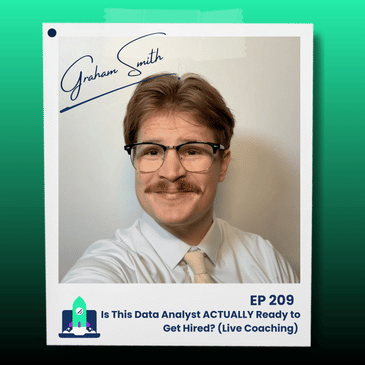
Skills aren't enough to land a data job. Here's what Graham was missing and how we fixed it live.
💌 Join 30k+ aspiring data analysts & get my tips in your inbox weekly 👉 https://datacareerjumpstart.com/newsletter
🆘 Feeling stuck in your data journey? Come to my next free "How to Land Your First Data Job" training 👉 https://datacareerjumpstart.com/training
👩💻 Want to land a data job in less than 90 days? 👉 https://datacareerjumpstart.com/daa
👔 Ace The Interview with Confidence 👉 https://datacareerjumpstart.com/interviewsimulator
⌚ TIMESTAMPS
00:27 – What's the SPN method
01:03 – Resume fixed in real time
20:03 – LinkedIn audit live
25:48 – Portfolio built in real time
27:06 – Your turn to get hired
🔗 CONNECT WITH GRAHAM
🤝 LinkedIn: https://linkedin.com/in/graham-smith-2656931a6/
🔗 CONNECT WITH AVERY
🎵 TikTok
💻 Website
Mentioned in this episode:
📰 Join 18k Other Analysts in My Newsletter
Get 1 weekly newsletter helping you take the next steps in your data career! Check it out: https://datacareerjumpstart.com/subscribe
Build Your Data Portfolio
We will build your data portfolio site for you for $1. All you need to do is go to MyDataFolio.com/build and enter your LinkedIn URL. Wait 30 seconds. And BOOM! You have a portfolio! Try it.
[00:00:00] This episode of the Data Career Podcast is brought to you by my data bootcamp, The Accelerator. Hey future analysts, before I jump into today's episode, I just want to let you know that we are starting a new cohort of The Accelerator on May 12th. This is my immersive data bootcamp designed to help you land your first data job. And I'll be there guiding you every step of the way using my proven SBN method. We'll dive into essential data skills like Excel, SQL, Tableau, Python and R.
[00:00:25] Plus, of course, you'll be building real world projects to showcase in your portfolio to hiring managers and recruiters. And the best part, you'll learn how to expand your network and connect with these very same recruiters and hiring managers along the way. And if you join today, you'll get six free months of my free data AI tools called Data Fairy, as well as a discount. So go check all of that out at datacareerjumpstart.com slash D-A-A. That's datacareerjumpstart.com slash D-A-A.
[00:00:55] Or simply click the link in the show notes down below. Join today to save your spot. Now, back to the podcast. This is one of my students, Graham. And actually, he's my little brother as well. And he's trying to land his first data job. Most people who are trying to land their first data job think it's their skills that's holding them back. But it's rarely their skills. It's usually one of the two out of three other things you need to land a data job following the SBN method. There's the S, the skills.
[00:01:23] But then there's the often forgot about projects, P, and networking, M. If you're missing any one of these three, you're likely to struggle. So let's go ahead and check in with Graham. Graham, how are your data skills? What skills and data tool are you comfortable with? I'm most comfortable with Python, R, Power BI, Excel, general AI stuff like ChatGBT and such like that. Okay, so it doesn't sound like his skills are lacking in any way. I've seen some of those skills, so I know that they're solid. Let's go to the P. Graham, do you have a portfolio? No, not really. Oh my goodness, okay. And are you networking? Barely, but not really.
[00:01:52] I'm gonna take that as a solid no. So over the next, I don't know, few minutes, we're gonna take it through a whole process so you can say yes to all those questions and you can be ready to end the job. You ready? I'm ready, let's do it. All right, let's dive in. All right, Graham, let's start with your resume. And we're starting with your resume because when you're applying for jobs, at least the traditional way of like, you know, applying for jobs online, oftentimes you're only relying on your resume. That's the only thing that they know about you. And when I say they, I'm talking about the hiring team. So either like a hiring manager or recruiter, but even in today's environments,
[00:02:22] usually just a computer, like literally that's all the computer knows. So we're gonna start the resume and take a look. All right, so first thing I'm seeing is, are you going for, I see your name, that's good. I see this junior data scientist here. That's good. That's the type of role you're going for? Yeah, hopefully in that realm. I feel like that's a good label for kind of the area I'm going for. Okay, I think that's fine. I like that you have this here anyways, so you are like keyword stuffing that you are a data scientist. Because we should say that Graham doesn't really have very much data experience necessarily.
[00:02:51] One thing is I would just let them decide that you're junior instead of just telling them that you're junior, right? So I would just be like, get rid of that and just call yourself a data scientist and let them decide what level you're at. Okay, that sounds good. Then you have your location, you have your phone number and your email. I think that's good. Then you have your LinkedIn here, but there is no link. So it's not any good. I think putting on your LinkedIn is good to do, but you want to make it a hyperlink or include the full link so that way people could actually go to your LinkedIn really easily. What happened then? It's a great question. I'm wondering the same thing.
[00:03:20] I feel like I have my LinkedIn link at the ready. So I must've just forgotten or I wasn't sure how to make a hyperlink. I don't know. All right. Well, no problem. Fix that. I think you'd be good. I'm going to scroll through the rest of your resume here. You have like a little summary that we'll read here. Professional experience, education, skills and projects. And I think that looks good to me. We should actually mention that this resume template is taken from my bootcamp. So yeah, I kind of like the template because it's what I recommend and it's one that does well in ATS.
[00:03:48] So from like a one page margins formatting perspective, everything looks well so far. Let's dive into your objective for summary at the top here. Data focused problem solver with a strong background in Excel, Python and data visualization. I've worked in everything from cleaning and sorting large data sets to building sports analytics projects and creating engaging content. I enjoy turning raw information into clear insights and have experience applying my skills to sports, business and creative projects like video editing and content creation. So that's actually one thing I noticed about your resume in general.
[00:04:18] Like you had Premiere Pro listed as a skill and you had kind of like this content creator stuff. I guess what type of role are you actually going for? Because earlier you said data science. That's true. I think a little while ago, I kind of tailored this a little bit to a content creation role just because I think I wasn't seeing the success I wanted to with just applying online to different data analytics positions. And there were a couple open content creator things that I applied for that seemed interesting. Okay.
[00:04:43] I think having like two resumes, one for like more data scientist roles and one for more of the content creator roles is probably good. The, the resume wouldn't change all that much. But personally, I don't think I would like probably include Premiere Pro on a data scientist resume. And I don't think I would necessarily like mention this at the bottom, the creative projects like video editing content creation. You might, but it's like to me, it's kind of saying you're not decided on what you want to be.
[00:05:11] And someone who wants to hire you wants you to be kind of decided. So I think two resumes would be good. I also really recommend that most people try to become data analysts instead of data scientists at the beginning. So I might have even like a third resume, I guess. That would be one that's like specifically for data analysts instead of data scientists. And the things that would kind of change would basically be right here. You would change at the very top, like what role you're going for. And then maybe some of these titles down here, but we'll, we'll go here in a second.
[00:05:36] Because when you're applying for data scientists job, the first thing an ATS or recruiter or hiring manager is going to do with your resume is say, okay, has this person been a data scientist before? What experience in data scientists person have? A computer does that by looking at your resume and looking, does this person say the word data scientist or data science on their resume? You have it here, but you don't have anywhere else. Ah, it's data science right here for a company you worked for. And I guess your degree as well. That's decent, but you might, you know, want to make a third for data analysts. Okay. This I think is fine.
[00:06:02] You have an opportunity to keyword stuff more here, Excel, Python and data visualization. Um, you could also mention like the power BI. I'll just write PBI because this mouse is hard to write stuff with. R as well. You mentioned the more that you, once again, when anyone's looking at a resume for the first time, they're trying to say, can Graham do what we need this role to do? And specifically when a computer is looking at it, they're like, Hey, this role requires someone to know Python. The more times you put Python on your resume, the better.
[00:06:30] Now, obviously you don't want to just put like Python a hundred times and that's going to look weird, but the more you can naturally keyword stuff, the better. So I'd maybe add the rest of your skills here. And then I might, I would definitely try to make it four lines. Like this, you can definitely write it tighter. That it's not going to take up an extra line. Cause you are out of room kind of on your resume data focused problem solver. I might maybe do that. Try to keyword stuff again and call yourself like a business minded data scientist or a business minded data analyst. Whatever your resume says just once again, keyword stuffing.
[00:06:59] And I think it's good that you mentioned that you have some of your experiences in here. I think that's good. Maybe clean it up a little, but I think that's pretty solid. I'd probably take off this part. Like I said, for unless any of these creative projects you have done are really heavy on the analytics, which we'll actually get to later in this episode. So stay tuned. Okay. This I would give, I don't know. I'd give a B plus I'd say for right now. We'll take that. This part up here. I mean, other than the LinkedIn, I'd give it an A minus I think. LinkedIn and the junior day. So you have an A minus and a B plus. Not bad.
[00:07:29] Professional experience. Okay. Here's what I'm thinking about a professional experience. I would, the number one thing you can do with your professional experience is have really relevant titles and then really relevant bullet points. Your title is kind of given to you by the company, but I think you can kind of make up your own title or at least stretch the truth a little bit. So for example, I think for this role down here, junior data analyst internship, I think if it's an internship, everyone knows it's junior. Once again, I would just probably call yourself data analyst and have a B internship. This feels redundant basically. Okay. That makes sense. That makes sense.
[00:07:59] For this part up here at the top, data slash content creator, I would probably come up with a better title. Once again, if you can, whatever title you're going for, the more you have that in your resume, the better. So if you're going for a data scientist role, I would almost just call yourself a data scientist. That might be a stretch for this role. I would say so. Yeah. So instead what I would probably do is I'd probably call yourself, you have to think about this a little bit longer and workshop it, but like some sort of a sports and data analyst.
[00:08:55] That makes sense. But since this is like a data scientist resume, I think cleaning this up would probably be a good thing to do. Another thing I noticed is you combined a lot of the company names into one word. Is this company really just called basketball visionaries? One word. I think so. Well, I know for a fact that this is my company, everyone, Snowden to Science. I can tell you that mine definitely is, is, has, it's three separate words. So spaces here would be good to have. Just double check on all of that. Okay.
[00:09:23] And, and just so you know, if everyone's like, oh, this is Avery's brother. That's why he got to intern at Snowden to Science. True. True. But also I give all of my bootcamp students the opportunity to intern with my company throughout the year. We have different opportunities, different projects. So they have the opportunity to put data analyst intern on their resume. So that way they have experience, even if they have no experience. So it's not just Graham, it's all of our bootcamp students. So I just noticed that. Okay. Let's go look at your bowl or we looked at your titles, event ambassador for Topgolf. That's going to be probably hard to make that look sexier than it is. I don't know.
[00:09:54] You basically want to try to include the word data or the word analyst as much, or scientist, but that's probably going to be pretty hard to do there. We could go from an operations, event operations analyst. You could do event operations analyst, or with a lot of students who are in kind of similar roles in my bootcamp. We sometimes go customer service analyst. You'd have to decide how much of a stretch that is and how you feel about it. But I think if you could maybe add event analyst, event operations analyst, I don't think it's terrible. Okay. So I'll just do event and then we'll put in the word ops right here.
[00:10:22] And we'll replace this with the word analyst. Okay. Next thing I noticed is you're currently still employed there, right? At both these places. It's true. Because they're kind of part-time jobs. Notice you have present tense up here on this experience. You have past tense, but they're both present. So we want to make sure you stay consistent on your tenses. If you're currently working there, it should be present. If it was in the past, you do the past tense. The rest of these tenses all look past tense. So you're good. Also, will you put this in for me? What?
[00:10:51] That year's not correct on this one. It should be... Okay, year's wrong. ...2024. Probably 2024. No one's going to know that though, except for you. But that's fine. We'll make that. Okay, let's see. The dates, by the way, look fine to me. I wouldn't necessarily change anything about the dates. Although I wouldn't actually, I wouldn't do summer. Okay. Because a lot of the ATSs, they're reading your resume. ATS stands for your applicant tracking system. Basically, the computer is reading your resume. They're looking for what date formats you're using. And since you're using different date formats, it's going to trick it. It's not very smart. Yeah.
[00:11:20] And that's counting like how many years of experience you have. And so you're probably short changing yourself. In fact, I would probably do that down here as well. And even if it was for the whole year, I would probably just do January through December 2022. Okay. So I keep all of these consistent. Okay. Premium meeting host. Once again, this is probably a tough title to make sexier. Kind of similar to up here. Customer experience analyst. Customer experience analyst could be good. That's good for the ATS.
[00:11:48] But when you get an interview and they're like, hey, what did you do as a customer service analyst? They might be expecting something a little bit more analysty than, you know, doing hospitality and meeting clients needs. So you just have to think through if that scenario happens, how you're going to respond. But personally, I rather have that issue of having to explain it to a human being in an interview than getting rejected by a computer at the beginning. That makes sense. So yeah, maybe customer service analyst is what I'll put right here. And then social media slash data assistant.
[00:12:17] I would probably do like maybe just data content analyst. Data content analyst. We'll just do DC. And then that way you have the word analyst one, two, three, four, five different times. And that might be a stretch. Maybe we don't even do it that many times. Maybe we leave premium seating hosts. But like regardless, right now you have analyst one. So that's like a five X at least or maybe at most five X of the word analyst, which is going to increase your odds for financial analyst jobs, business analyst jobs, healthcare analyst jobs. Just having the word analyst many times on your resume.
[00:12:46] Okay. So you have way more of a shot. Okay. Let's look at your bullet points. Create, collect, delivered, coordinated, aggregated, identified, delivered, anticipated, edited, and analyzed. Well, that was the first thing I was looking for is as a data analyst, did you analyze things? And it's your last bullet point. I guess create basketball analytics. It says aggregated and analyzed.
[00:13:04] Oh, you are correct. That's okay. That's good. We like to see that right there. Analyzed, analyze. So we see, we like to have the word analyze as much as we can. Analytics. We like that there. Let's see. I like that you have data visualizations. That's important. Keyword stuffing. Once again. Statistical analysis. Good. Okay. This is good. Actually. I like this.
[00:13:22] It integrates statistical media into engaging audience friendly media. That's, that's good. Now, one thing you're missing on a lot of your bullet points is you have strong action verbs. When I'm looking at bullet points, I'm usually looking at strong action verbs. I think your action verbs are fine. The other thing I'm looking for is quantification. And basically when I'm looking for quantification, it's do you have a number in your bullet? And the only number I can see in any of your bullet points is right here over 20 days. Look at, right? Yeah. So with a bullet, you always want to say not only what you did and how you did, but the
[00:13:52] impact it had. So, or just try to quantify how much of the bullet point you did. So for example, let's go to integrate statistical analysis and engaging audience friendly media. How many different medias did you, did you make? Would you say? Or have you made so far? Probably close to a hundred. Okay. Perfect. We'll just do a hundred plus audience friendly media pieces. And like, for example, like you can think in terms of, well, what did that lead to? So that lead to like money for the company leading to like a hundred thousand dollars. Some views. Okay. So views. So maybe we put in our view, our view
[00:14:22] trick here. So for instance, integrated, I would maybe say performed and integrated statistical analysis into 100 pieces of engaging media that generated a hundred thousand plus views, a hundred K plus. So now we have double, double numbers in just that one bullet. You know how big right here you have collect clean and organize large sports data set. You know how large, like we could put like a number of terabytes. We could put a number of rows. Like for example, you know, in sports analytics,
[00:14:49] one thing that's really useful is the actual player movement tracking. And that's like taking like just in basketball, for example, in one, like, I don't even remember, like one millisecond or something. I don't know. Let's just say it happens every second of the game. There's 48 minutes, whatever 48 times 60 is, right? You have the balls location and 10 players location. That's a lot harder to handle. And it's a lot more granulated than just every second. I'm pretty sure. Let's just say it's every 10th of a second. You have a big data set.
[00:15:15] And so if you can say how many rows it is or like how many gigabytes of data, I think that could be interesting. Once again, you can try to say like what the outcome of these things were. So let's try a different one. Let's do this one. Aggregate, analyze, stock market, backtest, and get it used in Python and Excel. Maybe, maybe you do something with money here. Like that would allow, that would allow some sort of money amount. Or maybe you just do mine. Like, cause it's, it's hard to quantify your bullet points and money because oftentimes you're just an individual contributor and you don't know how much money the business is making.
[00:15:43] Like for instance, you happen to know the owner of this company, Snow Data Science. And like, you can come to me and like, we can talk about when you used to edit my videos, like what that did for me or like what TikToks you made, how many views we got off that. Or you can just try to guess. That's the other thing. Cause you can just take an estimated guess. I think quantifying numbers would be good here. More numbers you have. So any questions about like your bullet points, quantification, action verbs, those types of things.
[00:16:07] Should I be more specific or more broad when it comes to like describing my actions? Like for the data analyst one, part of that one was cleaning data from like a stock market, brokerage, or app software, cleaning those with Excel. And then finding different like connections, like different. Can we call them APIs? You, uh, no. Let's pretend they're APIs. Let's pretend they're APIs.
[00:16:31] Yeah. So yeah, I wouldn't like, for instance, if you're applying for like, let's say a data science position at like a algorithmic trading company or something in finance, then maybe you do name drop the software. Okay. Um, I definitely think you should always name drop the tools you're using as often as possible. So for example, up here, like, yeah, you use Python for some of this, right? Yeah, I definitely use Python and definitely NBA's API. And I think basketball references API.
[00:16:57] Okay. I would, I wouldn't say unless if you're applying for like a sports position, then maybe you say NBA and basketball reference API. Otherwise I would probably just say API and Python. Yeah. You definitely want those on your, your resume. The more times you use the skills, the better. I'm telling you. Any other questions on that? I don't think so. One thing I'm thinking is you, we have to be conscious of space. Cause you don't have a ton of room left. We are going to probably take off a lineup here. That'll give you some white space.
[00:17:21] The other thing you might consider doing is I guess this would give you a career gap theoretically, right? 2023. No, right here, 2023. So you might, if you're applying for sports jobs, I think seeing that you've worked with the Utah Jazz and you understand the business is good. If you're applying to non-sports jobs and we can't really convert the title of this to customer service analyst or the bullet points, maybe we remove it because that would give you more white space. And it maybe isn't helping your resume outside of sports industry. Is more white space a plus?
[00:17:49] No, you just might want to add longer. Yeah. It's not like more white space is better. One page full is probably what you want, but you could probably expand or add more bullets to some of these and you might need it. You might not need it. It just really depends.
[00:18:02] You could even just take off one, maybe just one bullet point too. Okay. Any other questions about the experience section? No, we're good. Okay. Education section. Is this your degree title? Not officially. Okay. I like it, but is it statistics? Yeah. It's bachelor statistics? Yeah. I would definitely say like bachelors of statistics and then in parentheses put data science. I don't really like that. There's no like space right here. Okay. And then the other thing is GPA. I'm assuming if you don't put GPA, it's bad GPA. So you make the decision of how you want. Probably leave it off. Okay. Probably leave it off. That's fine.
[00:18:32] For anyone who's listening. I think if your GPA is above a three, you should include it. Okay. Skills and projects, skills, data analysis, Excel, Python R, data visualization, Premiere Pro. We probably would take this one off for the data scientist one. And we probably want to, you don't have Power BI down here. I think everyone should start putting like chat GPT and quad down here. I think that's valuable. And then you have like just more, this is interesting. Is this, are they supposed to be projects or are these just more skills?
[00:18:56] I think they were supposed to be project, but when I was first making it, I ran out of time and I just left it at that and never came back in. But how do you, yeah, I don't know. So in my, so you have skills and projects together. What I recommend my students do is they like say like what the project is. So we're going to get to your projects later on in this episode. But like, for instance, I would say like marketing analysis project in Excel.
[00:19:17] And that's like the bolded part. And then you have like this as like the, what comes after the colon of the project. And then I like to put a link to the, to the project here as well. So they can click on it personally. I think that's what I like. Probably take out the Premiere Pro for like the, for data scientist, data analyst resume for sports. Since most of your projects were in sports, maybe it's fine keeping it. Or if it's like more of a content creator role, then it's fine. Right. I think for like just like a normal data scientist or data analyst job, I'd probably take it off. I have a question about that. Yeah.
[00:19:45] How do links work with resumes? What do you have to download them as? Or do PDFs just? PDFs just have hyperlinks in them. They just work? Yeah. Like if you create this in Microsoft Word or Google Docs and you like double click it and you right click and you say add link and then you export to PDF, this just turns like blue and gets like the underline and people will just click it.
[00:20:03] There is an argument to be made that ATS systems, I've heard this from recruiters, they can't see your actual LinkedIn URL. And some of the ATSs like to see your actual LinkedIn URL. So if you just like post in your normal LinkedIn URL, but I don't actually have data on that. It's kind of just hearsay. So I think doing hyperlinks is fine. Okay. Any other questions about your resume? I don't think so.
[00:20:22] Okay. Just to summarize, I think I'd probably give you on your professional experience. I think this is probably your title specifically and the lack of quantification probably gets you like a B minus down here. And then education I think is fine. I think this is probably an A. My only complaint is say it's a bachelor so that people know. And then if you have your GPA is good at it, if not, no problem. And then skills and projects, I think this is probably a B minus as well because it's kind of confusing.
[00:20:51] Like if it's skills and projects, great, but this kind of just like it's skills or you need to specify what the project is specifically. Okay. Sounds good. You make these changes? Absolutely. I think if you make these changes, you're likely to get more interviews and you're likely to do better in those. Awesome. Excited. All right. Let's move on to your LinkedIn. All right. Moving on to your LinkedIn and next to your resume, once again, your LinkedIn is the only thing that's the first impression for recruiters and hiring managers and these computer algorithmic systems that are going to try to see if you're a match or not. So you want to make sure your LinkedIn is up to snuff.
[00:21:19] So when you're on the LinkedIn page, the first thing that you see is this huge cover banner right here. And most people have a blank. You have my company with like my old company name, my old company logo, which is okay, but I think we could do better. So I make these in Canva and there's lots of Canva templates. We have a bunch in the bootcamp that you can use, but I would change this. I think that'd be good. Next, your profile picture here. It's perfect. It's perfect. Okay. I think we can change it. You look kind of silly a little bit. I mean, I'll turn it to a more professional photo.
[00:21:45] And I think, I think even the bigger thing versus more professional is like there's a kitchen sink in the background. You don't like that? No, I don't think. I think you could use Canva to remove the background and just have it be like a color or like, like a corporate thing. Or you can give this to AI, like chat to APT and ask it to make it more corporate. Okay. I don't love AI profile pictures unless they're done really well. Next thing is your headline on LinkedIn and yours is good. Aspiring MBA data analyst, data analytics, data visualization, SQL, Tableau, and Excel. I like that you have SQL. I kind of just threw those in there. Yeah.
[00:22:15] You kind of just copied the template I give to the students in my program. Yes, sir. And Graham's in my program, but he doesn't actually all do all his homework all the time. So that's why he doesn't feel comfortable with SQL or Tableau yet. So I'd replace those with the things you are comfortable with, like Python and R and stuff like that. We're keyword stuffing here. Once again, keyword stuffing is as key on LinkedIn as it is on your resume, in your headline, in your experience, in your about section. We'll cover that here in a second. I'd also challenge the aspiring MBA data analyst here because the difference, what's the difference between an aspire? Get rid of the MBA because I think it's too specific. Okay.
[00:22:45] If you look at there's 30 teams, so I'd remove MBA here. And what's the difference between an aspiring data analyst? Not much. I would get rid of aspiring. A good thing to always remember is let the ATS, the recruiter, the hiring manager, judge how good and skilled you are. Next, I use your about section. This actually looks decent. I like that there's white space and it makes it easy to read. I like that there's lots of keyword stuffing down here. That's great. I don't get why you use Python slash SQL right here and the rest of them are commas. I would probably just keep that the same. This doesn't look terrible.
[00:23:14] I don't love the format, but it doesn't look bad. Like you have keyword stuffing. You kind of explain what you're doing. Although I don't just run the numbers. I build the pipelines and present the fun story. I did this before I got here. I changed it because it looked bad. With AI? Yes, sir. Okay. So I could definitely change it. I think you just want to humanize it a little bit because this feels cheesy as can be. Okay. Then you have your activity, which you're posting on LinkedIn, which is awesome. I think everyone who wants to land a job should be posting on LinkedIn. I have some feedback for some of your LinkedIn posts, but then what are you laughing at? Okay. Do you know what I'm about to say? No.
[00:23:44] You have no bullet points in your experience section. Oh, I must miss that part of the video. You got to copy and paste, at least copy and paste your bullets. Oh, I should buy resume stuff? That's fine. That's a good start. Should they, could they be different? Sure. Yeah, they could be, but just having them be the same is good. And that's the other thing I was going to say is saying that you're a data analyst year and then your resume data scientist, and then all of these titles not matching. Well, we're going to make brand new titles anyways, but I would make your, as the best of your ability and your bullet are your titles match on LinkedIn as they do on your
[00:24:14] resume to the best of your ability and the dates as well. And like for instance, there's this whole Costco job that's not even on your resume, which is fine because you have more room on a virtual resume, which is essentially what LinkedIn is than your one pager, right? So if you want to add extra stuff, that's fine. A handyman is a funny title. Was that your actual title? No, I was... Customer service analyst. The maintenance analyst. Maintenance analyst, sure. Anyways, so I would basically kind of the same thing I told you about your resume, just do the same thing here on LinkedIn.
[00:24:42] I would do the full degree title here, which is bachelor's of statistics, I would imagine. Add some like text like you do here. Once again, keyword stuffing is valuable in the experience, the education section, as well as the experience section. So like adding a blurb here and then including these types of things is good. You should definitely probably put stuff on projects. I haven't been as keen as on LinkedIn projects in the past. I'd make sure that you have all of your skills that are listed on your resume on your LinkedIn. And hey, I'll endorse you for some Python.
[00:25:11] Well, we'll talk about that here in a second. But having your skills on there, I think is a good thing. Going to, I think posting anything on LinkedIn is better than not posting. In fact, hey, look at your last post did fairly well. 17 likes. Wow. Not bad. I didn't know that. Yeah, pretty good. I was noticing some of these other ones like two, nine, five, eight. Yeah, I actually like these a lot. I think when you're posting on LinkedIn, what you did here is the right thing to do is doing or I recently did blank with one image is the right way to go.
[00:25:40] Like this isn't bad either, but it seems AI-y. It is. Okay. I like using AI for posts. It's better than nothing, but I got to start posting somewhere, you know? That's true. You're right. I'm not going to complain. The only thing I'll tell you with this one is I think if you added more white space, it would have been easier to read. But this, I like this and you're at least posting. So I think that's great. And I shouldn't, you're right. I shouldn't be critical because at least you can be critical, but at least your post. Not amazing post is better than no post. Progress over perfection. It's going to set me up. Yeah, that's true. Everyone starts from the bottom, right?
[00:26:08] In terms of LinkedIn, I'd probably, because you have no bullets in your experience section, I probably give you a C plus. Okay. But it's not terrible. You did a lot of things right. So just to recap, new banner, new profile picture, edit your headline. About looks fine. Keep posting the way you're posting. Add bullets in your experience section and a little blurb on your education. Okay. Sounds good. That's awesome. So these are all key parts, the networking aspect of the SPN method.
[00:26:34] I know it doesn't seem like it's networking, but this is basically objects networking on the behalf of you to other computers or hiring managers and recruiters. So it's really important that you get these right and you want to make sure that they're a hundred percent ready to go. All right. The next part of the SPN method is the P, the SPN, which stands for portfolio. And once again, no portfolio. No, I got some stuff put in there though. Okay, great. That's, I think a lot of people have done some stuff, right? That they can put in there. So over the next few minutes, we're going to try to see if we can go from absolutely no portfolio
[00:27:04] to landing a portfolio. Okay. The tool we're going to be using today to build a portfolio from scratch is called My Data Folio. And it's a new tool that lets you build a really beautiful portfolio website pretty dang quickly. And actually full disclosure, it's actually made by me and it's what I would like to have in a data portfolio. So link in the description down below to try it out. All right. So now you have a portfolio that you can send to hiring managers and recruiters. The last thing is I thought we could have talked more about actually how to network, like send cold messages, how to talk to people to then they like be able to
[00:27:34] open doors, but Graham's out of time. He's got to go to his job. So yeah, but I mean, I'll make sure to keep posting on LinkedIn, making sure that I up my game. And we did talk about your resume and your LinkedIn being better and posting on LinkedIn. And now with a better resume, a better LinkedIn and a portfolio, networking doesn't become as important. It's still really important. You got to be networking. But at least when you're networking, you'll have like evidence like this is a really good resume. This is a really good LinkedIn. This is a really good portfolio. Yeah. I'll feel more confident, like being able to like talk about myself and almost pitch myself now that I have things that I can show and feel good about. You have proof.
[00:28:04] I have proof. You have tangible evidence. If you guys enjoyed this type of coaching where we go over LinkedIn, resume, portfolio, then this is exactly what me and my team do inside of the Data Analytics Accelerator every single week with our bootcamp students. It's a bootcamp that's literally going to take you from zero to landing your first needed job. And we'll do group coaching calls just like this, where we can go over your resume, we can go over your portfolio, we can go over your LinkedIn and do audits and tell you what you should change and how to actually network with people. And make sure that you need to have all the support you need to land your first needed job. So if that's of interest to you and you want to join Graham and over a thousand plus other
[00:28:33] aspiring data analysts, you can check it out in the link to the show notes down below, datacrewjumpster.com slash DAA. And hope to see you in the bootcamp. Yeah. See you there.