Help us become the #1 Data Podcast by leaving a rating & review! We are 67 reviews away!
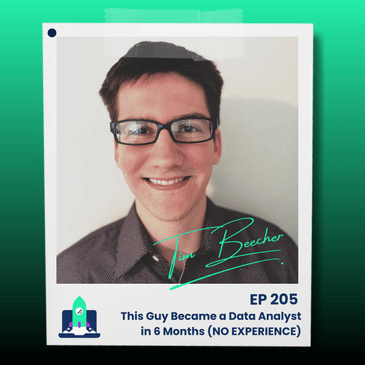
Tim scored a 1 on his AP computer science exam. Here's how he still landed a senior data analyst role at one of the biggest marketing agencies in the world.
💌 Join 30k+ aspiring data analysts & get my tips in your inbox weekly 👉 https://datacareerjumpstart.com/newsletter
🆘 Feeling stuck in your data journey? Come to my next free "How to Land Your First Data Job" training 👉 https://datacareerjumpstart.com/training
👩💻 Want to land a data job in less than 90 days? 👉 https://datacareerjumpstart.com/daa
👔 Ace The Interview with Confidence 👉 https://datacareerjumpstart.com/interviewsimulator
⌚ TIMESTAMPS
00:48 – Three failed careers
03:21 – Anyone can learn this
05:09 – The rejection phase
06:00 – Start reaching out
08:03 – Portfolio live in interview
10:06 – 100% remote, best pay ever
11:33 – Your turn
🔗 CONNECT WITH TIM
🤝 LinkedIn: https://linkedin.com/in/tim-beecher-a5ba74183/
🔗 CONNECT WITH AVERY
🎵 TikTok
💻 Website
Mentioned in this episode:
July Cohort - Last Chance for Lifetime Access
Last chance to get lifetime access to my data analytics bootcamp! Get a discount + bonus on top of lifetime access! Starts Monday, July 13th!
https://datacareerjumpstart.com/daa
💙 Thank you for subscribing & leaving a review
Thanks to YOU we recently became the most popular data podcast out there. Thank you so much for listening. If you haven't subscribed yet, hit subscribe. It costs $0. If you enjoy the show, leave us a 5-star rating on Spotify or Apple. It helps people like you find the show AND it helps us land better guests. Thank you so much for your support.
You can get paid to learn whatever you need to, whatever they want you to do. It keeps life interesting for me because I'm always learning. I'm always figuring out how to do something and I'm getting paid to do it. That's Tim Beecher today. He's a senior analytics associate at one of the biggest marketing agencies in the world, working from home, making the most money he's ever. But a few years ago he was sitting in a boring cubicle at the Better Business Bureau, making a hundred cold calls every single day, begging strangers to hand over their credit card information. Not fun at all. And even before that, he was changing locks out on houses in the Texas Heat as a locksmith. And before that, he completely bombed his AP computer science exam so badly that he scored a one out of five and s off. Everything tech related. So how did he do it? Well, this is the story of how Tim went from all of that to landing a senior level data analyst role with no analytics experience, no computer science degree, and no connections in the industry. And honestly, the way he did it is something that you could totally copy. It all started when Tim went to Utah State to study psychology. He liked what he was learning, but then reality kind of came in. He realized if he wanted to actually do anything with a psychology degree, he'd need to go back to school and get a master's, and that's like $30,000 in debt just to start off making like 50 grand a year. So not really realistic, so he didn't do that. Instead, he moved to San Antonio. He finished his degree online and took the first full-time job he could possibly find as a locksmith. He was going house to house, changing all these locks for new tenants in the blistering Texas Sea year round. It was really cool. There were a lot of situations where I had to solve problems, and that was an important skill that I developed and I had a good time doing it. And I did that for about a year, and then I realized I didn't want to do. Blue Cotter collar work the rest of my life. So after that, Tim pivoted again this time into sales. He ended up at the Better Business Bureau, cold calling business owners, trying to close them on a membership in a single phone call. Literally hundreds of phone calls a day. Just to get the one close and 99.9% of those calls ended in rejection. Very difficult. And, uh, there was a lot of rejection and I also realized I didn't want to do that the rest of my life. So here's Tim psychology degree. He isn't using a locksmithing career he doesn't want, and a sales job he hates. He's tried three different paths and literally none of them are working at all. And honestly, I think a lot of you guys listening are going to relate to this next part a lot because a lot of you are in the same exact spot right now. So one day Tim's talking to his younger brother Steve. And Steve has just landed a job as a data analyst to ride out of college. He's actually working for an insurance company. Fully remote, good pay, and he's actually really enjoying the work he's doing. He was explaining to me what he does and the problems he solved, and it was fully remote for him, so he didn't have to go into an office and he was making good money, and I was like, wow, I want to do that. Now here's the thing, Tim has. Every reason to dismiss all of this. Remember, he scored a one on his AP computer science exam. He went to an Excel workshop in college and he couldn't even understand what a VLOOKUP was. And in his own words, he thought tech was quote, the hardest thing I've ever done. But after looking into what a data analyst actually does on a day-to-day basis. He realized something really important. It was like, oh, okay, I can do this. I don't have to, to be able to code an, an app, you know? Yeah. I just have to be able to know my way around, uh, a table. I can always Google something if I don't know. Yeah, and honestly, that's something I tell people all the time. Data analytics, it's technical for sure. I don't wanna make it sound like it's not a technical degree, not a technical role, but it's not rocket science. It's not that hard. If you can learn PowerPoint, you can use Tableau. If you can use Excel, you're already halfway there. And sql, which is one of the hardest things that I actually teach people, really only has about 17 core commands. So Tim, solo this. And he saw that the pay was basically double what he was making in sales. And on top of that, he could work remotely and, and this was huge for him. He wouldn't have to go back to school and spend another 30 grand to get started. So Tim was kinda sold on becoming a data analyst and he went on LinkedIn and started looking for people who talked about data analytics. And that's where he found me on LinkedIn posting about how to land your first data job. So after reading a couple posts, listening to a couple podcast episodes, Tim joined my accelerator program and started building projects from day one. I wanna be clear about where he was starting from. Basically zero. Uh, psychology degree, failed AP test, and basically no memory of what he learned about the VLOOKUPs in that really short business Excel class he went to. But honestly, what Tim had is something that a lot of people overlook and that is problem solving instincts from his locksmithing job to sales and just figuring out his whole career path and all. He was a good problem solver and in data analytics that matters more than you realize. So with the accelerator program, he learned the tools, he built out his portfolio, and then he started applying for jobs and sadly, nothing really happened in the beginning. I wasn't getting as much, much traction as I had hoped. And so for a minute there, I, I thought about pivoting to, to something else. And truthfully, this is the part of the story that no one really talks about because on LinkedIn, all you see is the celebration post, oh, I landed in my dream data job, but you never see the months of silence and rejection that happens before that. And it honestly got so bad that Tim almost quit. But then he noticed something that seemed maybe important. I saw other people that were in the program landing jobs, and it was kind of the, the wake up call similar, like, oh, hey, this person did almost the exact same thing that I did. And they're, they're getting jobs, so it's possible other people in his cohort, people with similar backgrounds, similar skill levels. They were getting hired. So instead of giving up, Tim asked a really important question. He said, well, what are they doing that I'm not? So what Tim did next is part of the story that I really want you to pay attention to because it's the difference between people who land jobs and people who keep applying into the void in getting no callbacks ready. He stopped applying. He started reaching out to people instead, specifically, he noticed that a few people from our accelerator program were actually getting hired into one company, one of the biggest marketing agencies in the world. And there was a hiring manager who wasn't even part of my program. I never even taught them anything about data, but she followed my content and she really loved our community, and she had already hired one of our students previously who was actually doing really well at the job. She was really great. Set up, uh, like an intro call and she went through my resume and went through my portfolio. She reviewed his stuff, she liked what she saw, and she gave him a referral for an open position. Now, was this lucky? Yeah, I mean, it was, it was lucky for sure, maybe a little bit, but Tim. Put himself into the position to get lucky. He used our accelerator community. He sent the cold messages on his own. He did the uncomfortable work that most people won't be willing to do. So that one cold message led to a referral, which led to an interview. And here's what Tim did really well. He gets the interview at this huge marketing agency company, and he is interviewing for a senior analytics associate position at a marketing agency. But keep in mind. He has no real marketing experience and he has no real analytics experience on paper. He should not get this job, but in the interview, every time they ask him about his skills or his responsibilities, he didn't only just answer their question, he pulled up his portfolio online and walked them through a real project that kind of answered the question for them, and they would ask me about, you know, the, the roles. Or the responsibilities that this job was asking for, I could see, I could point directly to my portfolio and be like, here's an example of when I did this and these projects that he was showing them. Well, one of them was a hackathon that we ran in the program, like an internship program. You can think of it. Were a real newsletter company gave us their raw data. We had the open rates, the click rates, subscriber data, and we asked our accelerator students to analyze it and give him actionable recommendations. So Tim actually worked on this project solo. He wasn't the most technical person in the cohort. He wasn't even the smartest, but he did something that no one else did. He Googled what the morning Brew's open rate was, because the founder had mentioned he was modeling his newsletter after the Morning Brew, and he put that in the presentation as a benchmark. I think the thing that stood out to me was that I had listened and I I had understood the business. Yeah. So I, I had put on one of the slides what the, I think he was looking at open rates. I'd put like, what? I'd done a quick Google search of what's the morning bruise? Open rate. Oh yeah. And I had put that on there and as just like a comparison as a benchmark and be like, Hey, your open rate is this compared to this, you're doing really well. And I think he had, he had pointed that out that was, that was like no one else had had put something on that. And that was just for me, listening to what the stakeholder wanted and knowing that, hey, this could be useful to him. So even though I didn't have all the technical Python skills, R skills, whatever you may have, the fact that I had. Understood the business and presented it in a way that made sense. That went a long way. And that what my role is now. I mean, just think about that for a second. He wasn't the best at sql. He wasn't the best at data visualization, but he actually understood the business problem, and that's literally what a data analyst job is. Take complicated numbers and turn them into simple actionable insights. So back to the interview, he's interviewing at this marketing agency and he had just walked him through this real marketing analytics project where he analyzed email performance. For a real business, how do you think the interviewers reacted to it? Right. Probably pretty well because the interviewers didn't have to imagine whether Tim could actually do this job. He showed them real proof. He didn't make it a guessing game. He's like, here's the evidence, and they offered him the role. So let's zoom out here and look where Tim ended up. Tim's now a senior analytics associate at one of the biggest marketing agencies in the world. One of his main clients is actually LinkedIn. He's analyzing ad performance. He's building out Excel reports and PowerPoint decks and working with Tableau dashboards, helping clients make sure that they're not wasting money on ads, and he's continued to work from home, a hundred percent remote. He moved back to Utah to be closer to family and getting out of that Texas. He, and he's making the most money he's ever made. The cool thing is he's also learning new things on the job, which is getting paid to learn, which was the whole point in the beginning that he didn't need to go back to school and he could actually learn on the job and get paid to learn. You can get paid to learn whatever you need to, whatever they want you to do. It keeps life interesting for me because I'm always learning. I'm always figuring out how to do something. And I'm getting paid to do it. And some of those tools at the beginning that he was scared of. Well, now his day-to-day is mostly Excel. The thing he couldn't wrap his head around in the beginning at that college workshop. It turns out when you learn by doing real projects instead of sitting in a boring lecture hall. Things kind of click differently. We all learn better hands-on, and the more hands-on projects that you can actually do, the better. So this is a cool story, but why did I want to tell it to you? It's not because he's some genius who cracked the code and pivoted from an absolute. Nobody to a senior data analyst, it's because he's a normal person who tried a bunch of stuff that didn't work. He almost gave up, and then he did three things that actually mattered. Number one, he learned the skills basically from zero. He didn't know that much before, but he learned the skills that were necessary to land this first job. Number two, he built projects that proved he could actually do the work. And then number three, he used his network, in this case, the bootcamp and the accelerator to get in front of the right people, guys. That's it. That's literally the entire playbook. If you're watching this from a job you hate, or a career that you feel like is going nowhere, or you're staring at job listings for data analysts and wondering if someone like you could ever land in those jobs, well, Tim was exactly where you are. Psychology degree, not data failed. AP tests for computer science can't code. He's a locksmith, a cold caller. But now a senior data analyst working from home, you guys, the path is there. You just have to start walking it. And if you wanna follow the exact same roadmap as Tim. Learn the skills, build real projects, and then tap into the community that's actually getting people hired. You can join the same bootcamp that he went through. It's called the Data Analytics Accelerator. It's the bootcamp I run, the one that I'm actually thinking about and working on every single day, and I'll make sure I drop the link in the description down below. I promise you that no matter where you're at right now, no matter your skills, no matter how technical you are, you can become a data analyst if you take the right path, and I hope you take a path similar to Tim's link in the description to learn more. I'll see you in the next one.