
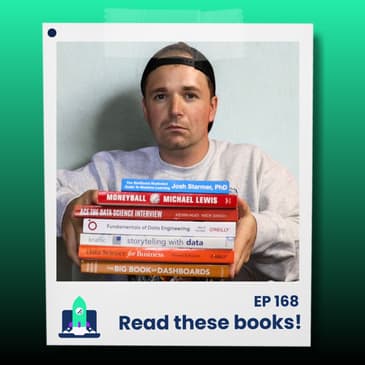
Tired of spending money on data courses you never finish? Here are 7 essential books that will actually boost your analytical skills, with no subscription required! Plus, make sure to tune in till the end as one lucky listener will get a free book from this list!
Get the books here!
DISCLAIMER: Some of the links in this video are affiliate links, meaning if you click through and make a purchase, I may earn a commission at no extra cost to you.
Storytelling with Data by Cole Nussbaumer Knaflic
👉 https://amzn.to/3ZYHhsG
Ace the Data Science Interview by Nick Singh and Kevin Huo
👉 https://amzn.to/3XZ9IaB
Moneyball by Michael Lewis
👉 https://amzn.to/44fy4OD
The StatQuest Illustrated Guide To Machine Learning by Josh Starmer
👉 https://amzn.to/40hRgu2
Fundamentals of Data Engineering by Joe Reis and Matt Housley
👉 https://amzn.to/3W84K8K
Data Science for Business by Foster Provost and Tom Fawcett
👉 https://amzn.to/4k7jkaD
The Big Book of Dashboards by Steve Wexler, Jeffrey Shaffer, and Andy Cotgreave
👉 https://amzn.to/462GJVj
💌 Join 10k+ aspiring data analysts & get my tips in your inbox weekly 👉 https://www.datacareerjumpstart.com/newsletter
🆘 Feeling stuck in your data journey? Come to my next free "How to Land Your First Data Job" training 👉 https://www.datacareerjumpstart.com/training
👩💻 Want to land a data job in less than 90 days? 👉 https://www.datacareerjumpstart.com/daa
👔 Ace The Interview with Confidence 👉 https://www.datacareerjumpstart.com/interviewsimulator
⌚ TIMESTAMPS
00:16 Book 1: The Big Book of Dashboards
02:52 Book 2: Data Science for Business
04:38 Book 3: Fundamentals of Data Engineering
06:05 Book 4: The StatQuest Illustrated Guide To Machine Learning
07:52 Book 5: Moneyball
10:09 Book 6: Ace the Data Science Interview
11:24 Book 7: Storytelling With Data
I've interviewed some of these awesome data authors! Check out these episodes!
Stats You Need to Know as a Data Analyst (w/ StatQuest)
👉 https://datacareerpodcast.com/episode/105-do-you-have-to-be-good-at-statistics-to-be-a-data-analyst-w-statquest-josh-starmer-phd
How to Ace The Data Science & Analytics Interview w/ Nick Singh
👉 https://datacareerpodcast.com/episode/74-how-to-ace-the-data-science-analytics-interview-w-nick-singh
Meet The Woman Who Changed Data Storytelling Forever (Cole Knaflic)
👉 https://datacareerpodcast.com/episode/142-meet-the-woman-who-changed-data-storytelling-forever-cole-knafflic
🔗 CONNECT WITH AVERY
🎥 YouTube Channel: https://www.youtube.com/@averysmith
🤝 LinkedIn: https://www.linkedin.com/in/averyjsmith/
📸 Instagram: https://instagram.com/datacareerjumpstart
🎵 TikTok: https://www.tiktok.com/@verydata
💻 Website: https://www.datacareerjumpstart.com/
Mentioned in this episode:
October Cohort of The Accelerator Starts on October 12th
Land your first data job ASAP with The Accelerator. And for this cohort only, get a discount PLUS our premium job board software PLUS our live AI workshops on how to analyze data Learn more here: https://datacareerjumpstart.com/daa
https://datacareerjumpstart.com/daa
Live "How to Become a Data Analyst" Webinar
Come learn the EXACT roadmap to landing your first data job: https://web.datacareerjumpstart.com/webinar
[00:00:00] Avery Smith: Tired of wasting money on data courses you never finish. Well, these seven books will actually make you a better analyst and no subscription is required. And by the way, one of you listening is going to get a free book from that list right there, and I'll talk about how at the end. Let's start with book number one, which is the big book of dashboards.
[00:00:20] Avery Smith: If you've been watching my videos for a while now, you'll know that I'm a very hands-on learner. I don't really love theory because it's just not how I learn. I just need things to be very applicable, very practical, and very hands-on. And that's exactly what this book is here. It's written by three Tableau Legends, Steve Wickler, Jeffrey Schafer, and Andy Cock grave, and it's.
[00:00:40] Avery Smith: An awesome book. The first half is going to give you basic principles of data visualization. Things like geal principles, what makes a good graph, a good graph, how to use color, sequential, diverging, different types of charts, et cetera, et cetera. It's like a really good primer on all things data visualization.
[00:00:56] Avery Smith: The second half is going to give you 28 [00:01:00] practical dashboard examples. Like this. Basically, they're gonna be examples from all sorts of different industries, all sorts of different use cases. Things like sales, manufacturing, sports, healthcare. Honestly, whatever your industry, there's probably something pretty similar inside of this book, and it's really good because they're going to give you a couple different things with the dashboard.
[00:01:18] Avery Smith: Of course, they're gonna show you the dashboard, but they're gonna explain the business use case, the kind of the business prompt. Why this dashboard got built in the first place? Like what key stakeholders, what did they need? What did the business actually need, and why was this dashboard created the way that it was?
[00:01:33] Avery Smith: They'll also give you similar scenarios. So even if you're not in, for instance, the sales industry and they're looking at a sales dashboard, they'll say, this is how you could apply it to the manufacturing industry, or This is how you could apply it in the science industry, or something like that. And then they'll go through and actually show you how the users use the dashboard and what they found useful on the dashboard.
[00:01:50] Avery Smith: They really go through it piece by piece, explaining every single part of the graph, the titles, different components, uh, each one of the individual graphs on the dashboard, and they explain, [00:02:00] you know, this is why we use this graph. This is why we used green color here and red color everywhere else, so on and so forth.
[00:02:05] Avery Smith: With that, they'll also show you like some different ways that you could have done it. Like we made this graph a bar chart, but you really could have done it Asa scatterplot or whatever. Right? They'll basically explain a couple different ways that you could remix the graphs on the dashboard. If you wanted to.
[00:02:18] Avery Smith: And then the other cool part is they give you the author commentary. So each dashboard in the book was created by one of the authors. And so they actually like have the author comment on what they were going through, what they were thinking about when creating this dashboard. And then Asa bonus, I think they give you all of the Tableau files as well.
[00:02:32] Avery Smith: So just that alone, you'll have like 28 different Tableau dashboard templates that you can use for future projects. So, uh, just that alone, I think that makes the book worth it. So if you're interested, I'll have a link to grab it in the description down below. And that goes for all of the other six books that I'll be talking about today.
[00:02:47] Avery Smith: So make sure that you go to the show notes, the description, whatever it's called, and check out all the links there. Okay, moving on to book number two. And it is Data Science for Business. And I love this book one because the cover look at the pretty, this cover is [00:03:00] Right, but more importantly, it does exactly what the title says.
[00:03:02] Avery Smith: It mixes data science with business in a really appropriate fungible way. There's not many books that do this very well that like actually combine data science and apply it to business. There's a lot of business books that we'll talk about, like maybe even data-driven things, right? There's a lot of data science books that we'll talk about like coding and models, but there's not a lot of books that bridge those two together.
[00:03:22] Avery Smith: I think this book does a really good job because doing data science for data science sake is fun, but all of us, were doing data science for. Business sake. And really what I mean, business, most of the time I'm talking about organizations because business often feels a little cold hearted and, uh, harsh.
[00:03:36] Avery Smith: But like if you work for a nonprofit, you can think about data science for nonprofits, it's just like basically doing data science with purpose for an organization. And this is a mix of practice. In theory, you know, that it has to be a little bit practical because I'm very practical, but it still has a ton of theory.
[00:03:52] Avery Smith: It's gonna teach you things like data cleaning. Databases. Data modeling with regression, what to look out for. When you're doing data modeling, it'll introduce you to some other [00:04:00] forms of machine learning, classification and clustering. You'll talk about text analysis, which I think is often underlooked, just like the analyzing of actual texts versus numbers.
[00:04:09] Avery Smith: That's really important 'cause think about it, we're on social media all the time typing things, and that's not really like. Numbers stored in like a numerical table, right? It also gets into ethics, privacy, and all that good stuff. So to me it honestly feels like it's the closest book. It's like the closest learning that I've ever had to what I experienced in corporate learning when I worked in in corporate.
[00:04:27] Avery Smith: It's like this is the closest thing to what it felt like to learn on the job at, at corporate. So overall, uh, a great book and I think you guys should check it out. Link the show notes down below. Moving on to book number three. It's a little bit newer here. It's the fundamentals of data engineering, and some of you might not know this, but I was actually the instructor for the data engineering bootcamp at MIT.
[00:04:49] Avery Smith: Why? I don't know, because when they reached out, I said, you shouldn't hire me for this. I'm not the best data engineer. You should get someone else. And they're like, no, we want you. Uh, and I was like, okay, great. And so I taught Data Engineering Bootcamp [00:05:00] at MIT for about a year. And uh, this book came in absolutely clutch because, uh, I have never really been that great of a data engineer.
[00:05:07] Avery Smith: So this book really helped fill in the gaps when I didn't know exactly what I was doing. It is a lot of high level concepts. And like thinking versus practical how to, so maybe a little bit more on the theoretical side, but keep in mind I don't really like theory. So, uh, this is theory in a good way somehow.
[00:05:23] Avery Smith: It honestly feels like it could be a college textbook, like it probably will be in the near future. And it covers everything with data engineering. What's. Data engineering. What's a data engineer? What's a data lake versus a data warehouse? What does cloud actually mean? How do you store data? How do you query data?
[00:05:38] Avery Smith: How do you do all this stuff efficiently and automate it and schedule it and orchestrate it? What is orchestration? It talks about all that stuff. You can talk about also like some of the big players and softwares and tools in the data engineering space. Like what's Kafka, what's spark? When do I use airflow?
[00:05:51] Avery Smith: Those types of things. And I'm lucky enough that I know the authors, Joe Reese and Matt Hasley. So check it out you guys. I actually have a signed copy. How [00:06:00] cool is that? Well, your copy probably won't be signed, but you should check it out and the show notes down below. It's a good book. I think you guys should get it.
[00:06:05] Avery Smith: The next book number four is really fun. It is the Stack Quest Illustrated Guide to Machine Learning. And if you've ever heard of the Person Stack Quest, he's also known it as Josh Starmer. I actually interviewed him on my podcast, uh, not too long ago. Or if you've ever searched anything statistical on YouTube, like what's a B value, what's hypothesis testing?
[00:06:24] Avery Smith: You've probably. Seen one of these videos. That's exactly what this book is. It's basically all of these Stack Quest videos into a book form. It feels really fun to read. If you've ever watched one of Josh's videos on YouTube, you know that he does all sorts of fun things like these fun little illustration, dinosaurs, and he says Triple bam all the time.
[00:06:42] Avery Smith: And he even like makes up songs. And that's exactly what this book is, is it's like take something really serious and really hard to learn. Basically, machine learning and statistics. And make it fun and easy to learn. It feels detailed enough that, like, it definitely could be a college textbook. I don't know if a college would be like, okay, using a college textbook.
[00:06:59] Avery Smith: I'm pretty [00:07:00] sure Josh uses Microsoft Paint to make these, or like illustrator, like, I don't know if they'd be okay using such basic cartoons in their textbook, but it's definitely detailed enough that it, it could be a, a textbook for sure. Give you a little feel for what it looks like on the inside, very illustrated.
[00:07:15] Avery Smith: Like if you're a visual learner, this is probably a good book for you. I personally use it Asa reference book because it. It's easy to understand. And a lot of the machine learning in math, I forget 'cause it's hard and we all forget it. And so this is like just like a good reminder of Oh yeah, that's how that works.
[00:07:29] Avery Smith: Oh yeah, that concept makes sense. I love how we drew out this diagram, so on and so forth. So if you're interested in machine learning, this book is probably a pickup for you. It's gonna cover things like linear regression decision trees, neural networks, support vector machines, basically all sorts of machine learning.
[00:07:42] Avery Smith: And by the way, I'm also lucky enough that this one. It is also signed by Josh. Woohoo. So even if yours won't be, make sure you pick it up in the show notes down below. It's a triple bam, that's for sure. Alright, moving on to number five. And it's a classic. It's a little cliche. It's money ball. I know it's a little expected, right?
[00:07:59] Avery Smith: [00:08:00] But this book is worth adding to your collection because yes, it was a book before it was a movie, but it's a great example of how analytics can affect an entire like. Industry, like literally baseball was never the same. After the story of Moneyball and then the book of Moneyball and then the movie of Moneyball, it really like popularized the idea of, Hey, in sports we can use analytics and data to get an edge to having a performance.
[00:08:24] Avery Smith: And it made geeks like me feel like, Hey, I can make a difference in the sports world, a story for another day. I actually had the chance to intern with Utah Jazz and do a little Moneyball stuff for them, and that was a lot of fun. But it's like really interesting because if you're unfamiliar with the story of Moneyball, it's basically the story of how one of the poorest teams in the MLB, the Oakland A's, were able to do really, really well, even though they weren't spending that much money on the roster and they didn't have like any good players.
[00:08:48] Avery Smith: And the reason is because instead of looking at kind of these glam statistics like home runs or batting average. They found other statistics that actually had a higher impact on winning things, like on-base percentage. And so they were able to sign [00:09:00] these underrated players for not that much money, and these players performed very well because they actually did things that were correlated with winning and not things that we thought were correlated with winning like home runs.
[00:09:09] Avery Smith: So it's also a really good example of getting your analytics, your charts, your stats, your research adopted. Buy the business because in the book there's kind of these young guns who are doing these analytics and they tell these scouts different things. These old scouts who have been in the baseball game for maybe 50 plus years, and they're like, Hey, you should be looking at this, not this.
[00:09:28] Avery Smith: And the scouts are like, who are you? You're a nerd. You just do computer stuff. You don't know baseball like me. And so that happens a lot in your career. You'll have multiple times when you've done some really cool analysis and you have to convince some person with 50 plus years of experience that. Hey, you need to change everything.
[00:09:43] Avery Smith: You've thought about this for the last 50 years and that's not an easy task. And so that's one of the things that they talk about in the book. How do we get these old scouts onboard with us? And for the record, one of my masters of analytics classes that I took, uh, in grad school, half of the class was literally just to read this book.
[00:09:58] Avery Smith: So this book, uh, is [00:10:00] like maybe 20 bucks, whatever it is on Amazon, right? It cost me like a thousand dollars 'cause I had to do it in college. So. Just buy it right now. Link in the show notes down below. Moving on to number six, one of my favorites, ACE, the Data Science Interview, and this is written by my friend Nick Singh and Kevin who, and this is a great book.
[00:10:15] Avery Smith: The first four chapters are all about the job hunt, which I think no one really talks about. I try to talk about it, but other than this book and me, there's not a whole lot of people talking about it. This book talks about like how to do data projects, how to send cold emails. How to do well in behavioral interviews.
[00:10:28] Avery Smith: And then the rest of the seven chapters are on technical interviews. So those are like the two parts of interviews. Behavioral, honestly, I don't like technical interviews and so this book's really useful for me, uh, because I hate technical interviews and if I ever have to do one again, you know, I'll be pulling this book out.
[00:10:42] Avery Smith: It covers statistics, probability, SQL coding. Product sense, case studies, basically anything you get asked in a technical interview for data this book is covering. And so honestly, if you wanted to be data scientists, like at a FANG company, FANG companies love technical interviews and this book is kind of modeled after the FANG interview.
[00:10:58] Avery Smith: So if you wanted to be like a data scientist [00:11:00] at Meta, you could probably just read this book like three or four times and be set and probably. Literally acce the interview because their interview processes are very documented. And honestly, if you study really, really, really, really hard for it, you can probably just pass it.
[00:11:13] Avery Smith: So this is the book that I would probably get if I was interested in that. Once again, I'm lucky Nick has signed the book for me. I've also interviewed him on the podcast as well. Anyways, if you want to check that book out, link the show notes down below the seventh book and maybe my favorite is Storytelling With Data.
[00:11:28] Avery Smith: And this is by Cole Affleck, who I had on the podcast recently. And this is all about how to turn your data into charts and. Get people to do what your analytics says. And so it's very similar to what we talked about with Moneyball, like how do you convince people that have been doing it one way for a long time to do it a different way based off of what your computer program says?
[00:11:47] Avery Smith: That's hard to do. And this book basically covers how to do that. The first half is all about data visualization principles, you know, things that, uh, the big book of dashboards kind of covers. But a little bit more in depth, a little bit longer. They do a lot of step-by-step [00:12:00] remakes of graphs. Like, this is a graph, how can we make it better?
[00:12:02] Avery Smith: And that's really useful because that's super practical in my mind. It's like, oh, okay, I totally see how we can, you know, use less clutter, use color more effectively, so on and so forth. And the second half is gonna be about presentation and storytelling skills. How do I actually convince you to take action on what the numbers of my program or my SQL code says?
[00:12:20] Avery Smith: And that's really useful because analytics is only useful for analytics sakes. By the way, this just so happens to be my spare copy. I have two copies of this, so if you'd like for me to mail this to you anywhere in the world, just make sure that you're subscribed to my newsletter. So you can go to data crew jumper.com/newsletter and sign up for absolutely free and join.
[00:12:37] Avery Smith: And I'll be announcing the winner in my newsletter At the end of the month. I'll just randomly choose. I might wait it based off of how active you are reading the newsletter. So I have an algorithm for that. So stay tuned, uh, and I hope that I get to send this book to you. May the odds be ever in your favor.