Help us become the #1 Data Podcast by leaving a rating & review! We are 67 reviews away!
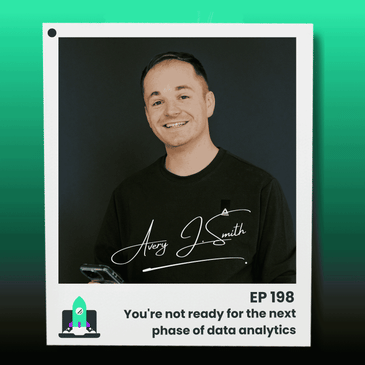
AI is advancing fast, and most data analysts aren't ready for what's coming. But here's the thing: AI won't replace you, it'll just change how you work. I break down what the future of data analytics actually looks like and how you can prepare yourself to thrive in it.
💌 Join 33k+ aspiring data analysts & get my tips in your inbox weekly 👉 https://datacareerjumpstart.com/newsletter
🆘 Feeling stuck in your data journey? Come to my next free "How to Land Your First Data Job" training 👉 https://datacareerjumpstart.com/training
👩💻 Want to land a data job in less than 90 days? 👉 https://datacareerjumpstart.com/daa
👔 Ace The Interview with Confidence 👉 https://datacareerjumpstart.com/interviewsimulator
⌚ TIMESTAMPS
00:00 AI is changing data analytics faster than we can keep up
01:00 Claude Code and the AI revolution in software development
03:00 Why AI won't take your data analyst job (it's just a tool)
06:20 From individual contributor to AI manager - the mindset shift
08:08 Focus on the "what" and "when", not just the "how"
🔗 CONNECT WITH AVERY
🎵 TikTok
💻 Website
Mentioned in this episode:
Live "How to Become a Data Analyst" Webinar
Come learn the EXACT roadmap to landing your first data job: https://web.datacareerjumpstart.com/webinar
October Cohort of The Accelerator Starts on October 12th
Land your first data job ASAP with The Accelerator. And for this cohort only, get a discount PLUS our premium job board software PLUS our live AI workshops on how to analyze data Learn more here: https://datacareerjumpstart.com/daa
You're not ready for the next phase of data analytics because there is a lot going on with AI right now and it is impossible to keep up. And I'm guessing that most of you guys who are listening are not ready for what's coming and I don't even know if I'm ready for what's coming. But in this episode, I will try to explain what I see coming in the near future with data analytics and becoming a data analyst as well as. Tell you how you can prepare yourself for that future to best succeed, give yourself the best chance of landing a data job, getting promoted, and ultimately succeeding in the data analytics field. But if you're new here, my name is Avery Smith. I help people land their first data job. I've worked with companies like ExxonMobil, Harley-Davidson, hp, and a lot of other companies help analyze data, and now I make contents teaching people about how to land their first data job. Now, lemme tell you what's going on with AI and why I think the future, we're not prepared for it. So AI is getting better every single day at a lot of different tasks. And I think the most recent groundbreaking moments where I've been reading a lot online, specifically in the software development space on Twitter, some people are calling it like a. Gutenberg Grass Moment, it's Claude Code. If you've never heard of Claude Code, it's from a company called Anthropic. They make a very similar product to Chatt called Claude, but they also have a programming version that's called Claude Code. And Claude Code is just like really good. It's basically like an AI programmers way you can think of it. And they just recently released what's called Claude Cowork, which is supposed to be code for non-coding. Task. I've played around with it. I haven't been super blown away or shocked yet. In fact, a lot of times it hasn't worked. But a lot of developers are pretty impressed with clot code. It's probably the number one AI product that's being talked about right now, and people are using it to build all sorts of different software, uh, a lot faster, a lot quicker, a lot cheaper than you know. Development has happened in the past, and I think that data is a little bit behind software in terms of the adoption of ai, but I think that's where we're going to in the future. So down the road, maybe it's Claude Cowork, I don't know. I don't think it is, but there's gonna be some sort of a tool that can basically replace a data analyst. Now when I say replace a data analyst, I don't actually mean take a data analyst. Job. I see AI only as a tool that people are going to use to do their jobs better, and I'll explain why. I think that's the case. I'll make my argument and how really AI just shifts how we work instead of, I guess, how much we work. Going back to this cloud code thing, the biggest thing that I think has happened is this is the number one AI product on the marker. Right now. Everyone loves cloud code and recently at the developer, the main guy for Claude Code has revealed that all the updates to Claude Code were actually. Built by Claude Coate. Now that's really meta, but basically this AI tool is building itself. Now, that's not to say that, that there's not like a whole team behind it. There definitely is, and humans are still needed, but the idea that this number one AI tool is actually built by the number one AI tool is pretty impressive. So I think this is a moment where we all need to sit back as data analysts and be like, what does the future look like? And first off, I wanna say, I don't think much is gonna change in the near future. Companies are really slow to adopt ai, like terribly slow to adopt anything new, and it's gonna take a long time to get inside of corporations and actually get things to work. So that's the first thing. In the near future, I don't see a whole lot changing necessarily, but let's say five years down the road, what does it actually look like? And I don't think AI is gonna take your job. I don't think if you're trying to break in the data analytics that you should, you know, go somewhere else, try something else, because AI is gonna take over. I don't think that's the case. I see it more of a, as like a hammer, like a tool, and I think it's going to change how we work. Now, this has actually happened many times before and unfortunately I'm not old enough to remember a lot of them, right? But like, obviously I'm shooting this right now on my iPhone. This episode, I'm recording it on these wireless mics. These didn't exist. 20 years ago, and now it completely changes the way that we do video, that we do content, those types of things. Technology ends up just changing how our job looks, not necessarily the problems that we're actually solved. Another example, I don't know if you guys have seen the movie Hidden Figures. I know there's a book, but basically it's about these three African American women. In the United side of the United States that work for nasa, and they're basically math computers. They're hand doing math calculations for space shuttle landings and stuff like that. Now, I haven't admittedly worked for nasa, although one of my students, uh, who graduated from my bootcamp, landed a job at nasa. So maybe we can ask him. Evan, if you're listening, um. I don't think they're doing like a lot of hand calculations like at NASA right now. Maybe they are. Maybe they are. Maybe. I don't know how it is, but my guess is they're using a lot of computers and it's like these mathematicians, let's just say that when computers came out, did they lose their job? No. Their job just transferred from doing the math calculations by hand to doing the math calculations on a computer. And that's honestly how I see the future of data analytics going is that data analysts might not be doing their analysis in Excel or SQL or Python in the future, but they'll be doing their analysis in some sort of AI tool, some sort of cloud code tool, some sort of whatever AI tool you wanna, you know, chat GBT interface to analyze their data. And I don't think that those tools are going to be able to do things without the humans. Now is cloud code programming itself? Yes. But there's supervision and that's the big thing I wanna talk to you is about the future of maybe every job is less about doing the job. And more about becoming a little supervisor. And I've heard the CEO of multiple companies talk about this. I'm forgetting the one where I specifically heard this in some interview, but basically like he sees individual contributors now becoming like managers to many AI services down the road. And so instead of being individual contributor, we're all becoming managers, managing like little AI employees. Is that going to happen? I don't know. But I definitely think that we are all going to be doing less hands-on tasks. We're going to be getting AI a lot more of the tasks. So our job becomes less of an instrument player, more of a conductor, less of a writer, more of an editor, you know, more of a manager role where we're actually like, we're setting things up at the beginning. Um, and it's really interesting because, you know, five years ago when I quit my, my data scientist job at ExxonMobil. I was just an individual contributor at ExxonMobil. I was working on different AI projects and it was a lot of fun. I had a lot of fun. I wasn't a manager at all. I quit my job. I started my own business, and over the last five years we've grown quite a bit to the point now where I have like a small team of, let's just say five to 10 people. All of a sudden, I'm a manager now and I don't know what the heck I'm doing, but it's really interesting because the way I manage employees is also the way I've realized that you need to manage AI as well, and that's number one. You need to set the right expectations. You need to give them all the resources upfront so that way they can actually know what they need to do. It's just really been an interesting process where it's like at the beginning you have to do a lot of work to set up everything correctly, and at the end you have to do a lot of work to make sure that your employees did everything correctly to your liking that they, you know, didn't mess anything up. And so it's like a lot of work at the beginning to set things up, a lot of work at the end to make sure everything went well and some back and forth in between to make sure that it stays on task right. And I'm, I'm not trying to liken employees, ai. My point here is we're all gonna have the mindset of being conductors have the bigger vision. And what that means for you specifically, especially for those of you who are trying to land your first data job, is the what or rather, the how of doing data analytics that we've been so focused on as like a culture and a society for the last 10 years is gonna matter a lot less like the tutorials of how to do things in Excel. The tutorials in Power BI or sql, they're gonna matter less. I still think they're gonna be important. I still think there's gonna be a lot of data analysts. In fact, basically my job at Exxon, this is before AI even really existed, right? My job at Exxon was to basically use mathematics and machine learning to do someone else's job, to do a trader's job. So I worked on buying oil from all around the world, right? And in the past, historically, there was just kind of a buyer, well, their gut feeling and maybe some like stock, like, oh, this stock's up so we're gonna buy this oil, or whatever, right? My job was to create math to make the right decision on what oil to buy. And then also another project I worked on was where should we send gasoline to around the world? Like wherever you're living at right now, your local ExxonMobil gas station, how much gasoline is there right now in like their storage? That was my job. And before, once again, it was like a trader who would do that basically. And my job was to use math to replace those people. It wasn't actually to replace those people, it was to supplement those people. Those people, their job wasn't in jeopardy at all. I was helping them create tools to do their job faster and more accurate and with more confidence, and that's how I kind of see it being with AI as well, is it's really just something that's not gonna replace us, it's just going to supplement our work. What that means for you specifically is like, it might not be as important to know the difference between Index match and Excel and a an X lookup like that might not be as important down the road. I think is really important and the thing that I'm not prepared for, the thing that you're probably not prepared for and something that I really hope to be doing more on this channel, on this podcast and in my newsletter is talk more about the why are we doing this or the, what are we doing? So not necessarily how to do something, but the why and the what. That is what I think is going to be the most important thing down the road, is knowing what to do when not necessarily how to do it. 'cause I think AI is gonna know how to do it, and I think we're gonna use AI most of the time to know how to do it. I still think it's really important to learn the how to make sure that AI is doing it correctly. But I think the what and the when is what really matters. And so what I'm actually doing is I run a bootcamp, it's called Data Analytics Accelerator. We'll have a link to the show notes down below if you wanna, if you're curious, you wanna check it out. I think I need to go through the entire thing again and really focus on the what and the when. 'cause the how I've been, I've nailed the, how we have had so many students go through this program. They've really enjoyed it. They become great data analysts at the end of it. But I think the most important thing is going through and going through, okay, why are we doing this? When would you do this again? You know, how did I know to do this? How did, how should you know to do this? When you get a data set in the future, what are some different things that you can do with it and when would you do it? When is it appropriate? That is what's going to be. That's what's gonna make you a Golden data analyst in this new era of ai, and I really hope that I will be part of your journey in learning how to do that. So that's why it's really important that no matter what you're listening, you hit subscribe and you stay tuned because over the next six to 12 months, I'm gonna be hitting this really hard and I don't want you guys to miss out. So thanks for listening, and I'll catch you in the next one.