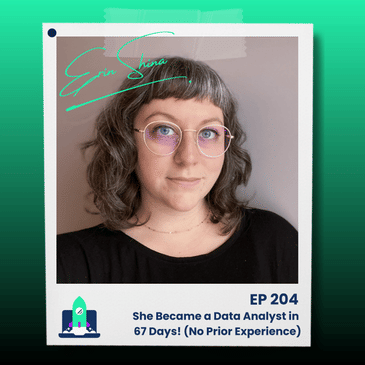
Music therapist to Fortune 50 financial analyst in under 60 days. Here's exactly how Erin did it without a traditional background.
💌 Join 10k+ aspiring data analysts & get my tips in your inbox weekly 👉 https://datacareerjumpstart.com/newsletter
🆘 Feeling stuck in your data journey? Come to my next free "How to Land Your First Data Job" training 👉 https://datacareerjumpstart.com/training
👩💻 Want to land a data job in less than 90 days? 👉 https://datacareerjumpstart.com/daa
👔 Ace The Interview with Confidence 👉 https://datacareerjumpstart.com/interviewsimulator
⌚ TIMESTAMPS
01:20 – From music to Fortune 50
07:18 – What a good boss actually does
12:51 – 60 days from sign up to offer
20:18 – Applying while building skills
20:36 – One resume tweak, three interviews
23:03 – Stop only applying to remote jobs
28:39 – What the interview was like
34:40 – Do this if you're starting over
🔗 CONNECT WITH ERIN SHINA
🤝 LinkedIn: https://linkedin.com/in/erinshina/
🔗 CONNECT WITH AVERY
🎥 YouTube Channel: https://youtube.com/@averysmith
🤝 LinkedIn: https://linkedin.com/in/averyjsmith/
📸 Instagram: https://instagram.com/datacareerjumpstart
🎵 TikTok: https://tiktok.com/@verydata
💻 Website: https://datacareerjumpstart.com/
Mentioned in this episode:
October Cohort of The Accelerator Starts on October 12th
Land your first data job ASAP with The Accelerator. And for this cohort only, get a discount PLUS our premium job board software PLUS our live AI workshops on how to analyze data Learn more here: https://datacareerjumpstart.com/daa
https://datacareerjumpstart.com/daa
Live "How to Become a Data Analyst" Webinar
Come learn the EXACT roadmap to landing your first data job: https://web.datacareerjumpstart.com/webinar
You were working as a music therapist and now you're able to work as a financial analyst for a Fortune 50 company. I am a financial analyst at a healthcare company. But you were able to land this, this financial analyst role pretty quickly signed up, clicked submit on the accelerator package like right before Christmas. Started actually like doing the program right after Christmas. I. Job was on March 1st, which was a Wednesday, and then that Friday I accepted my offer. That's not even 60 days. So one of the projects I think that really helped me was the SQL Project and the Accelerator, the, that was something that I talked about in all of the interviews that I had. Today I'm really excited about my guest. We have one of the, uh, members of the data Analytics Accelerator who has gone through a portion of the program and landed a pretty sweet job that we're gonna be talking about today. Uh, my guest today is Aaron Sheena. Aaron, welcome to the Data Career Podcast. Thank you. So happy to be here. Yeah. So excited that you, uh, agreed to come on the show and talk a little bit, uh, about your, your journey, which I think is something that's really unique and something that needs to be told because you have a pretty interesting background. Uh, you studied music in school, but you no longer work in music. So let's start off with what you're currently doing now. What do you do for work now? Sure. So, um, I am a financial analyst, um, at a healthcare company, um, called Humana. Uh. Nationwide. Um, and essentially I work in risk adjustment. Um, so basically looking at claims data, the data that comes through anytime you go to the doctor, um, and make sure that we're analyzing and filtering it correctly compared to the government agency that runs. Medicare, um, and making sure that we are kind of aligning with them so that we can predict how much we'll be reimbursed for caring for those members. Um, and so basically we then take that analysis, um, and, uh, use it to help us predict revenue and make projections for, um, both what we'll get paid for. During this year and then in future years as well. Um, so yeah, that's kind of the, the really paired down, uh, version of, of what I'm doing in a kind of complicated space. But, um, yeah. Okay, sweet. That's awesome. So basically, you know, you have two music degrees, I think you have a bachelor's and a master's degree. And now I think your official title, is it a financial analyst? Is that what it is? Yes. Yeah. Um, so I, it's two bachelor's degrees actually. I, um, my first one is in just kind of general music, and then my music therapy degree is another bachelor's. Um, but, uh, yeah. So even less impressive, right? Well, I mean, that's perfect. So, so two different music degrees, a music degree and a music therapy degree. Mm-hmm. You were working as a music therapist and now you're able to work as a financial analyst for a Fortune 50 company. You know, solving problems when it comes to healthcare billing, it sounds like. Mm-hmm. Yes. Correct. That's awesome. That, and that's the journey that's a little foreshadowing of what we're gonna be talking about today. So we're gonna get into what your background is and, and how you got to where you're at today. Um, but also it does look like, I mean, I'm no expert, you know, I don't work for Humana, but I'm guessing that your background back there is not the Humana offices. So can you tell us a little bit, are you remote? Are you hybrid? Are you in the office right now? Uh, I'm not in the office. I'm in my office. Um, at home I am, I'm a hybrid employee, so I do have one office day per week. Um, Humana is like headquartered in Louisville where I'm from. Um, and so my team meets in the office on Wednesdays and, um, which works for me really well since I am a very extroverted person. Um, but the rest of the time I am at home remote. Um, it's actually rare that I'm. In my office area instead of on the couch. So that, that's awesome. Um, and I'm guessing that was not the case as a music therapist, am I right? Uh, it was not, no. I spent, um, every day, even through the pandemic, um, every day at the hospital, spending most of my time in patient's rooms, um, sitting with them and, and providing music and, um, you know, going through that therapeutic process. Um, so a remote job was, uh. A very big change for me. Okay. And, and how has it been? I, I know you mentioned that you're extrovert is, are you lonely at home? Is it is, do you get enough interface? Do you get enough support from your team? Yeah, I'm really, really lucky. My team is super, super supportive. Um, we use Microsoft Teams, so I, I am my boss constantly. Um, you know, whether she likes it or not, but, um, I, I do feel like I get enough kind of interaction and, um, I really love my team. And getting to see them on Wednesdays, but it's also really nice to just kind of be relaxed at home while I'm, you know, working on, um, on my analysis and on, you know, all of my, my daily tasks. Um, and it, it feels. It feels very like, right. The pace is still good. I'm still, you know, kind of challenged every day, but it's much different than, um, you know, having to like, go into the hospital and, and kind of be part of that crazy environment. That's awesome. I I love hearing that because I love that you're like, yeah, I'm, I'm in my o my own office today, but to be honest, my real home office is my couch. I think that's awesome. Um, that you have the opportunity, you know, the commute in the morning from the bedroom to the couch must be very mm-hmm. You know. Full of traffic and stuff like that. Uh, but, but you know, all jokes aside, you had to deal with like a commute. You had to deal with traffic in your last, last job. Right? That was a, a decent amount of driving. Yeah, I, I'm very lucky that I live close to the hospital, um, where I was working. But yeah, I mean, it's, I still had to get on the interstate, um, and, you know. Make my way. Um, sometimes traffic was worse than others, but it's, yeah. I, uh, I much prefer when my dog is the only one that's in my way trying to, trying to get to the office now. Yeah. That, that is awesome. Um, I also have a dog and I can testify of the power of having your, your dog as your coworker. It is like so much fun. Mm-hmm. Um, and, and now, I mean, one of the things that you probably couldn't do as easily when you were doing the hospital visits is like, for instance, oh. Let's take, let's take the dog out for a walk or you know, I got to feed the dog or I gotta take the dog outside, or something like that. So I imagine that's gotten a lot easier since you've been able to work remotely. Yes. Yeah, basil, my dog is, uh, she is, her quality of life has increased even more than mine. So that's awesome. And that's what matters most, right? We don't, we don't really care about our own lives, it's just about our Ps. Exactly. Yep. Exactly. Okay. Awesome. Um, and you mentioned that you're able to, I am your boss, and that communication's going well. 'cause one of the questions I get is, you know, I want a remote job, but I'm also new to this field. And I'm kind of nervous that like, I'm not gonna be able to get enough training or get enough support from my team. You felt like that's been pretty good at Humana then? Yes. Yeah. Um, my boss is a really, really wonderful mentor. Um, and. The, the kind of professional and personal development that, um, my company invests in, um, has been a really, really good support. Um, there are lots of like modules and things that are provided just like by default from the company. Um, but then also my boss has been really wonderful and, you know, we'll hop on a Zoom and I'll share my screen and, you know, I'll say like this, I think this is what's giving me a problem, but, um, I can't, you know, figure out what I need to change or. What does, what does this actually mean? Um, and she can tell me and she'll kind of help me puzzle through it and, and figure out, um, you know, where I went wrong or how I should approach it in the future or what, what to tweak. Um, and so that's really, really helpful. That's awesome. So you not only have, like your boss, you're able to, you know, message anytime you get stuck, but you also have some sort of provided learning so that you're not like, stuck with the skills that you're at right now. You can kind of upskill as you go, it sounds like as well, right? Mm-hmm. Exactly. Yes. Yeah, my, uh, my next thing to tackle is, um, getting into some python for like moving data from one place to another. So, um, I'm excited to get started on that in the next couple of weeks. Sweet. That's awesome. Very cool. Um, okay, awesome. So actually, wh while, while you've mentioned Python mm-hmm. Let's talk about, as you know, an entry level financial analyst new to the field. What type of, what type of tools are you using on a day-to-day basis? Yeah, so biggest one is sql. Um, we use SQL Server. Um. And kind of the whole, like Microsoft Suite, all of that. Um, lots of excel for the kind of like financial part of it. Um, but most of my analysis and most of the testing that we're doing is within sql. Um, and yeah, that's been, it's been really fun to kind of take, uh, the skills that I know like. Uh, just in my own little like, simple projects into, you know, actual like millions and millions of rows of data. Um, and, you know, see, see how it translates. Yeah. I'm sure some of it is very similar, like, like you kind of have the base for it, but it's probably like you're doing things you might not have necessarily expected. Um, and using things kind of in a new way with his, with his new application. Mm-hmm. Yes. Yeah. There and there's a lot of, um, kind of logical. Like analytical thinking. Um, and you know, that's part of the learning curve of, of. Going into, you know, this specific industry, um, like healthcare. I thought, you know, being in the hospital every day, I thought I knew all of the acronyms, um, that came with like the medical, you know, field. Um, but apparently I didn't. Health insurance is like totally different. So, um, yeah, lots of acronyms. Um, lots of kind of the, the logical analytical thinking to get from point A to point B and then figure out how to get there in sql. Okay. I love that. And that's something that we didn't necessarily talk about. We, we, I mean, we mentioned your background, we mentioned your music degrees. We, we said the term music therapy a couple times. I wasn't familiar with music therapy beforehand. So, um, maybe, if you don't mind, will you just give like a, a quick introduction to what you were doing? You kind of mentioned it earlier, but if I was, if I was a 5-year-old, what is music therapy? Sure. So, um, you know, the go-to line, I guess, is that music therapy is using music to accomplish non-musical goals. So, um, in the hospital, what I was doing most of the time was using music for decreasing pain, decreasing anxiety, um, kind of providing that additional emotional support, um, that people often don't get, um, especially when they're going through something that is, you know. Potentially like traumatic and scary for them, like being in the hospital. Um, and you know, we worked really closely with our like hospice and palliative care team. Um, so a lot of, uh, folks who were going through kind of the end of life process, um. And Yeah, that's kind of what my, my daily life was like. Yeah. And, and I think that's important to realize because one of the tips that we, that we talk about throughout the data analytics accelerator is, can we find you a stepping stone job? Right? Because you're new to this world of, of data, right? You're, you're new to this world of data. You had no prior, you know, math jobs or science jobs, right? It was, it was the music stuff, right? Um, but you were able to land this. This financial analyst role pretty quickly, like within, within about 90 days. I was looking, I was trying to look, find our exact, when you told me you had the interview and you had the offer, um, and when you joined, you joined like right before Christmas, and then I think you started working like mid-March, right? Mm-hmm. Yes. Yeah. Um, so I, I like, you know, signed up, um, clicked submit or whatever on the. Accelerator package, like right before Christmas. Um, started actually like doing the program right after Christmas, like the week before Christmas and New Year's. Um, and I, I think my job. The interview was on March 1st, um, which was a Wednesday or whatever the Wednesday was that week. And then that Friday I accepted my offer. Um, so yeah, I was, uh, not expecting that. Um. That's not even, that's not even 60 days. 'cause February is not even 30 days. Right. So that's basically Right. Yeah. So that's awesome. Um, and absolutely incredible. Congratulations. Thank you. I cut you off. Thank you. Keep, keep talk, talking us through that, through that journey. Yeah. So, um, I should back up and say that part of what I was doing, um, before kind of getting into the, into the accelerator bootcamp, um, you know, when I. Was looking into data analytics as a potential, you know, career move. Um, I did kind of what anybody does and just Googled it, um, and landed on the Google, the Coursera, like Google mm-hmm. Data analytics program. Mm-hmm. Um, and I was doing that for a while. I think I started that sometime in the summer. Um, last year. Felt, um, like I was understanding things. Um, I didn't. I didn't have any, you know, foundational knowledge besides like, using Excel for budgeting. Um, and you know, I think it was a really good introduction into like, what is data analytics and all of that sort of thing. But I didn't, um, I made it like three quarters of the way through, but I didn't feel like I could like actually apply my knowledge in a way that was, um, helpful for me. I was like understanding it as I was going through, but there wasn't a lot of like. There weren't any steps after that. So, um, I was looking for something that was just more hands-on and more like active for me. Um, that's how I tend to learn best. And so I was, you know, just kind of looking to see what was out there. And, um, I think, I think you had a sale going on, I saw on LinkedIn and I was like, that sounds good. Um, you know, most boot camps are like five grand plus, and you know, that's not something that in my. Previous job that I could even consider budgeting for, um, in any kind of, you know, uh, reasonable timeline for wanting to make a career move. So, um, I was like, sounds great. This guy's cool. I'm gonna just do this and see where it goes. And so from there, that's kind of when I, uh, started like doing. Doing the Analytics Accelerator Bootcamp, um, and the curriculum, and I think it, that is what really. Made a big difference for me. Yeah. I, I think, I think your story is, you know, very similar. In fact, someone emailed me today and said, you know, how is your program different than the Google data cert? Um, which is, which is a common question, um mm-hmm. And I think, I think you kind of nailed it, like actually applying what we're, what you've learned. Right. Um, and then really focusing on creating the projects and the networking. Right. Because mm-hmm. At the end of the day, if you don't have the projects, you don't have the network, it's a lot harder to land that job and then also just doing it. Mm-hmm. With someone, like someone that's able to, you know, talk to you. I know you were pretty active on our community, so having all the peers around you, uh, I think, I think that's pretty helpful for, for most people. Um, and the other thing you did really well is, and I mean, I, I think this was helpful. You can tell me if I, if I'm wrong, um, but you were trying to land a data job. You don't have necessarily the, what people would consider the traditional or the ideal background. I don't think there is a traditional or ideal background for data analytics, but that's, that's besides the point. Um, but you found this job inside of healthcare and you have been working in healthcare as this music therapist. You've been visiting hospitals, like you said, you know, hospitals speak a little bit like the acronyms and stuff like that. Did that play a role in helping you land this job? Like, was that helpful to know the hospital stuff? Yeah, I think so. Um, you know, especially during my interview process, that was something that I spoke to a lot. Um, you know, and having kind of that background knowledge of just how the industry works, um, and understanding like, yeah, I might not know like the backend of health insurance, but I know like what these things mean and I know, you know, kind of why things are set up the way that they are. Um, even if, I dunno the details of like. How, how it works on the backend. Um, and one of the projects I think that really helped me kind of be able to speak to that was the SQL project, um, and the accelerator, the, um, healthcare analysis. That was something that I talked about in all of the interviews that I had. Um, and they were really, really interested to know, you know, not only to see that I had some SQL skills, but also just to see like. I had used my prior knowledge and like, um, how I had applied that understanding of the industry to the analysis, like with sql. Um, so that I think was really, really helpful for me. Um. Yeah, in that whole interview process, gosh, I actually, I mean, I should have realized that, but I didn't even, I didn't even realize that, and that's so cool because they were like, Hey, we're hiring for a financial data analyst role. The the hope is that someone will understand data analytics, they'll understand sql. They'll, they'll understand hospital, or I guess healthcare data. And you were like, oh, well here's a project I've done that you can read where I analyzed, I can't remember how much data is in that one, like 1.6 million rows of hospital data. Mm-hmm. And like looked at outcomes and like looked at like what procedures led to these different things and how race played in role in the hospital and stuff like that. And you're like, just, here you go. This is, this is my evidence. Right. Are you interested, Uhhuh? That must have been really powerful for the recruiter. They're like, oh. Wow. Uh, SQL project with healthcare data. I'm, I'm sure they didn't have very many other projects like that. If I were to guess, I don't know. But if I were to guess, I don't know who else applied, but apparently I did something right. So, yeah. 'cause, 'cause you interviewed and then like three days later had an offer. Mm-hmm. Yeah. That's amazing con that's so amazing. Congrats. Thank you. Um, one, one of the things I just wanna, I wanna highlight, um, that makes me so happy to hear, because when I was designing the, the analytics accelerator, I was like, okay, we have to do projects. And to be perfectly honest, uh, when I first got into helping people land data jobs, I, I had the same philosophy that projects were the way. But I had a little bit of a different twist where I was like, projects should be fun. It's always fun. To do your own personal data. So when I originally launched my bootcamp, all of the projects were actually from your own life, like your own screen time on your phone, the data, the, the music you listen to, you know, and stuff like that. And that those projects were really fun and I think they were very impressive to recruiters and hiring managers. They were a little bit harder because it's just hard, keep getting your own data. But now that we've transitioned to. Using data from all the different industries. I'm so happy to hear that we, when I was choosing the nine industries for the nine projects, I was like, man, there's so many industries. Which ones did we choose? And I'm so glad to hear that the healthcare and the SQL combo was at least useful for one person. That's so good to hear. Yes, yes, for sure. Um, and actually I think just having the projects in general and having the specific, um. Like specific tools for a specific project, um, I think was really, really helpful. Um, and, you know, maybe just also to highlight, uh, another aspect of the bootcamp. Um, I think the difference for me, I was applying to things, um, kind of, you know, throughout the whole, uh. The time that I was, you know, doing all the modules. Um, and I wasn't really getting a lot of bites and, you know, kind of trying to network and, and get referrals for, for jobs. But, um, I think the thing that made the difference was having, I went to one of your, um, I don't remember if it was a live session or just a module, but, um, all about resumes and like optimizing your resume. Um, and so I added like. Literally, as I was watching, I was like, okay, I'm gonna add these links to my portfolio projects. I'm gonna add, you know, a blurb about what I learned, what I analyzed, what I, and why, um, and what I found. Um, and I like sent off a round of, of applications kind of with that new resume, with my projects added like an actual section, not just a link to my, um, to my portfolio site and. I like literally had three interviews lined up for like that same week. Wow. From just that difference. Um, and that was, you know, one of the, one of those interviews that I had is the role that I ended up accepting. So, and yeah. Did you, did you apply to that job or did, did they find you? So I applied for it. Um, I have, uh, I know several people that also work for Humana and I had someone who was willing to let me be a, um. Or be, you know, my referral. Um, so definitely worked kind of with my network and, and connecting with people, um, to get my in, um, Humana as a company that I have, you know, uh, considered working for, for, for a long time. Um, and you know, I know just from having those personal, uh, relationships with people here, um. They're, they treat their employees really well. And so I was like, oh yeah, that's like a company I really wanna work for. So, um, that's kind of how I was focusing my, my networking attention. Um, but yeah, I had very, very quick turnaround from submitting those applications to hearing from recruiters for the, the specific positions. Okay. There's a lot there I wanna unpack. Um, number one, did you apply on like LinkedIn jobs Indeed, or on their website? On their website. Um, so I found them on LinkedIn, but I went to the website to apply. Okay. Um, yeah. Okay. Two. Um, one of the things I wanna, I wanna highlight here is, um, I don't know if you remember this, but the job, the job description, it probably said hybrid on the job description, do you think? Mm-hmm. Or do you say in mm-hmm. Okay. And I wanna highlight that because I've, no, this is like a super underrated play that everyone is sleeping on right now. And that's the idea of hybrid jobs. Mm-hmm. Everyone is like, oh, I don't wanna be in person. Right. So they, they go and they go to LinkedIn jobs, they use the Boolean search for remote. Mm-hmm. And they're competing with literally thousands of other people for these remote jobs, because literally you can be all over the US or the world. Right. And be an applicant for this job. Mm-hmm. But like your role, you're in the office. Like what? Eight hours a week on Wednesday. Mm-hmm. Like, if you want to like, you know, work from home, from, you know, the rest of the days, you can, if you wanna, I don't know Humana's exact policy, but let's just say you wanna go visit your, your parents, or I don't know, your brother, right. You could, you could go, mm-hmm. You could leave Wednesday night and come back home, you know, Tuesday night. Like that's like a week that you could be working somewhere else, like you're. Not quite remote, but you're 90% there, right? I guess. I guess literally 75%, right? Or what, what, what? 80% there. Um, yeah. 80. Yes. But, but it's, but it's pretty good, right? Mm-hmm. Yeah. And, and like I said, I am a really extroverted person, so I really like, you know, I, I think we get less done on Wednesdays than we do, like when we're all remote. Um, you know, 'cause we're. Catching up with each other and, uh, you know, socializing a little bit. Um, but yeah, we have, my team has a lot of freedom outside of those, those, uh, in-person days. And, you know, if you do need to take a, a remote day, that's also fine. Um, you know, I had a coworker yesterday who was like, yeah, I just. I'm not feeling super well, not well enough to not work, but can I just stay home today? And my team was like, yeah, of course. Just call into the meeting that we have and we'll be fine. Um, so there's a lot of flexibility there. That's, and that's awesome. And I think people are like, no, I only want a remote job. But the hard thing is like when you're doing a remote job, you're competing with people you know, not only in Louisville, right? You're competing with people all over the country, but if you're hybrid mm-hmm. That job pool that they're selecting from the candidate pool is so much smaller. And so you can stand out so much more as a candidate. Um, the third thing I wanna mention is, you know, you mentioned the referral. Mm-hmm. And people are gonna be like, well, okay, I don't know anyone. You know, I, no one's gonna refer me, but the people that referred you, what, what part of the company do they work for? Uh, not mine. Um, yeah, it's, uh, there are several organizations kind of within Humana. Um, and they are in one that is parallel with mine, but they are not in finance at all. Um, and so, you know. They, I even asked her, she, she like, looked into some of the jobs when I was talking with her and she was like, yeah, I don't know these hiring managers. Um, but I know this person who, um, you know, worked with this other person and, you know, she kind of connected some dots, but she, I didn't know, she didn't know anyone personally who was like, in charge of hiring or, you know, the next like three steps up, um, from my manager. So, um. Yeah, I think it's a powerful thing to, even if you aren't, if you can get a referral from someone, um, even if they aren't directly involved with. The position that you're applying for, I think it's really, really worth it to try to, you know, still build those relationships and, um, and see if they can help you out. Yeah, a hundred percent. Like when I'm working with a lot of people, they're like, Avery, I don't know anyone to get referrals. And the answer to that is bull crap. Unless you're like your brand new to the country and you've never, like, you don't speak English, or like you haven't really met people. Like, you at least know someone who works somewhere. Mm-hmm. And sometimes, mm-hmm. Sometimes, sometimes that person's gonna work at like, as a grocer at like, at like Smith's family grocer and like, that's not gonna be useful. But like you've probably have at least, you know, 20 contacts in your phone. Like open up your phone and go through one by one and just be like, okay, Paul Adams, where does he work? Alejandra und, where does he work? Paul Alstrom, where does he work? You know, and think through. Do these people work for a company that have an opening for a data analyst? Yes or no? Mm-hmm. And if they do, it doesn't matter if they're in marketing or if they're in sales, or if they're, you know, really doesn't really matter because the company just wants to kind of. To hire good people. And if that person's at that company, that's probably because they think that person's a good person. Mm-hmm. And so if that person has a friend, that's probably also another good person. And so just having any sort of referral from any company employee, I think is worth exploring. And I think it gives you a leg up in the application. So I think a job well done from you, because you went for the hybrid, you went for the referral, and I mean, that's what allows you to, you know, do an interview and then bam, you have an offer like two days later. Yeah, it was, uh, it, it wasn't a short process, you know, from, uh, starting getting into data at all to, um, you know, accepting a job offer. But I think, um, the, the, the steps that I took in the last, you know, couple of months of that journey, um, really, really made the difference. And, um. Yeah, a lot of it was kind of prompted by the accelerator program, so thank you for that. Yeah, of course. We're, I'm so glad it it worked out for you. Mm-hmm. Um, okay. Before we let you go, I gotta ask you a few more questions about the interview. Sure. Was it, was it technical? No. Um. Uh, and maybe part of it was because I had projects to kind of show what I knew. Um, but we didn't, there wasn't like an assessment for me, um, for any of the jobs that I interviewed for, you know, kind of in that round of interviewing. Um, I talked about my projects a lot. They ask questions about the projects themselves and kind of specifically what learned like the projects you had done. Learned. Yes. Yeah. So, um, the, the healthcare one, um, I talked about. Um, oh, I forget which is which now. But, um, I talked about the, I think Massachusetts education one. Yeah. Uhhuh. Um, I talked about that one. I talked a little bit about the data visualization one that I had on my portfolio. But, um, yeah, I like, they would ask me specific questions about, you know, like. What was your process with this? What did you know? How did you come to this conclusion based on this data and, um, things like that rather than like, you know, here is a, a data set. Can you query this? Like, I didn't have to do any of that. Like really, really technical stuff. I think because they could see that I knew, you know, how to at least do it. Select from where statement, and then they could ask me those deeper level questions. Um, yeah. Based on my portfolio, I think that's so powerful because one of the things we talk about in DAA is that a lot of times the people interviewing you are busy people and they don't wanna be interviewing you. And so they're coming in with questions five minutes before they're actually doing the interview. That's not true of everyone, but a lot of the times I've, I've hired people and I know that I've done that before. Mm-hmm. And so sometimes if you give them projects. All of a sudden you just gave them material for them to ask you questions about, and you kind of flipped the interview where you're, you've almost made the interview about stuff that you know and stuff that you've done versus them just like randomly asking you questions. Um, which I think is really, it makes it way less nerve wracking and it makes you look more impressive. So I think, I think that's mm-hmm. A, a win-win. So overall, you felt prepared and it was just the, the one interview. Uh, yes. So for the role that I had, um, it, it was in person, um, which was helpful for me, um, because I, I tend to do really well when I'm talking to people and, um, feel less nervous than, you know, if I'm, um, if it's like a phone interview or something like that. Um, but we did, it was one. Day. Um, but interviews with several people on the team. Um, but we had really similar conversations kind of between that, um, as pertains to kind of their role and, and the difference between the role that they're hiring for. Um, but yeah, I felt really prepared. I felt, um, like I knew what I was talking about, kind of going in. I obviously had done these whole projects and could speak on them. Um, and so that made me feel really confident in. My skills and also in my like, you know, presence and, and being able to really engage with them. Um, instead of being worried about, you know, am I gonna remember how to, like what the syntax is for this, you know, specific thing that they're gonna ask me about. Yeah. That's, that's awesome. Um, I love that the projects brings confidence. That's an important takeaway. Mm-hmm. Um, yeah. Okay. And then, uh, we did have a question here. Um, you can answer this to your heart's content, um, as much as, as you do or not. Um, but the question is, did you feel the need to negotiate or were you pretty happy, uh, with your offer? So, um. As I mentioned, I had interviews for three different roles, um, kind of, you know, all at the same time. Um, it was that like last round of applications that I sent in after changing my resume. Um, had all those interviews within, you know, that same week, the, um, the ones on that Wednesday where the last ones. Um, and a, the recruiter contacted me, um, and actually said that I had. Um, gotten offers from all three and that they wanted to, that they wanted to, um, you know, see what was my preference and that sort of thing. And I didn't negotiate with numbers necessarily, but I said that a, um, salary would put play a, a part in my decision of which role to take. Um, and so I asked if they could give me, you know, a range for each one. Um, so they came back with that and, um. You know, told me the ranges of what, what they could offer for each role. Um, and then I was really happy that the, the one that I had wanted the most did actually have, you know, the highest offer as well, the highest range. Um, and so I, you know, happily took that one. Um, so I didn't have to necessarily negotiate. Um, and then when I like accepted that offer, they. Um, said it was gonna be the, the highest end of the, of the range they'd given me. They just gave me that top number. Um, so you got what? You got what you wanted? Exactly. Yeah. I didn't have to like, you know, negotiate like. Face-to-face with somebody, but, um, you know, letting them know that that was an important part of my decision. I, I think that's good. Um, we, you know, a lot of people will talk about negotiating, um, and I think I'm probably not the, the best teacher of negotiation, if I'm being honest. I've never really negotiated that much, but so many students in our program have just been so. Happy with the offer that they get, that, that, I mean, negotiating is always probably a good idea. Uh, but anyways, a lot of people have just been super happy that they're like, I'll take it. I'm so, so stoked with this. Right? If someone offered me $10 million right now to go work for them, I'm not negotiating. I'm taking the 10 million million dollars right. And, and I mean, uh, kind of the same idea there. Um, mm-hmm. Okay. So one with this, uh, any advice that you'd like to give to people with non-traditional backgrounds, people with, um, maybe music backgrounds? What, what would you say and, and that helped you in your journey? Or what, what advice would you give them? Yeah. Um, so number one piece of like actionable advice is to do projects. Um, do projects that are based on skills that you have or, you know, the industry that you have, and then also ones that, um, show that you have knowledge for where you wanna go. Um, so if it's healthcare, if it's, um, you know, marketing, like whatever you're trying to kind of. Break into, do projects with that show that you know how to use the technical skills, um, in that industry. Um, and then just in general, I think, um, something that I realized through my journey was that even if you are like just starting and you don't really have a whole lot of like foundational knowledge, um, to go off of, you are. Um, more capable and you know, a lot more than you think that you do. Um, you know, everything transfers to everything else. Um, I guarantee that there's something that you, like do in your daily job that relates to, you know, your, your data analytics learning. Um, and I think that if you have started on this journey and you know, are, um. Even if you are at the beginning, you've done the hard part of like making the decision and starting. Um, and so now it's just about consistency and you know, keeping that going. I, I love that. I hope you guys listening take that to heart. Keep in mind that was a music therapist telling you that you have something in your current job that is relatable to data analytics. If you asked me like the most opposite of a data analytics job ever, I might say a music therapist, but you're absolutely right Aaron, that no matter what you're doing, you can relate something to what you're currently doing. It is experience for a data analyst job. So, you know, don't be discouraged when you see, you know, one to two years of experience. Two to five years of experience. You have some sort of experience that you can draw and I loved the advice, uh, on doing projects. So, uh, Aaron, thanks so much for being on the show. Uh, we'll have your LinkedIn down below in the show notes that people can connect with you and, uh, just so excited for you and your journey. Aaron, thanks for sharing it with all of us here. Thanks so much for having me. Yeah, no problem. Um, okay, great. Thanks everyone for listening. If you guys are listening live on YouTube or LinkedIn, uh, we just wanna say hello to you guys. Um, also, if you guys did not know, I'm doing a live version of the data analytics accelerator, um, starting on Monday, and I want you guys to be part of that, um, awesome program. We're going to be, if you guys are like, I want some more guidance, I want some more community, we're doing. Two hour live sessions every Monday. And then where I'm going to be building the projects that Aaron talked about, we're gonna build the SQL Hospital project. We're gonna build, uh, the DoorDash marketing project. We're gonna build the education Tableau project altogether on those Monday sessions. And then we're doing a live office hour on Thursday. So if you're interested, you can go to data career jumpstart.com/daa. Or you can just send me a DM on LinkedIn and I'll get you the stuff you need. So I just wanna make sure y'all, you guys know, 'cause that is an opportunity that, um, I haven't done before where I'm actually building the projects and I'm going live for three hours every week with you guys. So, uh, hopefully that's, that's pretty exciting. That Great. Aaron, anything else? No, I don't think so. Thanks so much for having me and, uh, good luck everybody listening. Yeah, sounds good. All right. Bye everyone. Let's see.