
Help us become the #1 Data Podcast by leaving a rating & review! We are 67 reviews away!
Most aspiring data analysts struggle with knowing what projects to build. This list of 5 projects spans beginner to advanced levels and is designed to impress recruiters and hiring managers.
💌 Join 33k+ aspiring data analysts & get my tips in your inbox weekly 👉 https://datacareerjumpstart.com/newsletter
🆘 Feeling stuck in your data journey? Come to my next free "How to Land Your First Data Job" training 👉 https://datacareerjumpstart.com/training
👩💻 Want to land a data job in less than 90 days? 👉 https://datacareerjumpstart.com/daa
👔 Ace The Interview with Confidence 👉 https://datacareerjumpstart.com/interviewsimulator
⌚ TIMESTAMPS
00:00 – From construction to Senior Financial Analyst (no applications)
03:06 – Why his non-data background actually helped
08:24 – The projects + portfolio that made recruiters reach out
10:27– How LinkedIn led to a job offer
23:03 – Biggest lessons for breaking into data
🔗 CONNECT WITH JORDAN
https://www.linkedin.com/in/jtemplemba/
🔗 CONNECT WITH AVERY
🎵 TikTok
💻 Website
Mentioned in this episode:
Live "How to Become a Data Analyst" Webinar
Come learn the EXACT roadmap to landing your first data job: https://web.datacareerjumpstart.com/webinar
October Cohort of The Accelerator Starts on October 12th
Land your first data job ASAP with The Accelerator. And for this cohort only, get a discount PLUS our premium job board software PLUS our live AI workshops on how to analyze data Learn more here: https://datacareerjumpstart.com/daa
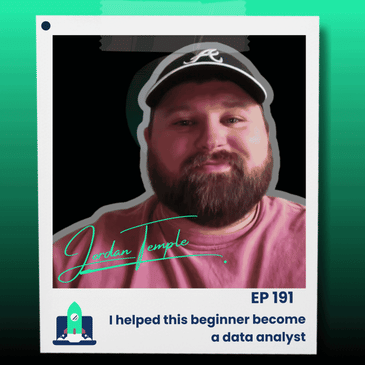
Today I wanna tell you about my friend Jordan Temple. Jordan was a construction cost estimator and a hundred percent new to data analytics. No experience whatsoever, but somehow a few months later, he landed a senior financial analyst role. Without even applying for the job. A recruiter actually found him on LinkedIn, messaged him, and he had a job offer shortly thereafter. So in today's episode, we'll talk about what Jordan did, where I helped him, and how you can steal our strategy to get recruiters in your inbox and ultimately land your own data jobs. So let's go ahead and dive in. But first I wanna tell you that this episode is sponsored by me in my own newsletter. Every Wednesday I send a newsletter designed to help you land your data job. It has a lesson, job listings, and a personal note from yours. Truly, it's a hundred percent free, and you can join 25,000 other aspiring data professionals@datacareerjumpstart.com slash newsletter. Or you can just click on the link, the description down below. Now let's go ahead and hop in.
Avery Smith:our guest today is Jordan. Jordan went through the Data Analytics Accelerator program and now is a Senior Financial Analyst at a company called, extentnet Systems. Senior Financial Analyst. Beforehand, I'll let you kind of explain it. You are a cost estimator. Is that right?
Jordan Temple:yeah, yeah. So work for a general contractor. And I was in the estimating department, but it was a lot of budget and cost estimation for ground up construction projects.
Avery Smith:Okay, so like, is this like residential or more commercial?
Jordan Temple:It was mostly residential multifamily apartments and some single family homes.
Avery Smith:Gotcha. So if someone's building a new home and they want to like, maybe they had like a plan, for example, from an architect or something like that, or maybe it was like a developer had a bunch of homes they want to get built. They'd come to your company and specifically you and be like, Hey, how much does this get a cost and you'd kind of give an estimate of what that project might cost.
Jordan Temple:Yeah, exactly. They, would approach us with their construction drawings and we would look through them and essentially put together a conceptual budget based on what we saw in the drawings and go from there.
Avery Smith:Okay. So I'm not a construction expert. I haven't been really exposed to that industry very much, but that doesn't sound super data analytics y to me. Would you agree with that? Or,
Jordan Temple:Yeah. No, it's it's definitely not really the the most data thing about it is looking at historical costs just to see What has changed over the years that way you can use that to forecast what future costs are going to be.
Avery Smith:okay. So in a matter of a few months, you're able to go from a role that wasn't necessarily very related to data analytics to a senior financial analyst role. So that seems like a pretty big jump, especially getting that senior in that title. So in today's episode, I was hoping you kind of walk me through that journey of going from, you know, this cost estimator to a senior financial analyst and what exactly it took, you know, what, decisions did you make that you're glad you make, what are some things you kind of wish you did maybe earlier in the process? Does that sound good with you?
Jordan Temple:Yeah, that sounds great. Let's get started.
Avery Smith:Okay, sweet. So I guess maybe we'll work a little bit backwards. So you got the senior financial analyst role. What are some of the, you know, Qualifications for this role that they were looking for.
Jordan Temple:One of the biggest things that they were looking for was someone who had a construction background. They wanted someone who I guess understood that side of the business. Because first and foremost, we're a telecommunications company. We work with AT& T, Verizon, T Mobile. And the big network providers and we install fiber optic cable for like outdoor and indoor facilities. So they wanted someone that was familiar with the construction side of things and had dabbled in data just a bit for the role. So that's, kind of their, main asks.
Avery Smith:Okay. And I think that's really important to, realize is a lot of data roles. I kind of said your background wasn't very data analytics y, but we see that that's actually kind of what they wanted in this case. And there's actually a lot of roles like this, no matter what role you're currently in, if you're listening to this. Like you can probably use it in data analytics one way or another. We've had a lot of teachers come through, the data analytics accelerator program, and they ended up becoming, you know, educational data analysts, or they become data analysts for a school system or some online learning platform or something like that. And in your case, you took your construction background. Now you're kind of like a construction data financial analyst type.
Jordan Temple:Yeah, that's, that's essentially what it is.
Avery Smith:Okay. Which is really cool. I don't think I realized that it did telecommunication stuff. One of the projects I did in my consulting company, Snow Data Science, you might find this interesting, was I helped create an algorithm based off of historic data, like you mentioned earlier that it was for a company. I don't even know what they exactly did but they provided quotes of how much it would install, how much it would cost to install I guess like high speed internet in their like residential office places. So a lot of the times they had like fiber going close to their You know, business, but it didn't actually tie into their business. And so they'd want to quickly, they want their salespeople to be quickly to estimate the cost of what it might cost that like this, company I was calling, you know, how much is it going to cost to get high speed internet in, our building? Well, these salespeople obviously didn't really know. And so what we'd use is the historic database, a bunch of different factors, and try to create a predictive model to be like, yeah, it's going to cost, you know, 50, 000 or something like that, and give these sales people a quick and dirty estimate. So anyway, it sounds like at least a little bit similar in those spaces.
Jordan Temple:It's, somewhat similar to what we do.
Avery Smith:Okay. That's, really neat. So now that, you're at this company what tools are you using on a day to day basis?
Jordan Temple:So the role is really Excel heavy. We do a lot of analyzing data in Excel, you know, using pivot tables and things like that. Other than Excel, we use Power BI a fair amount. Not so much building reports anymore. Most everything has already been built and put together. Now we just utilize those in our day to day functions, such as validating costs and things like that across the markets that we do work in.
Avery Smith:Yeah, that's awesome. First off, it's really cool that you can land I just want everyone listening to realize you can land a senior data role with like just using Excel. Jordan's proof of that, especially if you're leveraging that, senior, background from construction that you have, because you do have all those years of experience in construction. and then also it's just awesome that you're using, you know, Power BI, not necessarily that you're creating these Power BI reports, but you're able to know how they work. If they break, you could fix them, those types of things, because you are right. That like a lot of us, especially when we want to you know, when we're new to this, we're like, Oh my gosh, I'm going to go to this company. I'm going to start doing the coolest things on planet earth, and I'm going to save the world and make these cool visualizations and dashboards and models. But what it comes down to a lot of the time is we did that a long time ago and you just need to help fix stuff if it breaks or just
Jordan Temple:Exactly. Mainly just there to maintain it if something messes up. Or if you want to create something on your own, you know, you would think is beneficial to your role specifically, you know.
Avery Smith:yeah. Okay. So that's a little bit about what you do now. Let's talk about how you got this role. So what made you interested in data analytics in the first place?
Jordan Temple:So, I'm a big baseball guy, a big baseball fan, so analytics got really big in baseball, I don't know, 10, 15 years ago, so. Just that's kind of how I first got introduced to data analytics and that whole train of thought and mindset. And I've always kind of had it in the back of my head that it would be really cool to work in data. I've got my MBA. I took a few analytics courses really enjoyed those. And whenever I finished my program, I was hopeful to get some sort of analyst job. You know, that didn't work out. I ended up getting into construction. And worked in construction for several years. Enjoyed what I did, you know, working in construction, but knew that I wanted to get into something a little more, you know, numbers and data driven. So that's whenever I found your program and attended one of your, and, you know, informational calls and, you know, things took off from there.
Avery Smith:Yeah. Okay. So you were kind of like a money ball child.
Jordan Temple:Yeah. Yeah. Very similar.
Avery Smith:Yeah. That's awesome. I love the movie money ball of the book money ball. Yeah, I think, analytics and baseball and sports in general is really fascinating. And, that makes sense. So you kind of done this business stuff in the past. You know, you were hoping out of the MBA to maybe land an analyst job. What do you think the main difference between, you know, coming out of your MBA versus, you know, this last time you tried to get into analytics, what was the biggest difference that in the end for you?
Jordan Temple:I would say just having the hands on experience with the projects that were done in the program and having a portfolio, you know, none of those things were really covered in my MBA program. It was just more or less an introduction to different analytic systems and more theory based than application.
Avery Smith:Yeah. And there is a difference between the theory and the application, isn't there?
Jordan Temple:yeah, no doubt,
Avery Smith:Yeah, that, totally makes sense. For me, even when I got my master's degree at Georgia Tech in data analytics, it's one thing to learn the skills, right? It's another thing to apply the skills, and then it's a whole other thing to show off your skills. And for me, I mean, you can kind of in, the program, I try to do all three at once. But if you're not cognitively thinking through, it's really easy just to stop at step one of learning the skills and skipping the applying and skipping the showing. Right?
Jordan Temple:Mm hmm.
Avery Smith:Yeah, I agree. I think my program did a good job of teaching me, but didn't do a good job at helping me make it applied and helping me show off those skills. So, okay. You joined the program. We're doing projects for showing off our skills. You start doing a little bit more stuff on LinkedIn as well. Correct.
Jordan Temple:Yeah, yeah. So started posting a few times a week utilize the articles function and would post my module projects on those. Reach out to different content creators on LinkedIn and, you know, leave comments and engage with, other folks in the industry as well. And that was kind of how I got my foot in the door.
Avery Smith:Yeah. Okay. I like that. Explain that a little bit more, tell the listeners, how did you get your front of the door?
Jordan Temple:Yeah, I mean, just being proactive on LinkedIn. I mean, anything from posting about, you know, my, weekly goals and steps within the program interacting with other students in the program, posting projects asking for feedback on things. I mean, just trying to be as proactive as possible.
Avery Smith:Yeah. You did a great job. You have a great looking profile. You, commented, you know, thoughtful, left good comments and you also created good posts. You know, like you mentioned, you create some articles, you create some posts. And eventually that got to a point where someone, noticed a recruiter DMD, right?
Jordan Temple:Yeah, yeah, that's how I have my current role is someone DM'd me about the position asked me if I would be interested in it. They sent over the the job description. I read through it and did not feel qualified for it at all. I felt like it was just way over my head, they were pretty insistent that I would be a good fit for the role. So I was like, you know what, let's go for it. I had a call with someone at the the recruiting agency. We, spoke for 30 or 45 minutes, I would say just getting more familiar with each other, my background and things like that. And they were like, yeah, everything looks good. We're going to send your profile on to the company and we'll let you know that they're interested in moving forward. And I would say within 30 minutes of the conversation being over, they reached out and said that the company wanted to set up an interview with me. So that was really nice.
Avery Smith:Yeah. And, I think there's something really important here because this was a third party agency, recruiting agency that reached out to you via DM on LinkedIn said, Hey, we saw your profile. We might think you're a good fit for this role. And then they presented you to the company and we're kind of like backing you like, Hey, this is our candidate or one of our candidates. We feel really strongly about Jordan. And this is something I like to call the job hunt reversal. It takes a lot of factors, you know, one of it is luck, right? Because one of the reasons why this company liked you so much was, you were in the area that they were looking for, right? They weren't like, they're looking for someone in a hybrid role. We'll talk about this here in a bit. So that was kind of like, the location was a good for you. You had a great background that's on you. Cause you had, you know, you have done the choices you've made have given you the background and experience that you have. So that was on you. You had a great LinkedIn profile. You know, which is something that we've been working together on, like making sure LinkedIn profile was good. We were active on it so that we were like hyping up the LinkedIn algorithm to like be interested in us and, you know, have a better chance of attracting recruiters and stuff like this through that whole process, you weren't going out and applying for that job. That job was almost applying for you, right? Like all of a sudden, instead of you contacting a recruiter and being like, Hey, please hire me. The recruiter reached out to you and was like, Hey, please work for us.
Jordan Temple:Yeah, that's exactly how it felt. I mean, it was just like you said, almost a reversal of roles.
Avery Smith:How did that feel? Like, was that a way better process than what you did previously?
Jordan Temple:Yeah, I mean, it definitely it was different, but I mean, in a good way, you know, it definitely felt much better than me going to these different companies websites and having to register for their applicant tracking systems and, you know, mass applying for jobs, you know, it was it was pretty effortless on my end. They reached out, like I said, via LinkedIn, asked for my resume. And if I was interested in having a conversation and that was really all of the paperwork that I had to do.
Avery Smith:Yeah. And I know we'll talk about your interviews here in a second. You had a few interviews after that, but you said they weren't too bad. And I just want to emphasize to everyone, you guys can be the same as Jordan. It really comes down to having a good LinkedIn profile and a good resume to rank really well. And these recruiter algorithms that are going on on LinkedIn. And then one really thing, really neat thing about this whole process as well is if you're open to potentially working in person or hybrid work, the pool of candidates is a lot smaller. And so you have a chance to be, I guess, the same size fish in a different pond, a smaller pond. And so that worked well for Jordan because Jordan works hybrid. And you might be thinking, Oh, I want to work remote. Well, Jordan right now, originally it was one day at home, right? Jordan.
Jordan Temple:Yeah, originally it was only one day remote. That's how it started.
Avery Smith:But now,
Jordan Temple:Yeah, now I work remote two days a week Monday and Friday, so I only go into the office during the middle of the week, Tuesday, Wednesday, and Thursday.
Avery Smith:so basically if you reframe the word hybrid as I got to work remotely 40 percent of the time or 40 percent remote Or I had one thing that Jordan mentioned when we were talking earlier. I mean, Jordan, you're working on Monday and Friday, but it's almost as if you have an extended weekend in those cases, of course, you're still working, we're not dogging it at work, but like, if you want to go somewhere, for example, maybe, you want to go, I don't know, visit some family member in, you know, one state over or go to some event. So maybe like an NFL football game or an MLB baseball game. You could leave Thursday night after work, right? Work remotely on Friday and then you have the rest of the weekend where you're already in your location. You know, maybe you, leave Monday night and you get back to work on Tuesday or something like that. Like it just really opens up a lot of flexibility in my mind.
Jordan Temple:Yeah, it definitely does, and that's one of my favorite things about the role.
Avery Smith:Yeah. That's, awesome. So I think those are the things, I mean, you obviously had the great construction experience. You had the data projects displayed on your LinkedIn and displayed on your resume. Like you are a qualified candidate, but you're also, we're prepping your prime in the pump, the LinkedIn algorithm to make sure that like, okay, my profile is optimized. I'm putting stuff out there. And opening up chances, did, did the recruiting company ever say how they found you? Or is it just like, they just found you via LinkedIn, open to work.
Jordan Temple:hmm. They didn't really go into specifics, but with the company being located in the city that I work in, they, just relocated from Chicago to North Texas, and we're looking to... I guess backfill some roles of people that they had let go that didn't want to relocate and that's kind of how they stumbled across my name.
Avery Smith:Perfect. That's such a cool story. Yeah. I'm sure that was the LinkedIn algorithm. So all that work you're putting in ended up being worth it. so you have this recruiter who DMs you, you talk to the recruiter on the phone for like 45 minutes. They're talking about, I guess, experience mostly, like what type of experience you have in construction, what experience you have in data analytics, is that right?
Jordan Temple:Yeah, pretty much. They just, you know, wanted me to go through my education background, my construction experience kind of discuss my my portfolio projects that I had done, tools that I had worked with, and what I was looking for in my next role.
Avery Smith:So they had seen your portfolio.
Jordan Temple:Yeah, they saw it and they were, I mean, they thought that it looked really nice, had a had a good mix of projects using different, you know, analytic tools, Excel, SQL, Tableau, I think I had some Power BI in there, or Python. So, I mean, it was well rounded.
Avery Smith:So yeah, they were more asking about like the, whole portfolio or did they like dive into one specific project, one or two
Jordan Temple:I don't think they looked at all of the specific projects. They looked at the Power BI one that I had on there and they looked at The projects that I used dealing with Excel because the role is, you know, Power BI and Excel heavy.
Avery Smith:Yeah. Yeah. That makes sense because they were hiring for someone who, who needed Excel and Power BI skills. So yeah, that's, I mean, that's one of the reasons why we do at least one project with each one of the technical skills that a data analyst should know is so you at least have one project for every skill, no matter, what they're asking for, you at least have something, hopefully. So. Okay. That's awesome. And then they submit your information to the company. The company responds back within like an hour that they're interested in with you. And then do you have interviews from there?
Jordan Temple:Yeah. I had an interview the next day with the gentleman who's my now boss. It was only supposed to be about a 30 minute interview, but it turned into a 55 minute or an hour discussion. We hit it off great. I mean, it went really well. So after I finished that interview, I reached out to the recruiter, told them how it went on my end after I spoke with them. I guess they got with the guy that I interviewed with and just kind of debriefed and called me right back and they were like, yeah, I mean, they loved you, you know, they want to have you do another interview, but with one of someone who would be one of your teammates. I was like, okay, well, yeah, that sounds great. They wanted me to do the interview the following week, but I was going out of town on a family vacation. So I told them that. they gave the company a heads up and the the company was more than willing to, you know, wait for me to get back from vacation to continue the interview process. So that felt really nice.
Avery Smith:Yeah. That's, awesome. And do you remember what they asked you in those interviews? What, were those interviews focused around?
Jordan Temple:So the first interview was really just getting to know me just as a person just asking about my background. I'm from Louisiana. My boss is also from Louisiana. We're from different parts of the state, but we really just kind of talked about that for a little while. Just we, you know, we had that in common and Really played into that and just got to know each other really well. And then was just asking mainly about my analytics experience. You know, he asked about my MBA program, asked about the bootcamp, what type of stuff we did. And, you know, I was just transparent about all of that. And we had a really good conversation.
Avery Smith:Yeah. So no, like hard questions. You felt like, like they
Jordan Temple:No, not really.
Avery Smith:No technical questions. It even sounds like,
Jordan Temple:no, no, I mean, I didn't have any technical questions in any of the interviews that I did with the company.
Avery Smith:yeah. And I think, first off, I think that's a factor of this company. It sounds like, like a good company that, you know, they want to take care of their, people, but also I think it's a factor of just the broad experience you already had in construction and also the portfolio stuff you have there. Cause I mean, it really depends on the company. Like for instance, Facebook, no matter what you really do, they're going to give you a technical interview, like no matter what. Right. So some companies have their certain things, but really what these companies are testing for is can you actually do data analytics? They're looking for some sort of proof that you can actually do something. And if you provide that proof in advance, you know, a lot of the time that's helpful. If you say, Hey, here's my portfolio. They're like, all right, this guy seems like he knows what he's doing. So like, we don't have to stress test them too much.
Jordan Temple:Yeah, and I think that was the case with me. You know, I mean, they, saw my experience on my resume. They saw the portfolio, the few questions that I was asked about data analytics and things like that. You know, I mean, I nailed those. So I think the, biggest thing was making sure that I was going to be a good, I guess, cultural fit, you know, for the company. Am I easy to get along with, you know, I mean, how, am I going to fit with everyone else from a cultural aspect, you know, because the company's really big on culture and they've got several different organizations within the company and that's their emphasis, you know, is making sure that employees are happy and comfortable and like coming to work every day. So that's really big.
Avery Smith:Yeah. Okay. That, makes sense. Then you got the job offer and perks about the job offer. what were some of the biggest perks for you? Like what, made you excited about this job?
Jordan Temple:So one of the biggest things, like I said, was the being able to work remotely. You know, it started out as one day and his girl and said, you know, working two days remote. So that's nice. Five weeks of PTO starting out. That's pretty awesome. and, you know, It's, I mean, in my experience is unheard of the places that I've been, you know, typically starting out, you don't, get that much. So that both of those were, you know, really, really nice selling points.
Avery Smith:Yeah, that's, super nice. So yeah, better PTO, more flexible, like those, are awesome, perks for sure.
Jordan Temple:And I forgot about this one proximity to my home. It's like 12 or 13 minutes from, where I live to my work, to my office. So that's really nice as well.
Avery Smith:That's, so awesome. And I know one of the things we talked about with like the hybrid or, or remote work Previously is like, obviously it's great that like we talked about like the, I don't know, maybe you can go see an LSU baseball game on the weekend or something like that. Right. When you're on your four day ish hybrid weekend. But like the, good news is when you're in the office, you're in the office, which means you can get training from like your supervisor or, or the person above you, you know, you get more face to face time with bosses, which is really good for promotions. I know when during the pandemic and I was working at ExxonMobil, I kind of stopped going to the office and I think it really hurt my progression in my career there. So that's something I think that's really beneficial. And also it's just like, it scratches your social itch, right? Like you get to get out of the house. Jordan, do you have kids? I can't remember.
Jordan Temple:No kids.
Avery Smith:Well, I have a kid. I know sometimes I love to get out of the house now. It's just like, all right, I got to go to work. I got to go to work. So but like it gets you out of the house, get you with some people, right? Do you enjoy those things?
Jordan Temple:Oh yeah. I mean, it's, it's really the best of both worlds. I mean, I enjoy it. I mean, you know, during COVID whenever I was working fully remote. I mean, it was nice, don't get me wrong, but I started to go stir crazy being at home all the time. So, the hybrid work models is perfect for me. You know, there's Monday and Friday, whenever there's things that I need to get done, I can do that. I can You know, plan to do those things at home where I'm not going to have any distractions. And middle of the week, whenever I'm in the office, if there are things that I'm working on that I have questions on or need to collaborate with my team on, you know, I mean, that's what those days are for. So, I mean, it works out perfectly for me.
Avery Smith:Yeah, that, makes sense. Now I want to ask you a question. If you can go back, I'm pulling up your LinkedIn profile here. If you can go back and you can go talk to Jordan, you know, Jordan, just after he finished his MBA you know, trying to hope to land an analyst job. What would be some things you'd give him? What would be some advice you'd tell him to do?
Jordan Temple:Try to find a program similar to the one that I did and work on applying the concepts that I learned in my MBA program, you know, put together a portfolio, you know, use Excel at an advanced level SQL, some sort of data visualization tool, be it Tableau or Power BI, get more familiar with those and how to apply those. Don't just understand how they work, but apply those tools and be able to I guess be able to back that up.
Avery Smith:I love it. So basically do projects and build a portfolio.
Jordan Temple:Yeah. I mean that's really what it is. I mean, that's what it's all about. I mean, you need to be able to provide proof that you understand how to use these tools and be able to show that you can, and that I feel like that's the best way. If you don't have like a work portfolio, you know, you can have something like this where you've got projects that you've done on your own time.
Avery Smith:Yeah I give this analogy a lot. So sorry, Jordan, if you've heard it or if someone else on the call has heard it, but it's like, if I think the Fast and the Furious 10 movies literally coming out sooner rather than later, although with the strikes now, you never know, like all these movie dates have been pushed back. But regardless, like if you're hiring, if you're hiring a stunt For the fast and the furious 10 movie, which is an action movie with cars. I've never seen any of the fast and furious. I've actually never seen any of the fast and furious. But like, if you're hiring a stunt double that has to jump over a car, who are you going to hire the person that sends in a resume and says, yep, I can jump over a car or the person B that like sends in a resume that says, yeah, I could jump over a car and then like sends in some sort of like, maybe some sort of video of them jumping over a car in a movie or jumping over the car on their own time or something like that. It's like, you're going to go with person B because hiring, this is something that you and I, you know, people who are employed don't think about a lot. But like hiring is expensive. Hiring is terribly expensive because it takes a lot of the people's times. One. Usually you have to promote it on some job platform, or in this case, for instance, they're using a third party recruiter that costs money, right? That costs, you know, thousands of dollars. And then you have to like pay, have people fly out and interview for the job. There's all the time that you're spent doing the interviews. And then more importantly, It's like the training that's going into this new person. You just don't want to hire a dud and then train them three months later. Oh crap. This person's a dud, you know, have to let them go or, something, or like they make some terrible mistake. Like hiring is really expensive for these companies and they want to make sure that they're doing a good job, you know, and so they want low risk and the, the less risk you can make yourself appear, you don't even, it doesn't even have to be that you're less risky. It's the fact that you have to make yourself look less risky. Like that can make all the difference in the world.
Jordan Temple:agree. I agree totally.
Avery Smith:And I'm glad that you ended up, you know, talking to these recruiters and being like, even though you didn't feel like you were a fit, I'm super glad that you ended up, you know, going through with it because hopefully for people listening, that's a source of inspiration that like, yeah, I might not feel like I'm a good fit for this role. So I'm not going to apply. They don't apply, but there's a chance they could have landed that role.
Jordan Temple:Yeah, I mean, absolutely. I mean, If someone reaches out to you and they feel like you're a good fit for a role, you know, don't sell yourself short. I mean, there's a reason that they reached out to you. I mean, they obviously think that you would be a good fit. Otherwise, they wouldn't have sent you a message, DM'd you, and you know, kept you in mind for the role.
Avery Smith:Yeah. And, and even this is an example one time Facebook messaged me, actually they sent me an email and out of nowhere, like a cold email, like, Hey, we'd like, we think you'd be a great fit for this job. And I looked at the job description and I was not a good fit for the job at all. Not a good fit. And I was like, all right, sounds good. Let's do an interview. Right. Let's go. It was like a pretty high level job, to be honest. I was like, I don't think I'm a good fit. So I get on the call with this, like, honestly, it was like this director of like this team and she was really nice and we're talking and I kind of explain everything and, and she's like, yeah, you're not really that good of a fit for this role. And I was like, yeah, I totally agree. I'm not. And she's like, but I think you'd be a good fit for Facebook. So let me like, let me refer you to someone else inside of our company. You know, and so like, I could have just said, no, I'm, I'm not a good fit for this role, or I think you got the wrong guy, but even going into that interview and to be honest, kind of bombing the interview, because like, I just did not, I just did not have any experience with what, it wasn't even really like a data role. It was like a more data engineering role. And at the time I was far less experienced data engineer than I am now. Although I'm still not that great of a data engineer, but like, I just was not a good fit for the role, but that gave me an opportunity to interview somewhere else inside the company. Right. And so it's just like, I put this post out on LinkedIn the other day, but the hiring manager who rejects you the most is yourself. And that's, hard to take in sometimes.
Jordan Temple:Yeah, I mean, it really is. I mean, and that's obviously what I was doing whenever they first reached out about this role. I mean, I was disqualifying myself from it without knowing anything about it, really.
Avery Smith:Yep. So guys be like Jordan, get over that fear, you know, go from the cost estimator to the senior financial analyst, have a strong LinkedIn profile, have a strong portfolio and with time, some stuff's going to happen. I have faith in that. Jordan, anything else to add?
Jordan Temple:Yeah, I mean, if you're in Avery's program, I mean, listen to him. Just skills, networking, portfolio. I mean, focus on those three things and, you know, you'll get to where you want to go.
Avery Smith:Appreciate you, Jordan. Thank you so much for coming on the podcast.